


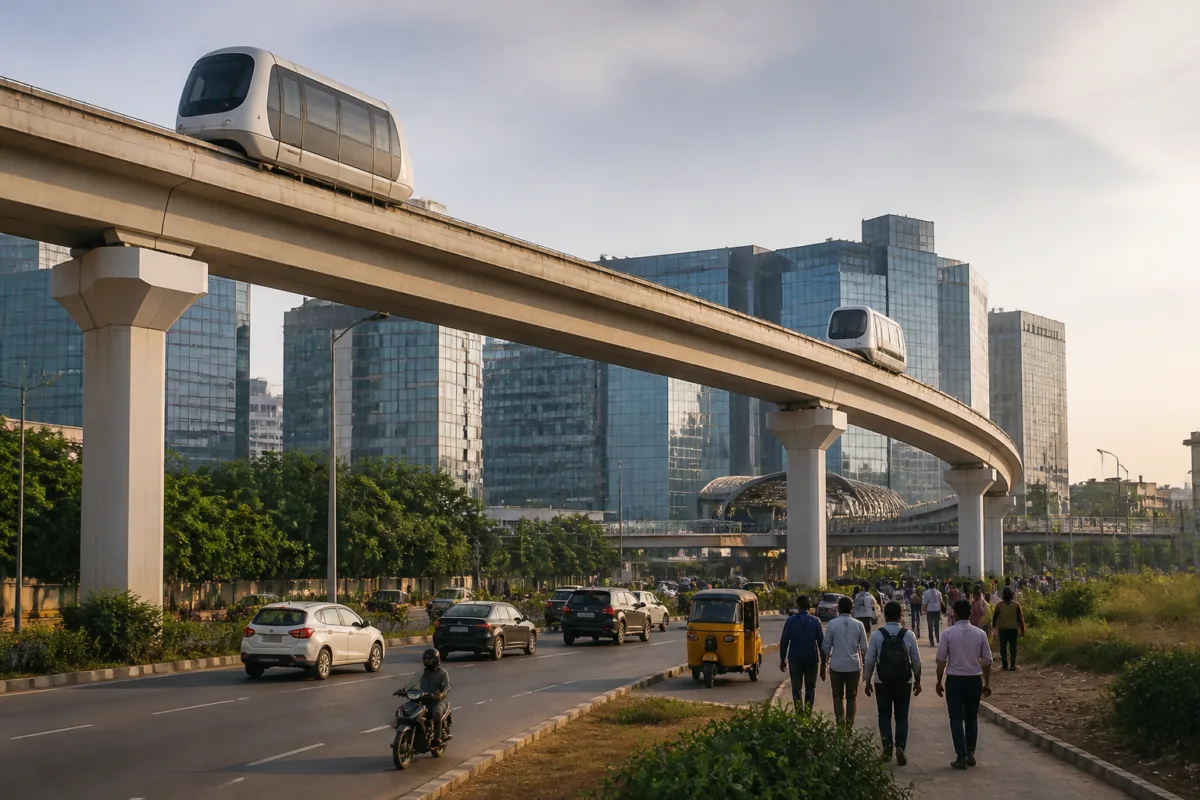
Hyderabad’s proposed 35-kilometre Personal Rapid Transit System (PRTS) would create an elevated driverless pod network linking Kukatpally with Knowledge City through Raidurgam and Biodiversity Park, while connecting with the city’s Metro and bus systems.
The Phase-I proposal, presented by Hyderabad Metro Rail Limited (HMRL) officials to Telangana Chief Secretary Sanjay Jaju at a Secretariat meeting on November 18, includes 64 stations. The project is intended to improve public transport access in Hyderabad’s IT corridor and address traffic congestion.
According to the feasibility work cited in the report, commuter demand for the proposed system is projected at 3.94 lakh passengers by 2030, 7.96 lakh by 2040 and about 10 lakh by 2050. HMRL has examined Personal Rapid Transit, Group Rapid Transit and other options as part of its assessment.
The proposed PRTS would use small electric pods operating on elevated tracks. The system is expected to be integrated with Metro Rail and Telangana State Road Transport Corporation bus services, although the report does not provide a final interchange design, fare structure or operating model.
Jaju directed officials to prepare a route map and action plan in line with Chief Minister A Revanth Reddy’s directions on reducing congestion. He also asked them to keep costs as low as possible, select routes based on traffic density and passenger needs, and make use of existing transport infrastructure where feasible.
The review followed a meeting chaired by the Chief Minister on November 12. At that meeting, officials were directed to examine a PRTS corridor from KPHB Metro station to Biodiversity Metro station via Durgam Cheruvu and Raheja Mindspace. The directions also included a multi-level parking facility with a PRTS depot near IKEA in Gachibowli.
The government has set out an accelerated target for the first corridor, with instructions to finalise its tender by December and complete the line within a year thereafter. These are reported directions and do not, by themselves, establish that construction or contracting has begun.
HMRL had earlier assessed the system’s feasibility for implementation under a public-private partnership model. The next planning stage is expected to involve consultations with technical experts and potential project partners.
Several agencies are to be involved in the process, including the departments of Municipal Administration and Energy, the police, the state bus operator, South Central Railway and the Hyderabad Disaster Response and Asset Protection Agency. Their coordination will be important because the proposed network would need to fit within existing roads, Metro facilities, utility corridors and transport interchanges.
The main planning challenge is therefore not only the construction of elevated tracks. The network’s usefulness will depend on whether stations are located close to employment centres, residential areas and existing public transport, and whether transfers between pods, Metro trains and buses are convenient. The reported proposal has identified integration as a goal, but the available details do not yet establish how that integration would work on the ground.
The 35-kilometre network remains at the proposal and planning stage. A route map, action plan, project structure, cost estimate and tender outcome will determine whether the pod system moves from a feasibility-backed concept to a funded urban transport project.

