


Hyderabad’s new water conservation measures are not simply a seasonal advisory. They reveal how closely the city’s drinking water supply, groundwater reserves, electricity demand and construction economy are now linked. The state government has asked households to cut drinking water consumption by 20 per cent, use air-conditioners at 25°C and reduce electricity consumption between 5 pm and 10 pm, while preparing enforcement and alternative supply measures across the metropolitan region.
The immediate trigger is a combination of reduced rainfall, falling groundwater levels and rising demand for water tankers. According to Hyderabad Metropolitan Water Supply and Sewerage Board (HMWS&SB) managing director K. Ashok Reddy, tanker bookings have doubled to 7,000 this year from around 3,500 during the corresponding period last year. The increase is a direct indicator of pressure on formal and informal water supply systems, particularly in areas where households and establishments depend on borewells or private tankers.
The government’s response brings several agencies into a single operational framework. Special officers will monitor conditions in all 16 mandals of Hyderabad district. The Hyderabad Disaster Response and Asset Protection Agency, or HYDRAA, will assist in identifying illegal extraction of water and other violations. HMWS&SB will remove motors illegally installed on drinking water pipelines, while fines and penalties may be imposed where required.
This enforcement focus matters because Hyderabad’s water problem is not limited to how much water is available. It also concerns how the existing network is used and who can access it. Illegal motors can affect pressure and distribution in drinking water pipelines, while unauthorised groundwater extraction can shift the burden of scarcity from one neighbourhood to another. The measures indicate that the administration is treating water conservation as a governance and compliance issue, not only as a household responsibility.
The groundwater data supplied at the review meeting makes the pressure clearer. Groundwater department deputy director M. Harish Babu said only three mandals in Hyderabad district had received normal rainfall so far. The average groundwater level had fallen to 10 metres below ground level, compared with 3.55 metres last year. Hyderabad district collector Priyanka has asked officials not to grant permission for new borewells, an approach intended to prevent further extraction while the city enters a period of higher demand.
The gap between the two groundwater measurements is significant because groundwater is often the buffer that absorbs shortfalls in piped supply. When that buffer weakens, households, commercial establishments, construction sites and institutions increasingly compete for tanker deliveries or seek additional borewells. That raises the cost of maintaining everyday urban services and increases the importance of public supply planning.
The government is therefore looking beyond a single source. Officials are examining additional water availability under the Godavari drinking water scheme, the possibility of drawing more water from the Krishna and the establishment of additional filter beds at Himayatsagar and Osmansagar. These measures are at different stages of planning, and the supplied report does not establish the volume or timing of water that each source could contribute.
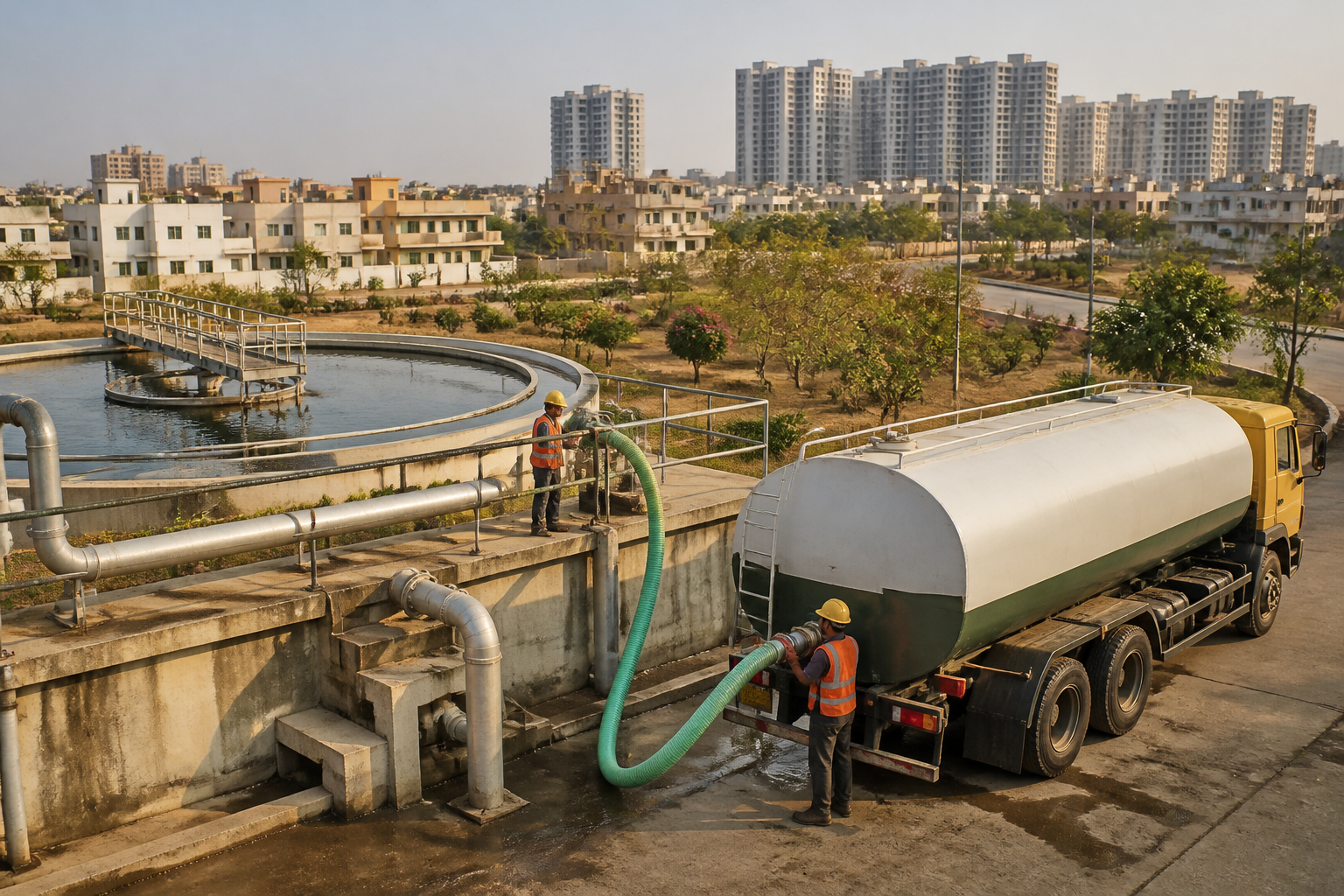
The city is also trying to separate potable water from uses that do not require drinking-quality supply. Treated sewage water is to be promoted for industrial use, data centres, gardening, landscaping and maintenance of central medians. Filling stations will be established at sewage treatment plants, while an application called ‘Dial a Green Tanker’ is planned to enable online booking of treated water tankers.
This proposed shift is particularly relevant to construction. The government has decided that 90 per cent of water required for construction activities should be sourced from treated water available nearby. Landscaping requirements are also being tightened: treated water will be made mandatory for landscaping in all areas, including government institutions. GHMC commissioner R.V. Karnan said drinking water would not be used for gardening, landscaping or maintenance of central medians.
The policy creates a clearer hierarchy for urban water use. Potable water is intended for drinking and essential domestic needs, while treated wastewater is positioned as the supply for activities that can use a lower-grade but regulated source. The effectiveness of that hierarchy will depend on whether treated water is physically available near demand centres, whether filling stations operate reliably and whether users can obtain it at a practical cost.
At present, the city’s treated-water network appears incomplete. Of HMWS&SB’s 13 treated-water filling stations, only three or four are operational. The remaining stations are scheduled to become operational by November 1, and another 20 filling stations are planned over the following 15 days. If implemented, this would expand the distribution network considerably, but the supplied material does not specify the capacity of each station or the expected volume of treated water available.
The distinction between treatment capacity and usable supply is central to the city’s wastewater strategy. A treatment plant can produce water, but urban users also need a distribution point, tanker access, pricing clarity and confidence in the quality of the supply. The proposed filling stations are therefore not a minor administrative addition. They are the physical link between sewage treatment and actual substitution of drinking water in construction, industry and landscape maintenance.
The water situation is also connected to electricity management. Southern discom chairman and managing director Jitesh V. Patil said the state’s power consumption had reached 20,018 MW and was expected to increase in March and April. The government has asked households to limit electricity use during the 5 pm to 10 pm period and is encouraging rooftop solar installations. Consumers have also been advised to plan electricity use according to the availability of solar power during the day.
The connection between the two systems is practical. Water pumping, treatment, distribution and tanker operations require electricity, while rising temperatures can increase air-conditioner use and peak power demand. The household advisory therefore places water and electricity conservation within one seasonal management plan. The government has also asked residents to maintain air-conditioners at 25°C, linking everyday cooling behaviour to the wider demand-management effort.
The weather outlook has added uncertainty to the planning challenge. India Meteorological Department scientist A. Sravani said day and night temperatures were increasing and that the onset of winter had been delayed. Rainfall during the withdrawal phase of the northeast monsoon was expected to be below normal, although cyclone-related weather systems could bring some rainfall in November. The report does not establish whether such rainfall would materially restore groundwater levels or reduce tanker dependence.
The administration has already taken up 22,000 groundwater recharge structures this year and is preparing a plan to provide groundwater recharge facilities to every household over the next five years. These measures point to a longer-term effort to improve the city’s water balance, but the immediate challenge remains managing demand until recharge and alternative supply measures produce measurable results.
Hyderabad’s water conservation plan therefore combines three different time horizons. The first is immediate enforcement: preventing illegal motors, restricting unauthorised extraction and monitoring the 16 mandals. The second is near-term supply substitution through treated-water filling stations, additional tanker services and possible augmentation from existing water schemes. The third is longer-term resilience through recharge structures and household-level groundwater facilities.
The evidence supplied so far confirms that Hyderabad is dealing with a linked water-and-energy stress episode, marked by a sharp increase in tanker bookings, lower groundwater levels and expectations of higher electricity demand. It also shows that the city’s response is moving towards differentiated water use, in which potable water is protected for essential consumption and treated wastewater is assigned a larger role in the urban economy. The next review meeting, scheduled after 15 days, is expected to assess progress on these measures and clarify whether planned enforcement, filling stations and alternative sources are being implemented at the required pace.

