


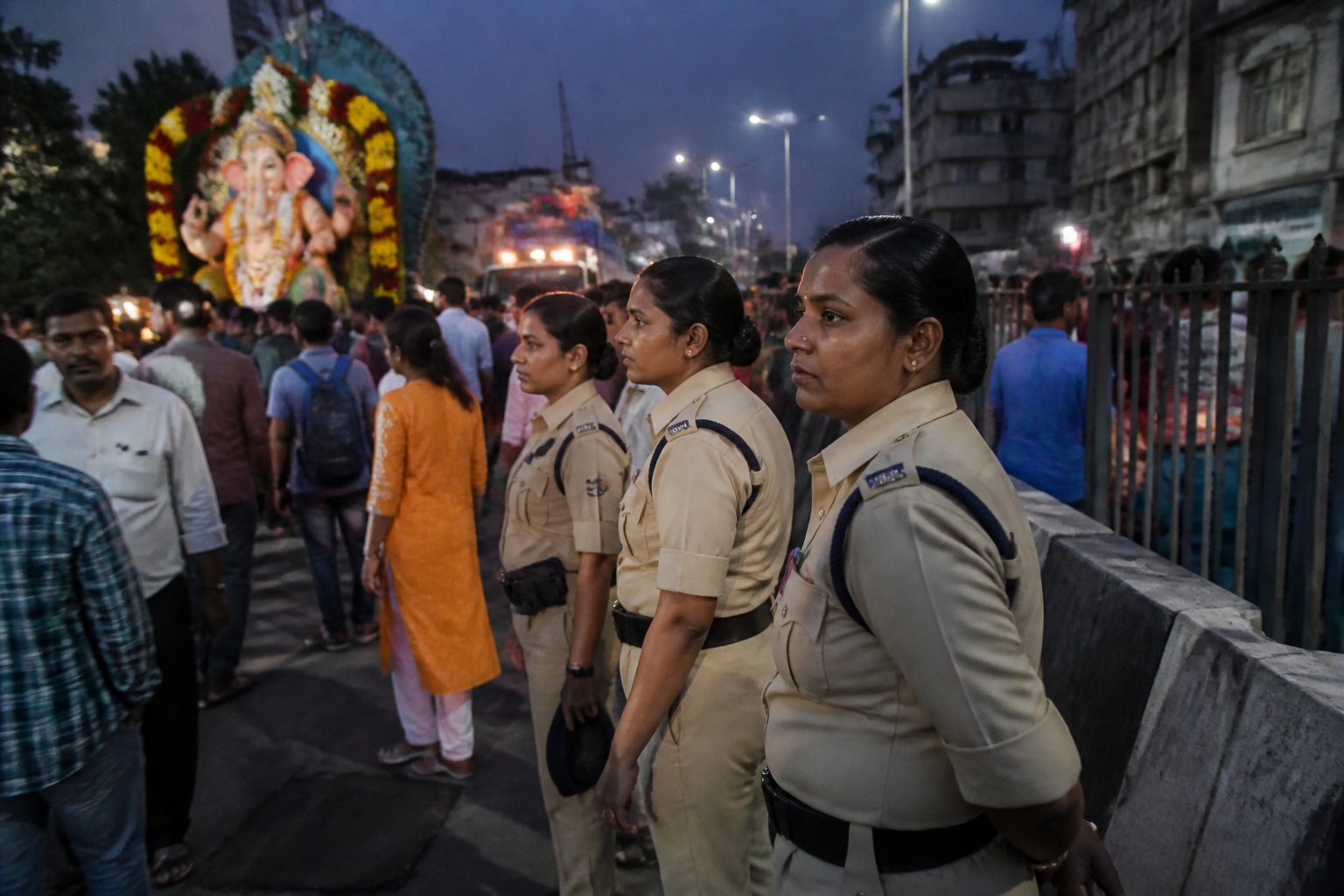
Hyderabad’s SHE Teams took 1,530 people into custody during a special drive conducted between September 14 and 23, according to a report by Deccan Chronicle. The operation focused on alleged harassment of women and girls during Ganesh immersion festivities, particularly along the crowded route from Khairatabad to Balapur. The scale of the intervention highlights how public safety during large urban gatherings depends not only on traffic and crowd control, but also on the ability of police teams to identify and respond to behaviour that can make public spaces unsafe.
The reported operation was organised as part of the security arrangements for the immersion celebrations. SHE Teams monitored crowded areas and watched for individuals allegedly involved in eve-teasing and other forms of harassment. Police said the initiative was intended to protect women and girls and prevent incidents in locations where dense crowds could make such behaviour more difficult to detect or report.
The central fact in the report is the number of people taken into custody: 1,530 over nine days. That figure indicates an extensive policing effort rather than an isolated intervention. However, the supplied report does not state how many of those taken into custody were formally arrested, booked, fined or released after questioning. It also does not specify how many complaints were received, how many cases were registered, or whether the custody figure includes people detained for preventive reasons. Those distinctions matter because custody is an operational measure, while a registered case or conviction represents a different stage of the justice process.
The report also does not provide a breakdown by location, age, offence, repeat behaviour or outcome. As a result, the number establishes the reach of the drive but does not by itself show the precise scale of confirmed harassment. The account uses the term “alleged” in describing those involved, and that qualification must remain central when interpreting the figure. People taken into custody should not be treated as convicted offenders unless a court or official case record establishes that outcome.
Even with those limitations, the operation offers a clear view of the institutional challenge created by major public celebrations. The immersion route from Khairatabad to Balapur passes through crowded urban areas, and the police response described by Deccan Chronicle relied on teams specifically assigned to monitor the experience of women and girls. This indicates that safety planning for a large procession extends beyond barricades, traffic diversions and emergency response. It also includes targeted surveillance and intervention against harassment in dense public spaces.
The role of SHE Teams is significant within that arrangement because the teams were deployed to identify behaviour that may otherwise remain difficult to address in a moving crowd. The report says personnel kept a close watch on crowded areas and identified individuals allegedly involved in eve-teasing and other forms of harassment. Their function, as described, was therefore both preventive and enforcement-oriented: a visible presence intended to deter misconduct, combined with action when individuals were identified.
The operation also shows why the design of security during civic events cannot be separated from the design of the event itself. Large-scale celebrations create temporary urban conditions in which movement is concentrated along particular routes, streets become heavily occupied and ordinary patterns of public surveillance change. In such circumstances, the ability to monitor specific locations and respond quickly becomes an important part of how the city manages public space.
The supplied report does not provide details about the number of personnel deployed, the technology used, the number of patrol teams, the locations where interventions occurred or the coordination between SHE Teams and other police units. It therefore cannot establish which enforcement methods were most effective. It does, however, record that monitoring was carried out along the immersion route and that police described the action as part of a broader security effort for the celebrations.
That distinction between general security and targeted safety is important. The report identifies women and girls as the intended beneficiaries of the drive, while also describing the operation as a response to harassment in crowded areas. This places gendered safety within the wider framework of urban crowd management. A public event may be considered orderly when traffic is moving and no major incident is reported, but that does not necessarily mean that all sections of the public experience the space as safe. The policing effort described in the report reflects the need to address that narrower but important measure of public order.
The number of people taken into custody also raises questions about what happens after a large preventive operation. The source does not say whether those detained received warnings, whether cases were registered, whether families were informed, or whether any individuals faced prosecution. It does not report statements from those taken into custody or provide details of complaints by women and girls. Without that information, the operation can be assessed only in terms of its stated purpose and reported scale, not its legal outcomes or long-term effectiveness.
For city administrations and police departments, this is a recurring governance problem: large public gatherings require arrangements that work at street level and remain accountable after the event. Monitoring and detention may prevent some incidents, but the public record also needs to distinguish preventive custody from formal criminal action. Clear reporting on complaints, cases and outcomes would make it easier to assess whether such drives are deterring harassment, improving reporting or primarily increasing police visibility during peak events.
The report’s details point to a model in which specialised teams are integrated into event security rather than deployed only after complaints emerge. SHE Teams monitored the route during the immersion period, and the police presented the action as an effort to ensure the safety and security of women and girls. This approach recognises that crowded urban environments can require dedicated attention to forms of harassment that may not be captured by conventional traffic or emergency planning.
At the same time, the available evidence does not establish whether the intervention changed the experience of women attending the celebrations. There is no information in the supplied material about the number of women who reported feeling safer, the number of incidents prevented, the presence of help desks or complaint channels, or the accessibility of police assistance along the route. These are important indicators, but they are not reported in the source and cannot be inferred from the custody figure.
The operation should therefore be read as evidence of an enforcement effort, not as proof that the underlying safety problem has been solved. The reported 1,530 detentions show the scale at which police acted during the nine-day drive. They do not show how much harassment occurred, how much was prevented, or what happened in the subsequent legal process. Those unanswered questions are necessary for evaluating whether the operation delivered sustained public safety or remained a festival-specific intervention.
What the report confirms is that Hyderabad treated women’s safety as a distinct operational priority during the Ganesh immersion celebrations. The police monitored crowded areas along a major immersion route and took action against people allegedly linked to harassment. What remains unclear is the distribution of those actions, the legal outcomes and the experiences of women who used the route. Future official reporting on similar operations would be more informative if it recorded those details alongside the headline custody number.
