Hyderabad Residents Demand Action on Dangerous Roads
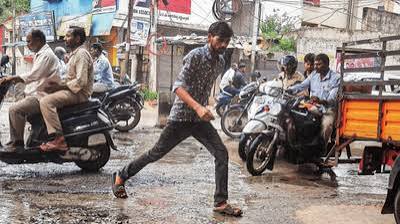
Hyderabad, August 31: A roadside protest over a large pothole on the Imlibun–Putlibowli stretch briefly turned a road maintenance issue into a traffic disruption, after a man sat on the carriageway demanding repairs. Traffic police intervened and cleared the obstruction. The episode highlights how deteriorating road surfaces can quickly become both a safety concern and a mobility problem in a densely used urban corridor.
The protest occurred as Hyderabad continues to deal with damaged roads during the monsoon season. Potholes and waterlogged stretches have affected movement across several parts of the city, adding pressure to already busy roads. Recent civic assessments have identified nearly 1,000 waterlogging hotspots across Hyderabad and surrounding municipal areas. For commuters, the impact extends beyond slower journeys. Deep potholes can force two-wheelers to make sudden manoeuvres, while cars and buses may have to reduce speed or change lanes. These movements can increase conflict between different road users, particularly where traffic volumes are high. The economic cost is also wider than the immediate repair bill. Poor road conditions can increase vehicle maintenance expenses, extend travel times and affect the reliability of daily commutes. For businesses, repeated delays can add to logistics and employee travel costs.
The incident also points to a broader challenge in urban road management: maintenance needs to move from reactive repairs towards regular monitoring. Filling a pothole after it becomes a public flashpoint may restore the surface temporarily, but lasting road quality depends on identifying drainage problems, damaged layers and recurring causes. Hyderabad’s monsoon conditions make this particularly important. Water can enter cracks and weakened sections of a road, accelerating surface deterioration. Without adequate drainage and timely maintenance, repaired sections can deteriorate again. The city has already announced focused pothole-filling and road repair measures amid monsoon-related disruption. However, the effectiveness of such programmes ultimately depends on the quality, durability and monitoring of completed work.
Citizen reporting can also play a role in identifying problem locations. Hyderabad’s civic grievance systems are designed to route complaints to the relevant municipal authorities, although residents have previously reported technical and response-related difficulties with complaint platforms. The Imlibun–Putlibowli incident therefore reflects more than one damaged road surface. It shows how basic infrastructure failures can affect safety, mobility and economic activity at the same time. Timely repairs, stronger road maintenance and effective drainage will be important if Hyderabad is to build a more resilient and reliable urban transport network.