


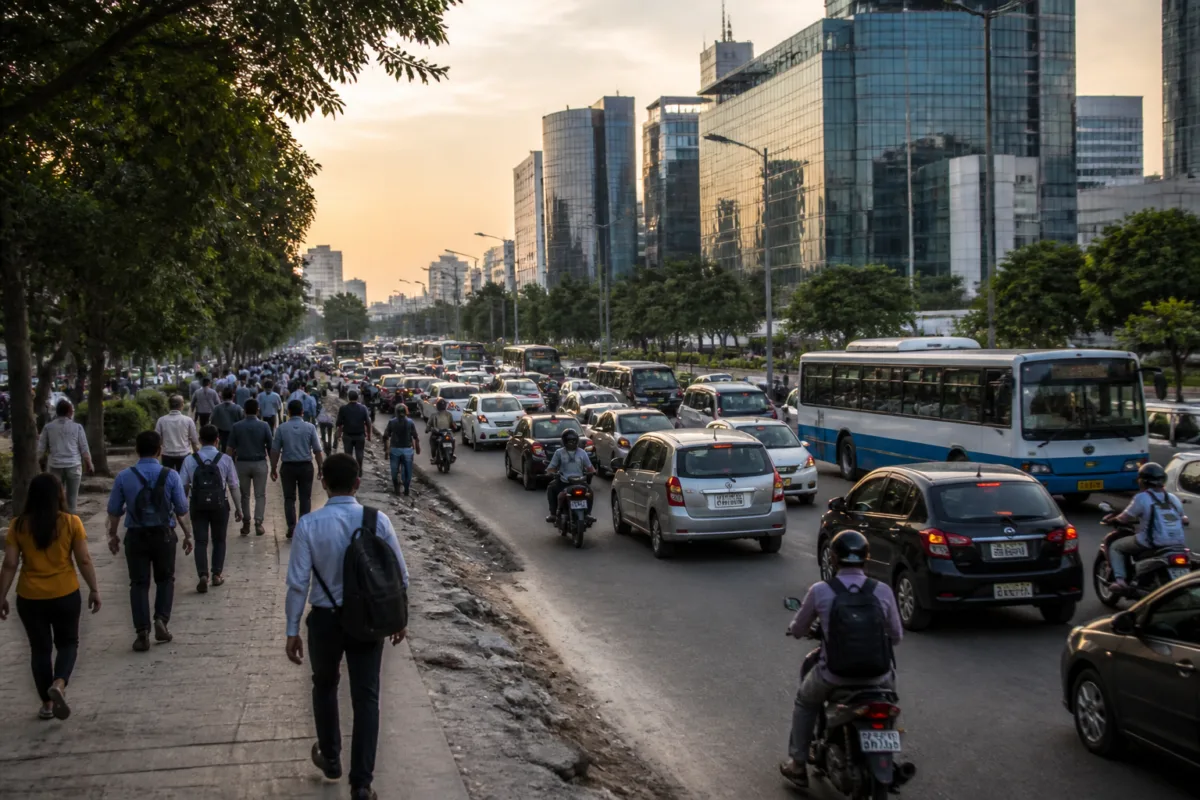
Hyderabad’s mobility debate is shifting from traffic management to the way the city allocates road space, plans development and coordinates public agencies, according to speakers at the Cyberabad Moves 2026 panel discussion.
Special chief secretary Jayesh Ranjan said the city needed to identify the underlying problems before pursuing isolated measures such as common mobility cards or pedestrian crossings. He called for a broader shift in commuting patterns through better use of road space, technology and policy interventions.
Ranjan said 9.3 million new vehicles had been registered in the city over the past year. He also cited a peak-hour survey at Cyber Towers, which found 10,138 people travelling alone in cars and another 3,584 vehicles carrying two occupants.
The figures were presented at the panel as evidence of the pressure created by private vehicle use and low vehicle occupancy. The discussion, however, did not announce a confirmed vehicle-reduction programme or provide a government implementation schedule for the proposed measures.
Institutional fragmentation emerged as another central concern. Sashi Verma, chief technology officer at Transport for London, said responsibility for urban development and mobility was divided among several agencies. He called for an empowered mechanism capable of integrating decision-making, funding and accountability instead of relying mainly on coordination bodies.
Verma also criticised planning regulations that leave portions of privately owned land fenced off as inaccessible open spaces. He argued that developers should make the areas around buildings and ground floors more welcoming and accessible to the public. This links mobility to the design of everyday urban space rather than treating congestion as only a road-capacity problem.
Former Bogotá mayor Enrique Penalosa said Hyderabad first needed to decide what kind of city it wanted to become. He cautioned that metro rail and mass transport could improve mobility without necessarily eliminating congestion. In his view, expanding transport infrastructure would need to be accompanied by restrictions on private-vehicle use, particularly during peak hours.
Penalosa proposed satellite-based vehicle tracking and congestion-based charges, under which motorists would pay more to use busy roads during peak periods. These were recommendations made during the panel, not confirmed Hyderabad policy decisions.
He also identified motorcycles riding or parking on footpaths as a major concern and called for strict enforcement. On bus transport, he advocated dedicated bus rapid transit corridors on high-demand roads, with centrally placed lanes and enforcement against unauthorised vehicles entering them.
The discussion placed walking at the centre of the transport system. Penalosa said every public-transport journey began and ended with walking, making the quality of footpaths a core requirement rather than an add-on. He also urged Hyderabad to develop extensive cycling corridors and public parks as the city expands.
Transport adviser N.V.S. Reddy proposed integrating employee transport services with the Cyberabad Police’s Hawk Eye app to strengthen women commuters’ safety across their journeys, including first- and last-mile connections. He also stressed the need for better footpaths and walkways.
Rekha Srinivasan of United Way of Hyderabad highlighted research-led and on-ground interventions for safer, more accessible and inclusive transport. Industry representatives called for sustained corporate participation, staggered working hours and measurable corporate social responsibility outcomes.
Taken together, the proposals place Hyderabad’s mobility challenge at the intersection of transport, land-use planning, public-space design and institutional accountability. The immediate policy question is not only whether the city can add transport capacity, but whether its agencies can agree on priorities and enforce them across roads, development sites, footpaths and public-transport services.

