


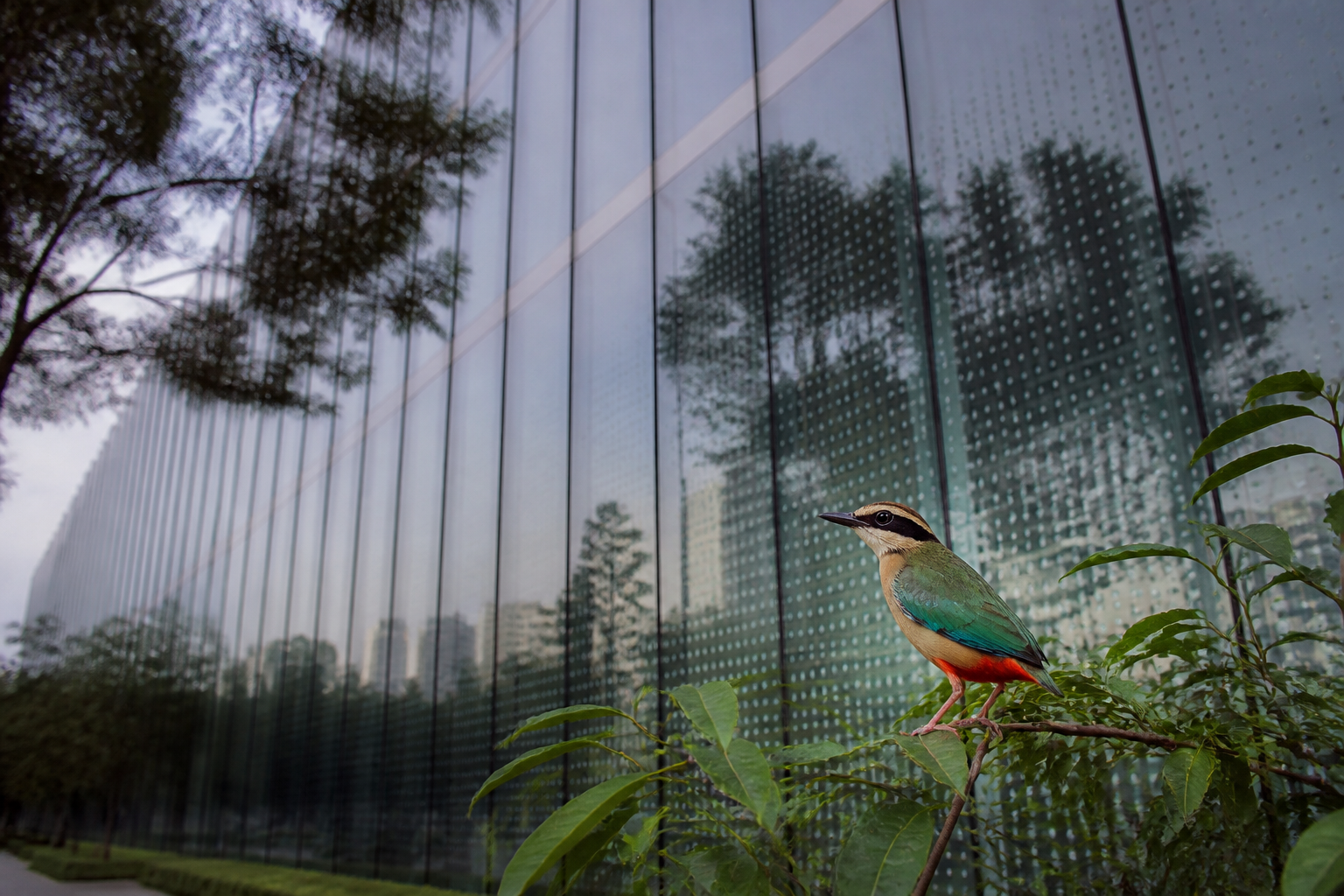
Seven Indian Pittas rescued in Hyderabad over 10 days, with five dying after colliding with glass facades, have exposed a recurring conflict between the city’s expanding high-rise environment and the movement of migratory birds. The cases reported by the Animal Warriors Conservation Society are not only a wildlife concern; they raise a built-environment question about whether the design of urban glass surfaces accounts for the species that move through the city.
The Indian Pitta, a colourful passerine that breeds in the Himalayan foothills of India, Nepal and parts of Pakistan, has been spotted at several places in and around Hyderabad as winter migration to southern India begins. According to the report, the birds undertake the journey to escape harsh weather in the north. During that movement, some are encountering building facades that they cannot recognise as solid barriers.
The immediate outcome has been severe. The Animal Warriors Conservation Society rescued seven Indian Pittas at different locations in Hyderabad during the 10-day period covered by the report. Five died after collisions and two were injured. Santoshi Pradeep, a founding member of AWCS, said the two surviving birds were recovering at the organisation’s rehabilitation centre from injuries sustained after hitting glass facades.
The reported numbers are small in absolute terms, but they are significant because they represent only the cases that reached one conservation organisation. Pradeep told Telangana Today that many similar incidents could go unreported across Hyderabad and other parts of Telangana. That limitation makes the seven cases an incomplete measure of the problem rather than a complete estimate of bird deaths caused by building collisions.
This distinction matters for urban governance. When an injured bird is found and taken to a rescue centre, the event becomes visible. A bird that dies at an inaccessible facade, falls into a restricted compound or is not discovered may never enter any official record. Without systematic reporting, authorities and building owners cannot easily establish which locations are repeatedly involved, during which periods collisions occur, or whether particular facade designs create higher risks.
The central design problem described in the report is that glass facades can reflect the surrounding environment or appear open to birds. Exhausted after migration, the Indian Pittas may not identify the surface as an obstacle before impact. The report does not provide a citywide collision database, a mapped list of buildings or a comparative assessment of different facade materials. It does, however, identify a direct pathway from design choice to wildlife mortality: large glass surfaces are being placed within the flight environment of migratory birds without visible preventive treatment.
Shiva Kumar, a wildlife activist and founder of the Voice of Nature Foundation, said certain patterns on glass facades could help birds recognise obstacles and change direction. His suggestion points to a potentially practical intervention, but the supplied report does not specify which patterns have been tested in Hyderabad, what spacing or design standards would be required, or how building owners could be expected to install them. Those details would be necessary before any citywide solution could be assessed.
The urban issue is therefore not simply whether glass is used in construction. It is whether a facade is treated as a purely aesthetic or energy-related building element, or as part of the city’s ecological infrastructure. A building envelope separates indoor space from the outside, but it also sits within streetscapes, open areas and movement corridors used by birds. If its surface visually merges with sky, trees or surrounding vegetation, the facade can become a hidden hazard for species passing through the city.
Hyderabad’s reported incidents also expose an institutional gap. Telangana Today reported that similar incidents occurred in October last year, but said neither the Forest Department nor civic authorities had taken steps to prevent them over the following year. The report does not establish whether any formal complaint, inspection, building regulation or advisory was issued after those earlier incidents. It does show that the problem was not entirely new when the latest rescues took place.
That gap between recurring incidents and preventive action is important. Rescue organisations can provide emergency care, but they cannot by themselves change facade design across a growing city. Their work begins after a collision has already occurred. Prevention would require some form of coordination between wildlife authorities, municipal bodies, building owners, architects, facade consultants and conservation groups. The supplied material does not identify an existing coordination mechanism or a designated agency responsible for bird-collision prevention.
The absence of such clarity creates a familiar administrative problem: responsibility is distributed, while the harm remains largely unrecorded. Wildlife groups may see the injured birds. Building owners control the facades. Civic authorities oversee aspects of the urban building environment. The Forest Department handles wildlife-related response. Unless these roles are connected through a reporting and intervention process, each collision can remain an isolated rescue rather than evidence of a recurring urban condition.
The available evidence also points to a seasonal dimension. The incidents were reported as winter migration to southern India begins, and the Indian Pitta is described as a bird that travels from northern breeding areas. This means the risk may not be evenly distributed across the year. However, the report does not provide enough information to determine the length of the migration period in Hyderabad, the locations most affected, or whether weather, lighting, vegetation and building height influence collision frequency.
These missing data are not a reason to dismiss the problem. They identify what a useful public response would need to record. Each incident would ideally be linked to a building or facade, date, time, weather condition, bird species, injury outcome and the presence of reflective or transparent surfaces. The current report provides some of those elements—the species, the 10-day period, the collision mechanism and the outcome—but not enough to compare sites or measure change.
The seven reported cases also show why urban biodiversity cannot be treated as separate from construction decisions. The deaths occurred at high-rise buildings, meaning the relevant intervention is located within the ordinary production and management of the built environment. The issue involves materials, facade detailing, maintenance and possibly approvals, even though the supplied report does not state whether any particular project violated a rule.
That distinction is essential for responsible policy discussion. The available evidence supports the conclusion that collisions occurred and that activists are calling for patterned glass or other visual cues. It does not establish negligence by individual building owners, identify a legally binding requirement that was breached, or prove that every glass facade in Hyderabad presents the same level of risk. Any regulatory response would need to be based on a documented assessment rather than on assumptions about all high-rise construction.
For now, the clearest public-interest step described in the report is improved reporting and response. AWCS and the Telangana Forest Department have provided contact numbers for the rescue of birds and animals: 96978 87888 and 1800 425 5364, respectively. Those channels may help bring more incidents to official or organisational attention, although the report does not say how the information will be compiled or used for preventive planning.
The larger question is whether Hyderabad will treat these deaths as isolated wildlife emergencies or as signals from the city’s rapidly changing physical environment. The evidence confirms seven collisions, five deaths and two injured birds during one 10-day period, while also indicating that the true number may be higher. It does not yet establish the scale of the problem across the city or the effectiveness of specific facade treatments. Those are the gaps that future monitoring, building-level mapping and a clear response framework would need to address.

