


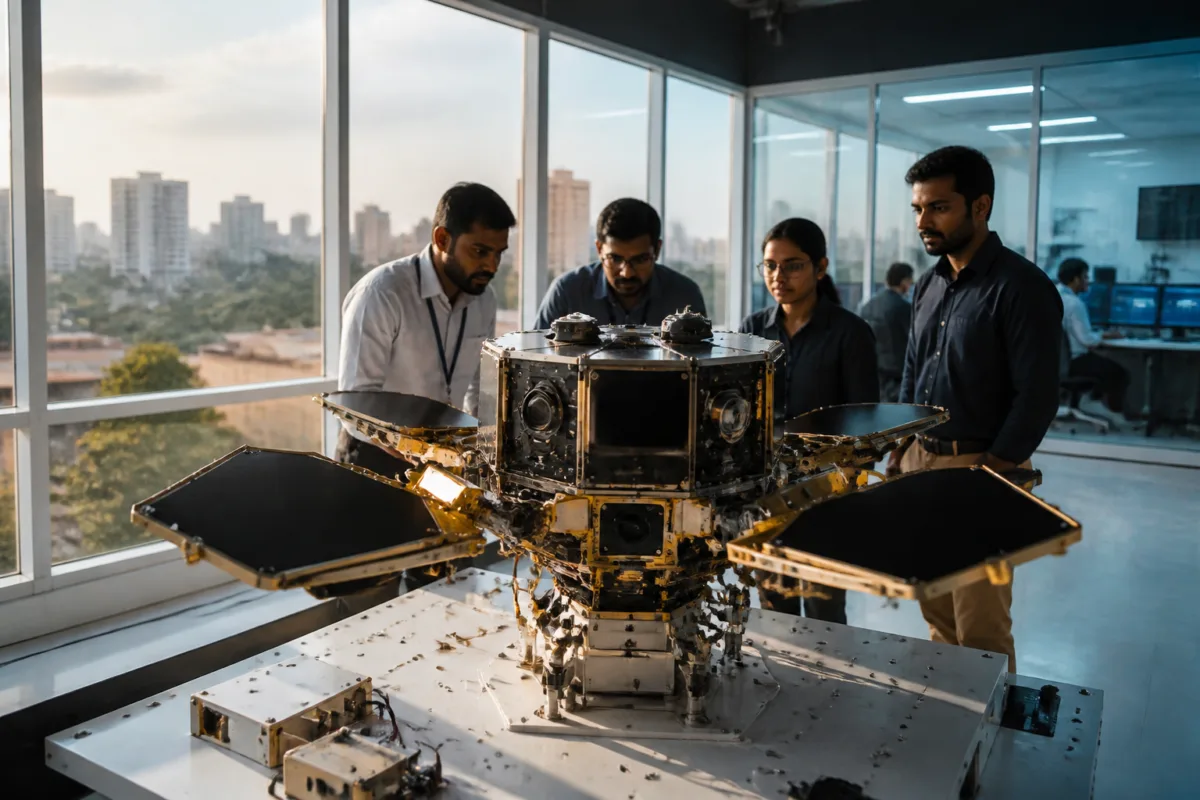
Hyderabad-based space-tech start-up Cosmoserve Space is expanding its local manufacturing base for space debris removal while preparing to repeat an orbital demonstration after its robotic capture system failed to deploy during a July 2026 flight.
The company currently procures nearly 60 per cent of its mission components locally. Its mechanical systems are largely developed in-house and sourced from Hyderabad, while specialised electronics and optical systems continue to be imported.
Cosmoserve founder and CEO Dr Chiranjeevi Phanindra told Deccan Chronicle that the company expects Hyderabad’s space ecosystem to gradually close this supply gap. He cited Hyderabad-based EON Space Labs, which is developing optical cameras for space applications, as a potential future local supplier once those systems are fully qualified.
“Electronics and optical systems are still imported. Over time, I expect both can be built in India,” Phanindra said.
The company has inaugurated a 14,800-square-foot Base 1 facility at VSD Tech Park in Gachibowli. The facility is designed to support the development and testing of space robotics and satellite-servicing systems, with laboratories for robotic capture, orbital rendezvous, microgravity simulation, satellite integration and mission control.
Cosmoserve also plans to use the facility for work on in-orbit repairs and refuelling. The expansion places Hyderabad’s technology and manufacturing capabilities closer to a specialised space-services market that requires precision robotics, optical sensing, electronics and mission-control systems.
The company’s Mission EMBRACE demonstration was carried aboard Skyroot Aerospace’s Vikram-1 rocket in July 2026. Cosmoserve said about 75 per cent of the mission’s systems performed as planned, based on telemetry, but the robotic capture petals did not deploy.
Phanindra attributed the failure to restraint cables that held the petals against the base structure during launch. The cables did not cut on command, leaving the petals locked. He also said low temperatures may have caused the soft petals to stiffen. For the next flight, Cosmoserve has ruggedised both systems and added reliability measures and redundancy.
The company plans a full-scale space debris capture demonstration in 2027. The mission will send a chaser spacecraft towards a non-cooperative target, approach it to between 25 and 10 metres, move closer, capture the object and deorbit it into the atmosphere.
The demonstration is intended to validate Cosmoserve’s ReVIS architecture, a dual-spacecraft system. Under the model, a larger orbital service station would carry fuel, equipment and spare parts, while a smaller autonomous vehicle would travel between satellites to capture, diagnose, repair or remove them.
Cosmoserve says the system is designed to service multiple dead satellites in one campaign, allowing mission costs to be shared among several satellite operators. Phanindra said the company is targeting a reduction in servicing costs from about $10 million to below $1 million per satellite.
The 2027 demonstration will therefore serve as the next operational milestone before Cosmoserve offers the service commercially. Its immediate priorities are the repeat capture test, qualification of locally developed components and validation of the complete ReVIS architecture in orbit.

