


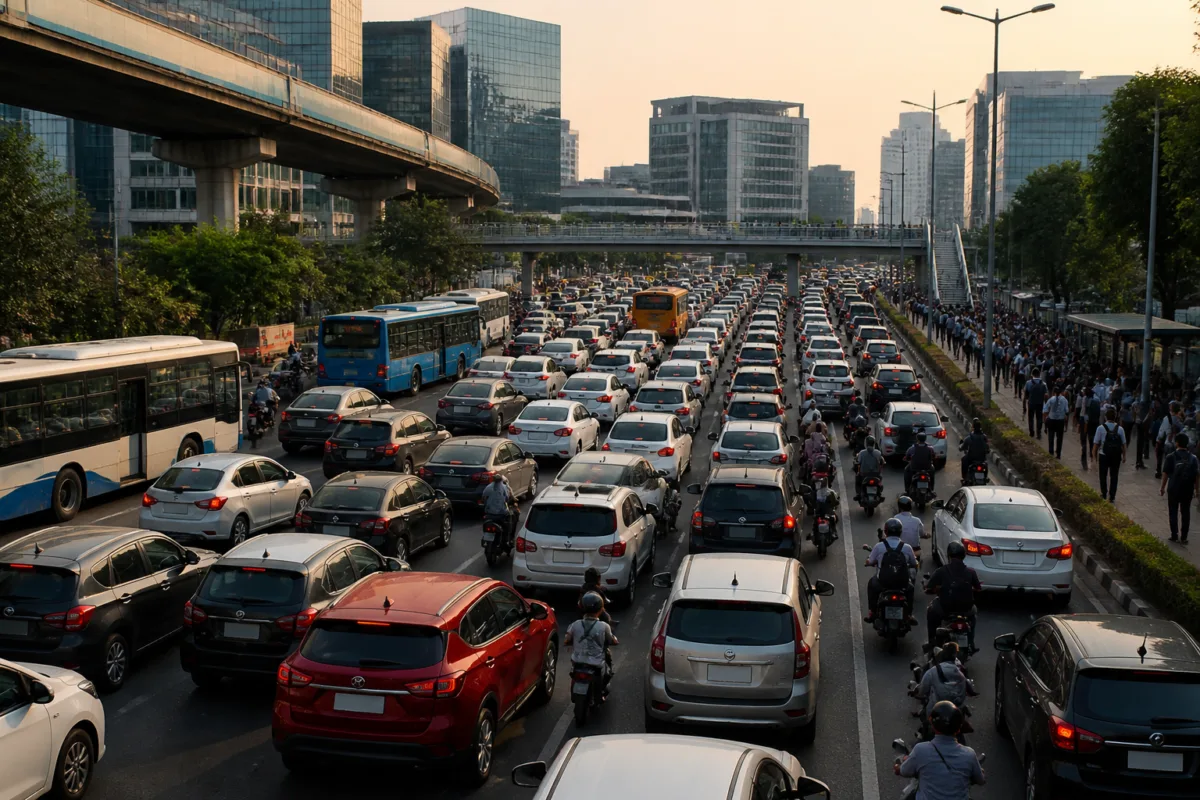
A study involving researchers from BITS Pilani’s Hyderabad Campus, Cardiff University and King Fahd University of Petroleum and Minerals has found that motorists in Hyderabad may accept congestion pricing on the city’s busiest roads if the charge shortens journeys and its revenue is reinvested in public transport.
The researchers surveyed 435 car commuters and found that shorter travel time was the benefit respondents valued most. The study was led by Prasanta Sahu and Bandhan Majumdar of the Transportation Research and Innovation Lab at BITS Pilani, along with Dimitris Potoglou and Naveed Marazi. According to the report, the study was funded by the Government of India.
The findings do not represent a confirmed congestion-pricing decision by the Telangana government or Hyderabad’s transport authorities. They instead set out conditions under which commuters could be more willing to support a road charge and suggest locations where a pilot could be considered.
The researchers recommended beginning with corridors near employment hubs, commercial districts, metro interchanges and chronically congested intersections. The report identifies Hyderabad’s IT corridor as a possible pilot area because of its heavy peak-hour traffic.
Cyberabad traffic police surveys cited in the report indicate that more than 10,000 vehicles pass the Cyber Towers stretch in Hitec City every hour. Around 6,550 of those vehicles carry only the driver, while nearly 3,500 carry two people. Daily traffic on Hitec City’s main road is estimated at 1.5 lakh vehicles.
The study’s argument is that congestion cannot be addressed only by adding road width. Prasanta Sahu said delays are also driven by bottlenecks, uneven road widths, inadequate pedestrian facilities, on-street parking, bus-stop activity and poorly designed junctions. The researchers therefore called for recurring queue locations to be identified and corrected before authorities pursue indiscriminate road widening.
One proposed intervention is grade separation at junctions where conflicting turning movements and limited intersection capacity repeatedly create queues. The researchers also linked congestion pricing with better public transport, saying the combination could reduce delays, emissions and fuel wastage.
Bandhan Majumdar said commuters are more likely to accept a charge when they can see a clear public benefit, including shorter journeys, cleaner air, improved road safety and stronger public transport. The report suggests that revenue could support additional buses, feeder services, improved footpaths, road-safety measures and cleaner transport options.
A related option raised in the report is a high-occupancy vehicle system on selected corridors. T Satyanarayana Reddy, a former scientist-G and head of Traffic and Transportation Planning and Engineering at the Central Road Research Institute, said vehicles carrying fewer than three occupants could face peak-hour restrictions or an additional charge. Automatic Number Plate Recognition cameras could be used to identify vehicles, monitor compliance and issue challans where violations are established, he said.
The scale of the challenge is reflected in the growth of vehicle ownership. Hyderabad, Ranga Reddy and Medchal-Malkajgiri districts together recorded 94.78 lakh registered vehicles in 2025, compared with 89.89 lakh in 2024, according to the figures cited in the report. The combined count is expected to approach one crore by the end of 2026.
Congestion pricing would therefore shift part of Hyderabad’s traffic policy from expanding supply to managing demand. International examples cited in the report include Singapore, London, Stockholm, Milan and Oslo, where road-charging systems have been used to influence travel demand. Their relevance to Hyderabad would depend on local factors such as public transport capacity, enforcement, exemptions, privacy safeguards and the transparent use of revenue.
For Hyderabad commuters, the study’s central proposition is not simply that driving should become more expensive. It is that any charge would need to be tied to visible improvements in travel time, bus services, walking conditions and road safety. Without those improvements, a fee could be viewed as an additional burden rather than a congestion-management tool.

