


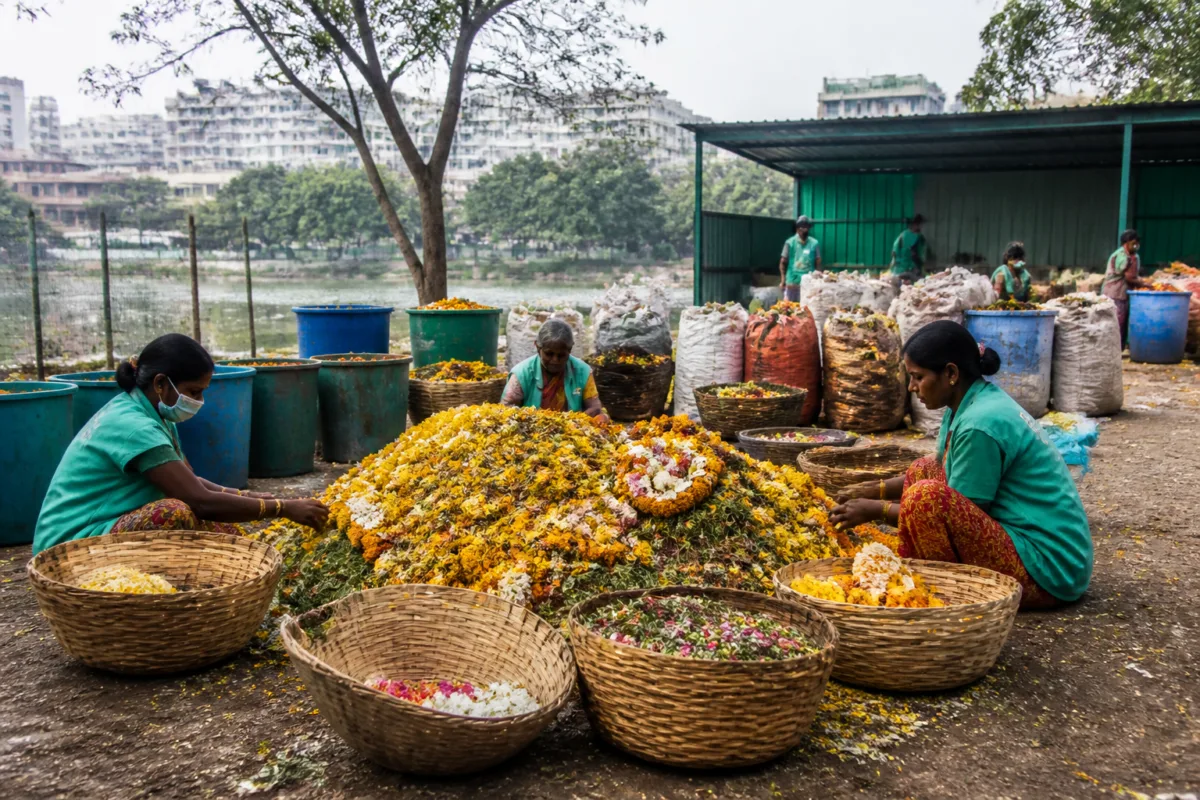
Hyderabad’s Malkajigiri Municipal Corporation has converted around 7,000 metric tonnes of floral waste from religious festivals and idol immersions into incense and dhoop sticks, diverting the material from the city’s general waste stream.
The initiative was carried out by the civic body in collaboration with Pakka Organics. Flowers offered during Ganesh Chaturthi, Bathukamma and other religious ceremonies were collected separately, processed and used to manufacture incense products.
According to MMC additional commissioner for sanitation Raghu Prasad, more than 6,400 metric tonnes of the collected material came from Ganesh idol immersion activities. Around 400 metric tonnes was generated during Bathukamma, the floral festival celebrated in Telangana.
To prevent the flowers from being mixed with municipal garbage, the corporation established dedicated collection kiosks at major immersion points. Safilguda lake was among the locations where the separate collection system was put in place for flowers offered during religious ceremonies and those accompanying Ganesh idols.
The collected material was dried and powdered before being mixed with herbs, natural resins and wood powders. The resulting mixture was used to produce incense sticks and dhoop sticks, according to the report.
MMC commissioner Vinay Krishna Reddy said the programme was intended to convert floral waste into useful products through scientific collection, segregation and recycling. The civic body said the process reduced the burden on municipal waste-management systems and supported environmental protection.
Floral offerings are often discarded along with other waste after religious events and immersion ceremonies. Separate collection allows the material to be handled independently instead of entering the general municipal waste chain. In this programme, collection was linked directly to processing and product manufacture.
The quantities recorded by the corporation show that Ganesh immersion activities accounted for the largest share of the collected floral waste, while Bathukamma contributed a smaller but distinct stream. The dedicated kiosks provided designated points for residents and festival participants to deposit the flowers separately.
The initiative places collection, segregation and processing within one municipal waste-management operation. Its next steps, including the continuation of dedicated kiosks and the handling of floral waste from future festivals, will determine how consistently the model can be applied across immersion points and other religious-event locations.

