


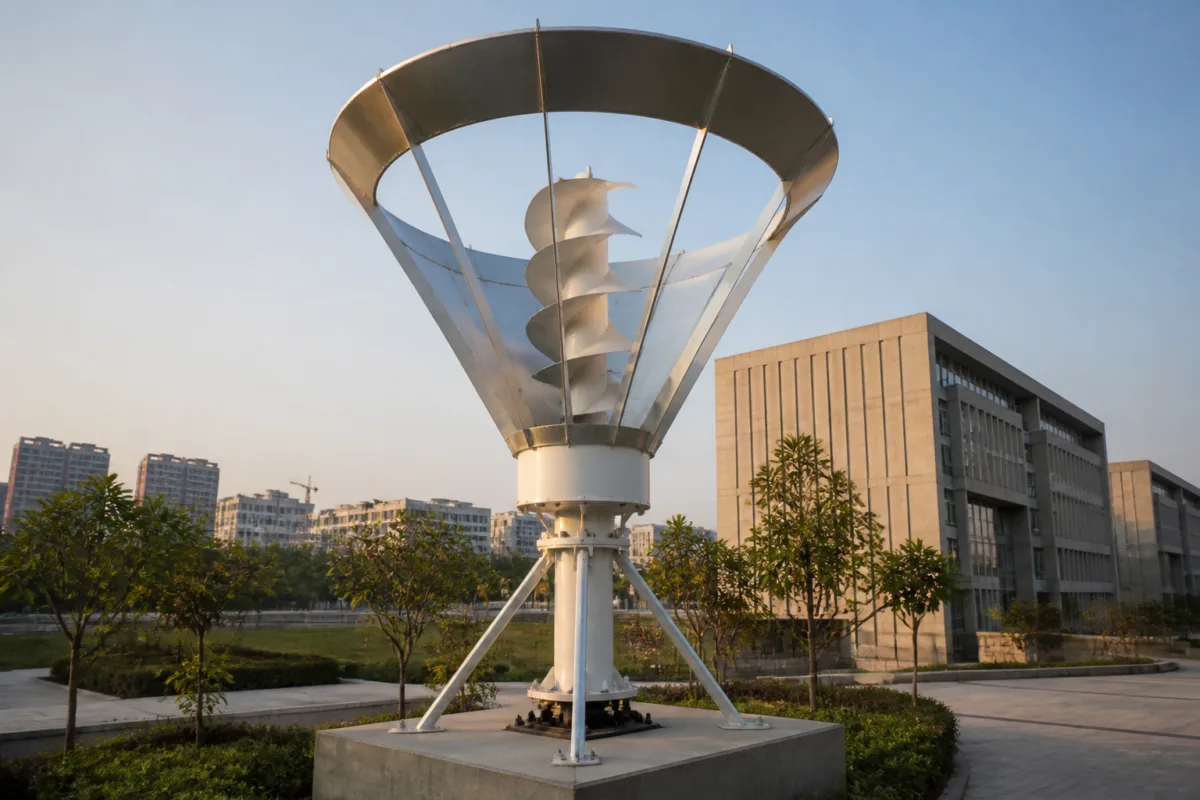
Pandit Deendayal Energy University’s patented urban wind turbine addresses a basic limitation of conventional wind power: large turbines are designed for stronger, more consistent winds, while cities offer fragmented airflow around buildings and infrastructure. The PDEU team says its compact Archimedes turbine can generate power at wind speeds as low as 1 metre per second, using a trumpet-shaped collector and an aerodynamic system designed to capture wind from multiple directions.
The development is significant not because it immediately changes the scale of renewable generation, but because it shifts the question from where large wind farms can be built to whether smaller systems can extract useful energy from the built environment. The prototype was installed on the PDEU campus and its experimental performance was assessed in controlled wind-tunnel conditions. That makes the university’s work an early-stage technology development, while also showing the institutional and design challenge involved in adapting renewable energy to urban conditions.
Conventional wind turbines are generally associated with tall masts, large blades and locations where wind is sufficiently strong and steady. According to Prof Anirbid Sircar, director of PDEU’s School of Technology, large turbines typically require wind speeds of about 4 to 10 metres per second. The PDEU design instead seeks to operate at much lower speeds, with the current configuration intended to capture wind at 1 metre per second.
That difference is central to the urban application. The report does not establish that the prototype can supply large quantities of electricity or replace grid power. It does show that the researchers are targeting a part of the wind-energy problem that conventional systems are not designed to address: low-speed, changing and multidirectional airflow. In cities, the ability to accept wind from varying directions is particularly important because compact installations may not have the same exposure or operating conditions as large turbines in open areas.
The technology combines four aerodynamic elements. The first is an omnidirectional trumpet-shaped collector intended to gather wind from multiple directions. The second is a converging Venturi duct, which accelerates airflow towards the turbine. The third is a honeycomb flow conditioner that improves the uniformity of the flow and reduces turbulence. The fourth is a three-bladed Archimedes spiral rotor with a 60-degree helix angle, connected to a permanent magnet generator.
Together, these components create an aerodynamic pathway that collects, concentrates and directs incoming air towards the rotor. Rohit Pawar, the research scholar who spearheaded the innovation in PDEU’s petroleum engineering department, described the design as a system for capturing and accelerating wind before it reaches the Archimedes rotor. The approach is different from simply increasing rotor size. It attempts to improve the quality and direction of the airflow reaching a compact turbine.
This matters for the built environment because urban renewable systems must contend with physical constraints. A city-based installation may have limited space, changing wind directions and airflow disturbed by nearby structures. The researchers say their configuration is omnidirectional and does not depend on complex mechanical tracking mechanisms. That feature could reduce the need for the turbine to constantly orient itself towards the wind, although the supplied report does not provide comparative maintenance, cost or output data.
The project also illustrates why decentralised energy systems require a different design logic from utility-scale generation. Large renewable projects depend on suitable sites and infrastructure for producing and transmitting power. A compact system, by contrast, is conceived for deployment closer to where electricity is used. PDEU director general Prof S Sundar Manoharan said compact, efficient and adaptable wind systems have become increasingly important as demand grows for decentralised and sustainable energy solutions.
The word “decentralised” is important in this context. It describes a move towards generating energy through smaller systems distributed across multiple locations rather than relying only on large, centralised facilities. The PDEU report positions the turbine as potentially relevant to urban applications, but it does not specify the buildings, public facilities or neighbourhood systems where the prototype would be deployed. Nor does it establish the amount of electricity that a commercial version could produce under ordinary city conditions.
Those gaps are not minor technical details. They determine whether an urban wind turbine remains a promising laboratory design or becomes a practical component of city energy infrastructure. The current evidence confirms that the university has fabricated a prototype, patented the design and tested it under controlled wind-tunnel conditions. It does not yet provide field-performance data from different urban sites, long-duration output measurements, installation costs, noise levels, maintenance requirements or the amount of power generated at the claimed low wind speed.
The distinction between controlled validation and urban deployment is especially important. A wind tunnel allows researchers to examine the behaviour of a fabricated system under defined conditions and compare the results with numerical investigations. A city presents a less controlled environment, with wind affected by buildings, roads, trees and other structures. The supplied report does not include a field trial or a performance comparison with existing small-scale wind systems. As a result, the research should be understood as a technology demonstration rather than evidence of a ready-to-scale urban energy product.
The design’s institutional setting is also revealing. The prototype was installed on the PDEU campus, allowing the university to connect research, fabrication and testing within one environment. The project was led by a research scholar and supported by senior university officials, indicating a model in which an academic institution is developing a built-environment technology around a specific urban problem. The patent provides legal protection for the design, but the supplied material does not state whether the technology has entered commercial development or received approvals for wider installation.
For municipal and building authorities, such questions would become relevant before adoption. A distributed energy device placed on a building or public facility would need to be evaluated not only for electrical output, but also for structural integration, safety, access for maintenance and compatibility with existing power systems. None of those implementation details is provided in the report. It would therefore be premature to treat the invention as an immediate solution to urban energy demand.
The policy landscape described by the report is limited to the broader need for decentralised and sustainable energy systems. No specific government scheme, municipal programme, tariff arrangement, building regulation or deployment target is cited. This absence underscores an important institutional issue: technical innovation and urban implementation operate through different systems. A university can demonstrate a new design, but deployment would require decisions by building owners, energy authorities, local administrations and potentially distribution utilities.
The project’s data story is similarly focused on operating conditions rather than energy scale. The key comparison is between the approximately 4-to-10-metre-per-second wind speeds associated with large turbines and the 1-metre-per-second operating point cited for the PDEU prototype. The report also identifies the rotor configuration, including three blades and a 60-degree helix angle, and states that wind-tunnel experiments supported the numerical investigations. However, it does not provide a power curve, annual energy yield, efficiency percentage or output in watts.
That missing information limits direct comparison with other energy technologies. Wind speed alone does not establish how much electricity a system will deliver. Output also depends on the volume and consistency of airflow, the efficiency of the rotor and generator, operating duration and losses in the system. Since those figures are not supplied, the evidence supports a conclusion about the design’s low-wind operating objective, not about its economic or grid-level value.
The larger urban question is whether cities can make productive use of small, irregular energy resources without adding complex infrastructure. PDEU’s design suggests one possible route: use aerodynamic collectors and a compact rotor to improve energy capture where wind is weak and direction changes. That is a different proposition from building large turbines in high-wind locations. It places emphasis on adaptability, footprint and integration with local energy systems.
For now, the evidence establishes a patented prototype, a stated ability to capture wind at low speeds and controlled experimental validation at PDEU. It does not establish commercial readiness or performance across real urban sites. The next developments to monitor are field testing, independently reported electricity output, durability, installation requirements, operating costs and evidence of integration into a building or campus energy system. Those measures will determine whether the innovation can move from an academic demonstration towards a workable urban energy application.

