


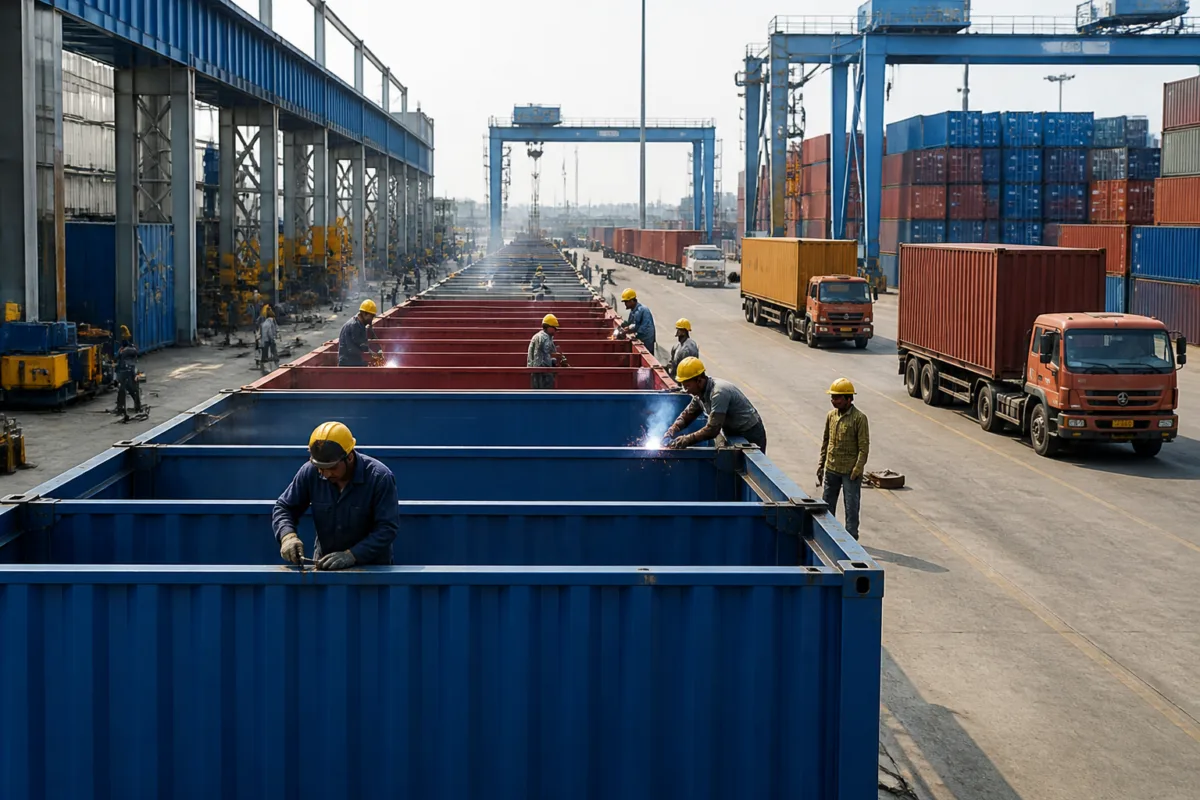
Gujarat is set to receive a major policy boost for container manufacturing after the Union Cabinet approved a Rs 10,000 crore incentive scheme aimed at expanding India’s domestic capacity and reducing dependence on imported containers. The Container Manufacturing Promotion Scheme is expected to support new facilities and production in industrial regions including Bhavnagar, Rajkot and Kutch.
The scheme, announced in the Union Budget for FY 2026-27, is scheduled to be rolled out from the next financial year and continue until 2039-40. It will provide initial support for setting up manufacturing facilities, followed by production-linked incentives over the subsequent decade, according to the report.
The Centre plans to increase India’s annual container manufacturing capacity more than ten-fold, from an estimated 70,000 twenty-foot equivalent units to 7.5 lakh TEUs. The move follows the shortage of shipping containers during the Covid-19 pandemic, when the disruption affected India’s export-import trade and exposed the country’s dependence on foreign suppliers.
Manufacturers in Gujarat began exploring container production after the pandemic, but high production costs, infrastructure constraints and limited policy support prevented several plans from progressing. The new scheme has revived expectations that domestic manufacturing could become commercially viable and attract fresh investment from large industrial groups.
The policy comes as containerised cargo movement in India is projected to grow substantially. According to the Ministry of Ports, Shipping and Waterways, domestic container traffic is expected to rise from 24 million TEUs in 2024 to 175 million TEUs by 2047. The projected increase is expected to create sustained demand for containers and strengthen the case for building domestic production capacity.
Gujarat has several advantages for developing the sector, including an established industrial base, proximity to major ports, engineering capabilities and access to steel and ancillary industries. The state could therefore support an integrated manufacturing ecosystem rather than isolated production facilities.
However, manufacturers said financial support alone would not be sufficient. Container production must meet stringent international quality standards because the units operate across global maritime networks. Overseas manufacturing centres benefit from economies of scale, integrated supply chains and lower production costs, creating a competitiveness challenge for Indian producers.
Ashish Joshi, a container manufacturer from Kutch, welcomed the scheme but said implementation would need to be timely and practical. “We appreciate this policy, but the govt needs to move quickly. Manufacturers elsewhere are continuously working to reduce production costs, while India’s policy is still in the pipeline. We expect the govt to introduce a simplified and transparent framework. Land costs should also be considered alongside manufacturing costs while designing incentives,” Joshi said.
Industry participants have also identified affordable industrial land, competitive input costs, reliable infrastructure, access to finance and a predictable policy framework as necessary conditions for a sustainable manufacturing base. The next milestone will be the scheme’s rollout from the coming financial year, when the Centre is expected to establish the framework for facility support and subsequent production-linked incentives.

