


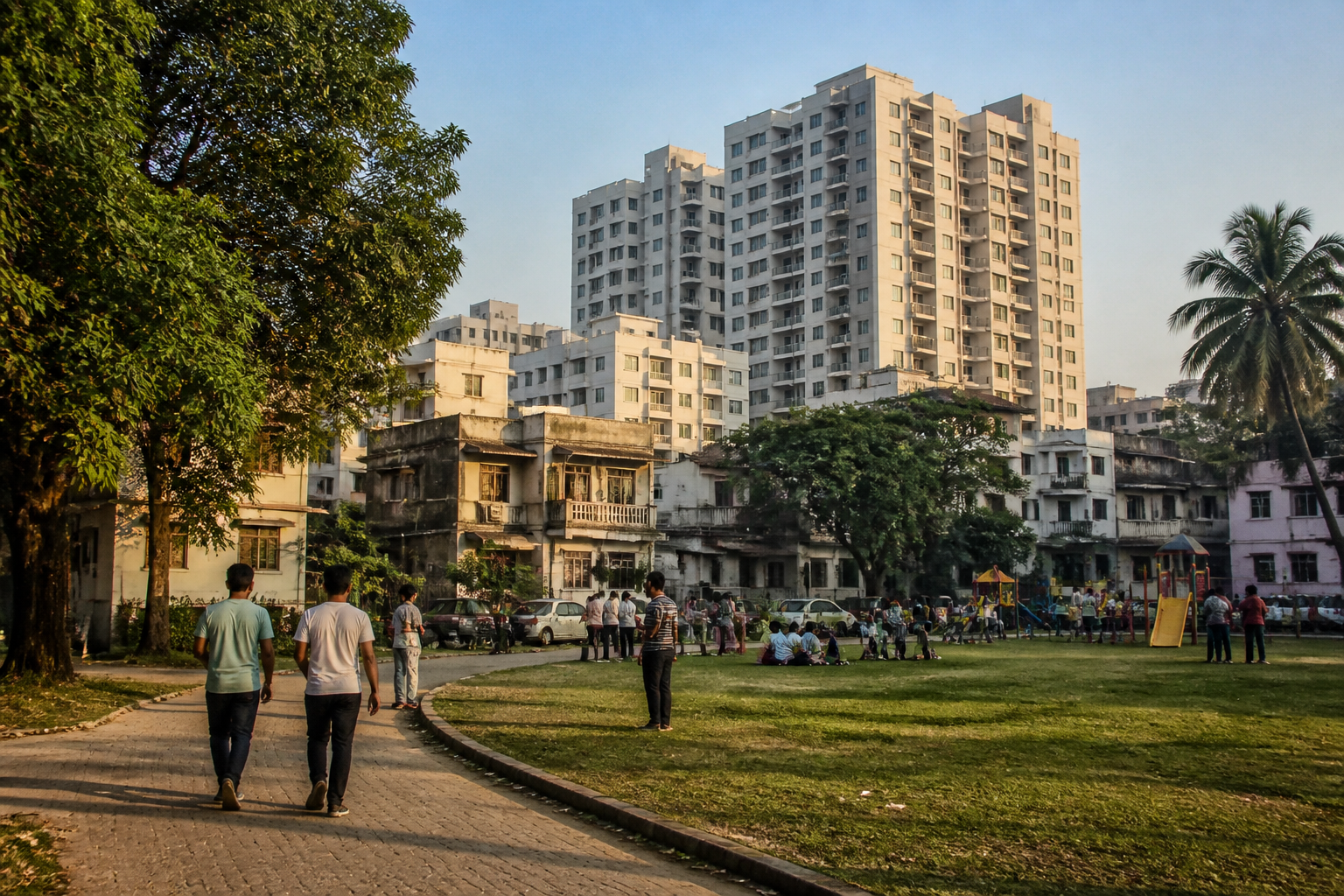
Golf Green is changing, but not in the way many Kolkata neighbourhoods have changed. New towers, cafes and younger professionals are reshaping the area, yet the housing society’s defining feature remains its relationship with the city around it: it was planned without boundary walls separating it from nearby refugee settlements, and its public life continues to revolve around shared parks, cultural programmes and everyday adda.
That combination makes Golf Green more than a well-known residential enclave. Developed by the West Bengal Housing Board in 1975, it represents a particular phase of Kolkata’s urban expansion, when housing was being built not only as a collection of private flats but also as a social and institutional project. Its current transition raises a larger question for the city: can an older planned neighbourhood absorb real-estate pressure and changing lifestyles without losing the informal connections that made it function as a community?
Golf Green began as a very different landscape. Before the housing society existed, the site was described as a large expanse of trees and muddy ponds, associated with an unused golf course that had belonged to royalty. Local boys used the grounds as football fields. Between 1967 and 1972, the area also became a hideout for young men linked to the Naxalite movement who were being pursued by police. The land was described as crime-ridden and connected to the financial difficulties of the golf club before it was sold to the Kolkata Metropolitan Development Authority in 1972.
The creation of the West Bengal Housing Board a year later provided the institutional framework for the site’s transformation. The planned residential society was initially intended for high-income groups but was later expanded to include middle- and low-income buyers. It was divided into seven phases, with four- and five-storey buildings and bungalows arranged around parks and internal roads. The first phase did not immediately attract strong demand. Samir Roychowdhury, who bought a flat for less than Rs 1 lakh, recalled that applications were initially fewer than the number of constructed units, allowing early buyers to choose their homes. Two or three years later, allotments were made through a lottery as demand grew.
This slow beginning reflected both the physical setting and the housing culture of the period. The site had a troubled past, was relatively secluded and did not immediately fit the traditional preference for independent houses. Scientist Shantanu Paul, as cited in the source report, linked the early hesitation to the area’s history, its isolation and a wider Bengali reluctance towards flat living. Golf Green therefore became part of Kolkata’s gradual movement towards organised apartment housing, while retaining design elements associated with a lower-density neighbourhood.
Its planning relationship with surrounding settlements was equally important. Golf Green was separated from the Royal Calcutta Golf Club by a running wall, but it did not build a boundary wall to isolate itself from nearby refugee colonies such as Bijoygarh, Jadavpur, Poddar Nagar and Arabinda Nagar. The decision was not merely a design choice. It reflected an approach to urban coexistence at a time when Kolkata was still absorbing the social and spatial consequences of refugee settlement after Partition.
The source report recalls public works minister Jatin Chakraborty advising early residents in 1980 that living side by side without a wall would allow neighbours to avoid feeling like unwanted guests. That principle gave the housing society a different relationship with its surroundings from gated developments that treat the neighbourhood beyond their compound as a threat or an inconvenience. Golf Green’s openness was not absolute, and the area had a running boundary with the golf club, but its internal layout allowed roads and daily movement to connect it with the settlements around it.
Central Park became the physical and social centre of this arrangement. Initially a muddy pond, it was developed after the 1980s after the pond was filled, an overhead tank was installed and fencing was added. The park is described as the lungs of an increasingly concretised area. Between 700 and 800 people walk there every morning and evening, while its scale provides a shared open space for residents across the different phases.
The park’s management also shows how neighbourhood infrastructure is maintained when responsibility extends beyond a single municipal department. The Central Coordination Committee manages the space and generates revenue by allowing film shoots and events. The arrangement links the maintenance of an everyday public amenity to local institutional capacity and commercial use. Each block also has a children’s tot-lot park, while the CS ground hosts local football and cricket matches. These spaces help distribute community life beyond private homes and formal housing blocks.
The importance of Central Park is not only recreational. It provides a setting for repeated encounters between residents, especially during morning walks and evening gatherings. When the park closes around 8 pm or 9 pm, particularly in summer, people continue to gather outside. In this sense, the neighbourhood’s social infrastructure is made up of more than buildings and roads. It includes routines, accessible open spaces and informal places where different generations can meet.
Golf Green’s cultural life developed through the same shared structure. Its Durga Puja celebrations are described as distinct from a typical commercial barowari puja. Women from the neighbourhood prepare bhog, and the community follows the traditional Shodashopachara Puja. On Navami, residents participate in Pungti Bhojon, sitting in long lines for a community feast. The four days also include performances, plays and poetry contests, with well-known artists taking part in different capacities.
Basantotsav became another prominent event, with performances by artists including Kabir Suman and the band Bhoomi. Residents such as Chinmoy Roy, Sujit Mukherjee and Rabindra Sangeet singer Rama Mondal contributed to the cultural environment. Actors Soumitra Chatterjee and Rabi Ghosh lived in Phase 1, while author Mahasweta Devi owned a flat in Phase 4. The presence of artists did not by itself create the neighbourhood’s culture; it was the organisation of recurring local events and the availability of shared spaces that allowed that culture to become visible.
This history matters because Golf Green is now experiencing a familiar urban transition. The earlier landscape of bungalows, four- and five-storey buildings and government-quarter-style housing is being supplemented by 12-storey towers. A bungalow that cost more than Rs 1 crore would have far more takers today than it did in 1979, indicating the rise in property demand and the changing economic profile of the area. New buyers are increasingly young working professionals rather than the government employees associated with the society’s earlier phase.
The most visible sign of this change is along Uday Shankar Road, where bungalows in Phase 1 have gradually been converted into commercial premises. Their ground floors, balconies and repurposed rooms now accommodate cafes. Travelistan Cafe, described as Kolkata’s first travel-themed cafe, began this shift around 2017-18, followed by outlets including Blue Tokai and Hatari. The new commercial activity has given the neighbourhood a different public identity, but it has also placed pressure on a residential environment originally designed around quieter domestic use.
The Golf Green Central Coordination Committee says it maintains community standards, limits rentals and does not tolerate late-night disturbances. That response reflects a neighbourhood trying to manage change through local rules rather than allowing commercialisation to proceed without restraint. The issue is not simply whether cafes or towers are desirable. It is whether the area’s existing institutions can regulate new uses while preserving access, security and the slow-paced life residents associate with Golf Green.
Security has already begun to alter the meaning of the open society. A largely elderly population is facing concerns linked to scattered robbery incidents and road accidents attributed to rash driving. One resident said the community was being pushed towards fencing and security kiosks at important entry points to prevent the entry of anti-social elements. This creates a direct tension between the neighbourhood’s original promise and its current anxieties. Measures introduced for safety can also reduce permeability and make an open housing society more internally separated.
That tension is central to Golf Green’s urban story. The society was planned as a formal housing development but became part of a larger urban fabric through its roads, parks, cultural events and lack of a complete boundary wall. Its evolution now shows how real-estate demand, tower construction, cafe culture, ageing populations and security concerns can place pressure on the physical and social arrangements that once made a neighbourhood inclusive.
Golf Green does not offer a simple model to copy. Its openness depended on a specific history, institutional ownership, local leadership, cultural participation and a large central park. Its current condition also shows that openness cannot be preserved by sentiment alone. It requires maintenance, traffic management, security arrangements and rules for commercial and residential change. The neighbourhood’s experience suggests that the future of older housing societies will depend not only on how many new homes they can accommodate, but also on whether they can protect the shared spaces and local institutions that make urban housing more than a set of buildings.
The evidence from Golf Green confirms a neighbourhood in transition rather than one that has abandoned its identity. Towers and cafes are expanding, but Central Park, community pujas, cultural programmes and everyday gatherings continue to anchor local life. The developments to watch are how new construction affects the society’s open spaces, how commercial activity is regulated, and whether security responses lead to selective fencing of a place originally designed to live without borders.
