


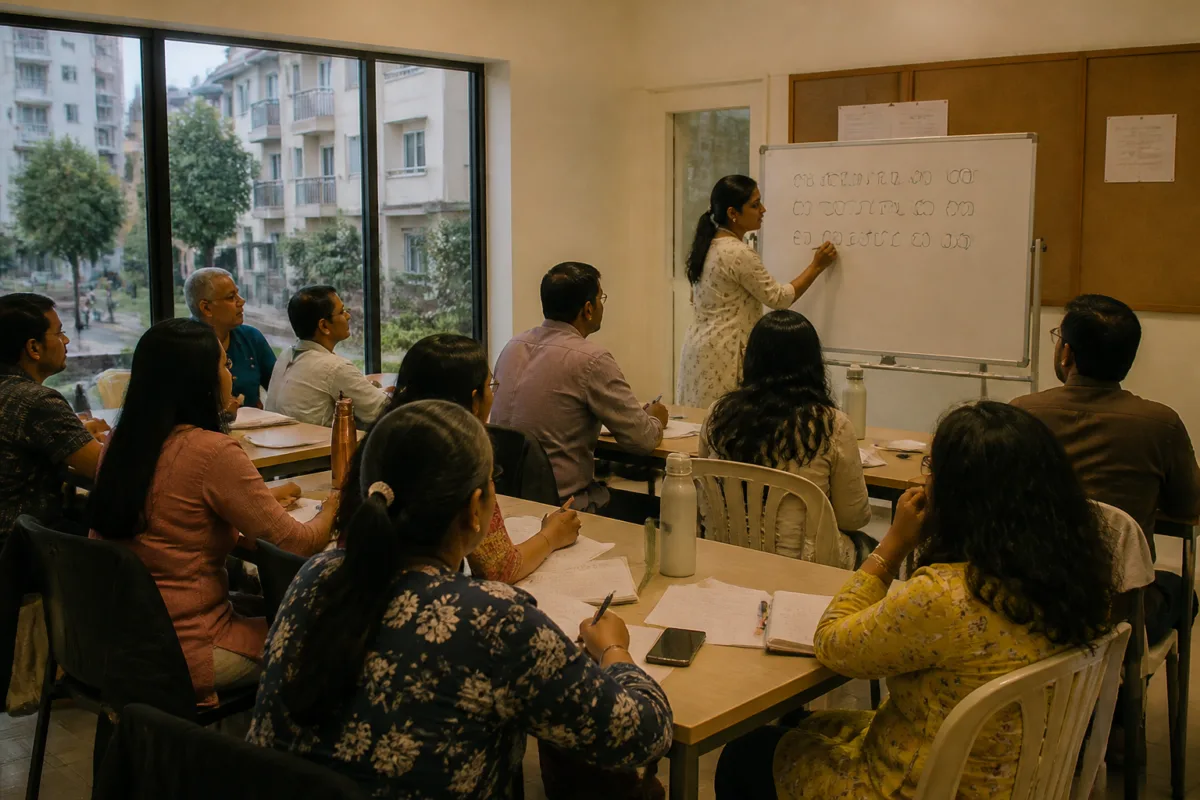
Across Bengaluru, free Kannada classes are doing more than teaching vocabulary. In resident welfare association offices, apartment reading rooms, community halls and online groups, adults are learning how to speak with milk vendors, cooks, shopkeepers, neighbours and bus conductors. The activity is small in scale, but it reveals an important feature of a rapidly expanding city: belonging is often built through everyday exchanges rather than formal declarations of integration.
For Koramangala resident Shilpa John, learning Kannada has a practical purpose. Asking her milk vendor for two litres of milk or greeting her cook in the morning gives her a sense of progress. Her journey from “Kannada gottilla” to “Nanage swalpa Kannada gottu” has been measured through ordinary conversations rather than examinations. When she discusses the day’s meals with her cook, who prompts her when she struggles to find a word, the language becomes part of a daily relationship.
That experience is being repeated across Bengaluru’s apartment communities. The classes are organised by residents’ associations, volunteer teachers and community groups, with formats varying from structured grammar lessons to informal spoken-language sessions. Some begin with the Kannada script and sentence formation. Others focus on situations that new residents are likely to encounter: buying vegetables, reading signboards, speaking to service workers or managing a short exchange with a neighbour.
The diversity of these programmes reflects the diversity of the city itself. Manisha Arora, who speaks Punjabi and grew up in Kolkata, has enrolled in a free Kannada programme conducted by Makaranda in collaboration with the Bangalore Apartments’ Federation. She describes the interactive sessions as enjoyable and engaging. The programme is one example of how the city’s apartment networks are becoming spaces not only for housing, but also for cultural contact and local orientation.
Bengaluru’s private residential developments bring together people from different states and language backgrounds. Shriram Sameeksha Apartments in Jalahalli, for instance, is home to residents from Bihar, Uttar Pradesh and Kerala, and has held free Kannada classes for non-Kannada speakers. In such settings, the question is not simply whether residents can access a lesson. It is whether the places where they live can help them build relationships with the city beyond the boundaries of their own community.
Pai Layout Residents’ Welfare Association offers a clear example of how a local institution can create that opportunity. It began free spoken Kannada classes at its RWA office in 2025. The first class attracted participants ranging in age from six to 90. The weekly one-hour sessions, held every Sunday from 4pm to 5pm, have reached their 19th session. The current batch has more than 50 students, according to association secretary Subramanian NH, and a new beginners’ batch is planned for January 2027.
The scale is modest, but the model matters because it uses existing neighbourhood infrastructure. An RWA office, reading room or community hall can become a low-cost learning space without requiring a new institution. The same network that manages maintenance, notices, festivals and resident communication can also support language access. This gives apartment communities a role in urban life that extends beyond the administration of buildings.
The programmes also show that language learning is not a single activity with a uniform method. Some learners want to understand grammar and sentence structure. Others need only enough spoken Kannada to manage daily interactions. Corporate workshops compress the basics into a few weeks, while volunteer teachers often combine vocabulary with humour, food references and local expressions. Digital platforms widen the reach further through short videos, daily-word posts, pronunciation lessons and conversational exercises.
Instagram pages, YouTube channels such as bfluent, Shashi’s Pathshala and Learn Kannada Online, as well as Telegram and WhatsApp groups, allow learners to practise outside a classroom. Voice notes can be exchanged, phrases can be repeated and lessons can begin before a person moves to Bengaluru. This makes language learning more flexible for residents whose working hours, travel patterns or family responsibilities prevent them from attending a fixed weekly class.
But access to lessons does not guarantee fluency. Learners face difficulties with pronunciation, vocabulary retention and tense variations. Regional language influences can shape how sounds are produced, while differences in usage and slang can make classroom Kannada feel different from the language heard on the street. Some Kannada sounds are difficult to represent distinctly in English, contributing to pronunciation errors, a volunteer associated with Makaranda told the Times of India.
Attendance is another practical challenge. Makaranda runs a three-to-four-month course consisting of 24 lessons held twice a week. A volunteer said that 50% to 60% of students successfully complete the course and receive certification. The same volunteer estimated that around half of the participants are serious learners, while about 10% seek only limited, everyday conversational skills. These figures suggest that the demand for classes is not identical to the demand for formal certification.
The distinction is important because many learners measure progress through use rather than completion. A conversation with a shopkeeper, a greeting to a domestic worker, or an attempt to read a signboard can provide immediate confirmation that a lesson has become useful. Teachers encourage learners to practise with shopkeepers, neighbours and public-facing workers, learn the names of vegetables and watch Kannada films with subtitles.
Sumi Anurag, a Kannada teacher at Prestige Jindal City in Nagasandra, says learners build confidence when they practise beyond the classroom. Her approach treats language as a social skill tied to the physical routines of the city. The places where people buy food, wait for transport, meet neighbours and manage household work become informal classrooms. This connects language acquisition to the way Bengaluru actually functions at street level.
The relationship works in both directions. For learners, speaking Kannada can reduce the distance between their homes and the wider city. For the people they encounter, a resident’s attempt to use the local language can make an interaction more reciprocal. The source report describes learners as feeling less like strangers after successful conversations with bus conductors, vegetable sellers or neighbours. These exchanges do not erase differences in class, occupation or origin, but they can create a shared everyday vocabulary.
Apartment communities have also used language learning to connect with local cultural events. Deepa Annigeri, who teaches free spoken Kannada classes in the reading room of Mantri Greens Apartment in Malleswaram, saw her second batch of students present a Kannada skit during the complex’s Rajyotsava celebrations in 2025. She has since started a third batch for residents of the complex.
The skit demonstrates how a language class can move from instruction to participation. Students are not only memorising phrases; they are using Kannada in a public setting within the community where they live. For Annigeri, the classes provide an opportunity to share local culture and bring neighbours together. She describes learning as involving both necessity and the pride of respecting and speaking the language of the place where residents live.
This community-driven ecosystem does not replace formal language education or public services. The supplied report does not establish how many such classes operate across Bengaluru, how many residents participate in total, or whether the programmes are connected to any city-wide policy. It does, however, document a distributed pattern in which residents’ associations, apartment federations, volunteer teachers and digital platforms are responding to a common urban condition: people live close to one another while often lacking a shared language for daily interaction.
That condition is likely to remain visible in Bengaluru’s apartment-led expansion. New residents may arrive with professional networks, digital services and private communities already available to them, but everyday city life still depends on interactions that cannot always be mediated by technology. Buying groceries, speaking with building staff, taking a bus or asking for directions requires contact with people outside one’s immediate residential or professional circle.
The Kannada classes therefore raise a larger question about what residential communities are expected to do. They are traditionally associated with maintenance, security, parking, repairs and internal rules. In these examples, they also function as spaces for social learning and local participation. Their contribution is not measured only by the number of students who complete a course, but by whether residents gain the confidence to use the city more openly.
The evidence available in the report remains community-level rather than city-wide. It confirms active programmes, specific participation numbers, teaching formats and learner experiences, but it does not establish their total reach or long-term outcomes. What it does show is that language access can grow through small institutions embedded in neighbourhood life. In Bengaluru, a weekly class, a reading-room lesson or a voice note shared online can become a practical bridge between the home residents have built and the city they are still learning to inhabit.

