


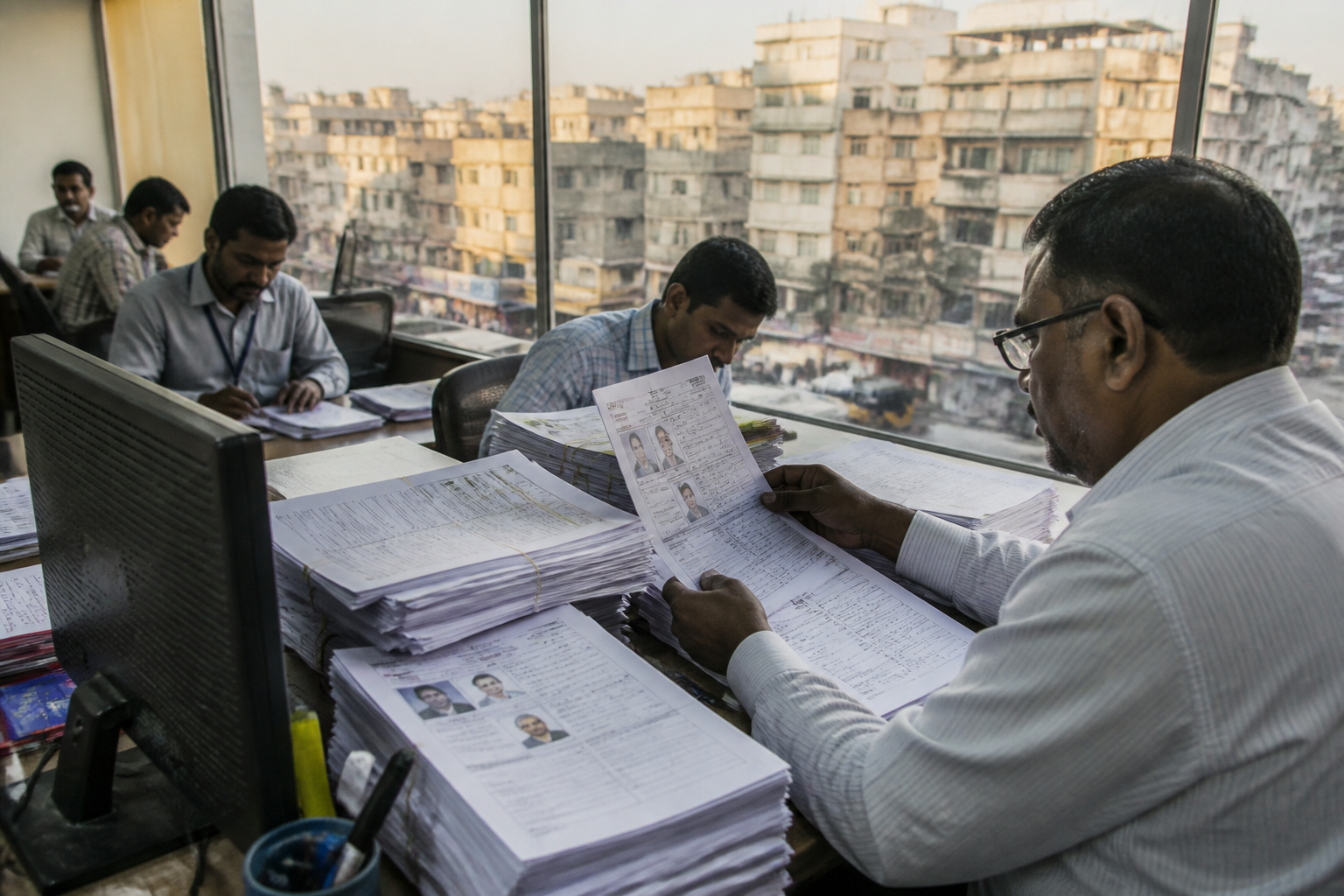
Concerns over alleged misuse of electoral forms during Telangana’s Special Intensive Revision process have turned a technical exercise in maintaining voter rolls into a wider test of administrative accountability. In Hyderabad constituencies including Musheerabad and Bahadurpura, allegations that Form 7 applications were submitted without voters’ knowledge raise a basic question about the city’s democratic infrastructure: can a citizen’s name be removed from the electoral roll without a process that is visible, verifiable and capable of correction?
The issue matters because electoral rolls are not merely administrative databases. They determine whether residents can exercise a constitutional right at the polling station. A person whose name is missing may have no practical opportunity to challenge the deletion on election day. The problem is therefore not limited to inaccurate records. It concerns the relationship between the state and the urban citizen, particularly in large constituencies where officials must manage high volumes of applications, frequent migration and changing addresses.
The account published by Telangana Today, written by Dr Arroju Srinivas, describes allegations that Forms 6, 6A, 7 and 8 intended for enrolment, overseas registration, deletion and correction were being misused. The article alleges that pre-printed Form 7 applications containing names and addresses were submitted in several Hyderabad constituencies. It further claims that applications were directed at voters associated with a particular community or political party. These remain allegations in the source material, but they identify a vulnerability in a system that depends on applications, declarations and field verification.
Form 7 exists for legitimate reasons. A voter’s name may need to be removed after death, relocation or the discovery of a duplicate entry. Form 6 is used for new enrolment, while Form 6A concerns overseas Indian electors. Form 8 is used for corrections and changes. The administrative purpose of these forms is to keep the roll accurate. The concern described in Telangana is that the same mechanisms can become instruments of exclusion if false information is accepted, if applications are processed in bulk without adequate scrutiny, or if the affected voter learns of the deletion only at the polling station.
That distinction between correction and exclusion is central. Electoral-roll revision is necessary in any growing city. Hyderabad has residents who move between neighbourhoods, rental homes and districts, while records may contain duplicate or outdated entries. A functioning system must remove ineligible or duplicate names without removing eligible voters. The difficulty lies in ensuring that speed and digitisation do not replace the human checks required to establish whether a person actually lives at an address and whether the application reflects that person’s circumstances.
The source article refers to observations by the Telangana High Court questioning how a voter’s name could be deleted without prior notice or an opportunity to respond. It also states that a sitting judge received such a notice, presenting the episode as an illustration of weaknesses in the process. The court’s reported position places procedural fairness at the centre of the dispute. Notice is not a minor administrative formality: it gives the affected voter an opportunity to contest an error before the deletion becomes an obstacle to voting.
The reported court intervention also highlights the limits of treating electoral management as a purely technological exercise. The article says that reliance on technology and artificial intelligence without field-level verification could place genuine voters at risk. Digital systems can identify patterns, process applications and flag anomalies, but they cannot by themselves establish whether a resident has died, moved, submitted an application or been targeted by a false declaration. Those questions require accountable officials and a documented chain of decisions.
The institutional responsibility is distributed. Booth Level Officers are the frontline link between the electoral roll and the neighbourhood. Supervising officers and the state election administration must ensure that applications are examined according to the applicable rules. The Election Commission is responsible for maintaining the integrity of the electoral process, while courts can intervene when procedural safeguards are alleged to have failed. The source reports that Telangana’s Chief Electoral Officer, C Sudarshan Reddy, directed that criminal cases be registered against those providing false declarations, citing Section 31 of the Representation of the People Act, 1950, and Rule 20 of the Registration of Electors Rules, 1960. The article states that violations can attract imprisonment of up to one year.
That response is significant because it frames false applications as more than clerical mistakes. If a declaration is knowingly false, the issue moves from record maintenance to potential criminal liability. But enforcement after irregularities are identified does not answer the question of how many applications were accepted, how many voters were affected, or how quickly wrongly deleted names can be restored. The supplied material does not establish those numbers. It does, however, point to the importance of publishing clear records of complaints, inquiries, deletions, restorations and prosecutions.
The proposed safeguards in the article focus on the points where administrative design meets local reality. It calls for stronger Booth Level Officer systems and personal visits to applicants’ residences when Forms 6, 6A or 7 are received. It also suggests system-level flags for bulk Form 7 applications originating from a single internet protocol address or submitted by one person. Such flags would not, by themselves, prove wrongdoing. They could nevertheless identify patterns requiring human review before names are removed from the roll.
This is where the Hyderabad episode connects to a wider problem in urban governance. Cities increasingly use digital platforms to handle large public databases, from property records and welfare lists to transport permits and utility accounts. Digitisation can improve speed and traceability, but it can also make errors harder for ordinary residents to understand. A citizen may know that a vote has disappeared only after reaching a polling station, when the immediate remedy is difficult. The more consequential the database, the more important it becomes to provide advance notice, accessible appeals and rapid restoration mechanisms.
The article’s concern over Forms 6 and 6A also points to the risk of duplication and inaccurate enrolment. It alleges that ineligible individuals could be enrolled and duplicate votes created in different locations, diluting the representation of genuine voters. These claims are not quantified in the supplied material and should not be treated as an established finding. They do identify the two-sided challenge facing electoral administrators: preventing wrongful deletions while detecting duplicate or ineligible entries without using broad assumptions that place legitimate voters at risk.
A reliable electoral roll therefore depends on more than a database. It needs rules that are understood by applicants, local verification that can be audited, notices that reach affected residents and officials whose decisions can be identified. It also needs a correction process that works before an election, not only after a voter has been turned away. The source’s proposed reinstatement mechanism addresses this last gap, although the article does not provide details of an existing procedure or its processing time.
The reported High Court observations and the Chief Electoral Officer’s response establish the institutional outline of the problem, but several questions remain open. The supplied account does not state the number of Form 7 applications under scrutiny, the number of names deleted, the number restored, the constituencies covered beyond the examples cited, or the outcome of any criminal investigations. It also does not include the text of the court order or an official electoral-roll audit. Those details would be necessary to measure the scale of the alleged irregularities.
What the episode does establish is the need to treat electoral-roll management as a public-facing service with constitutional consequences. In a dense and mobile city, accurate records are difficult to maintain, but administrative difficulty cannot remove the requirement of notice and accountability. For Hyderabad’s voters, the practical test will be whether officials can verify applications before deletion, identify suspicious patterns without relying on automated decisions, and provide a simple route to restoration when an eligible citizen’s name is wrongly removed. The next developments to monitor are the implementation of the reported corrective measures, the handling of complaints and the findings of any official or judicial review.
