


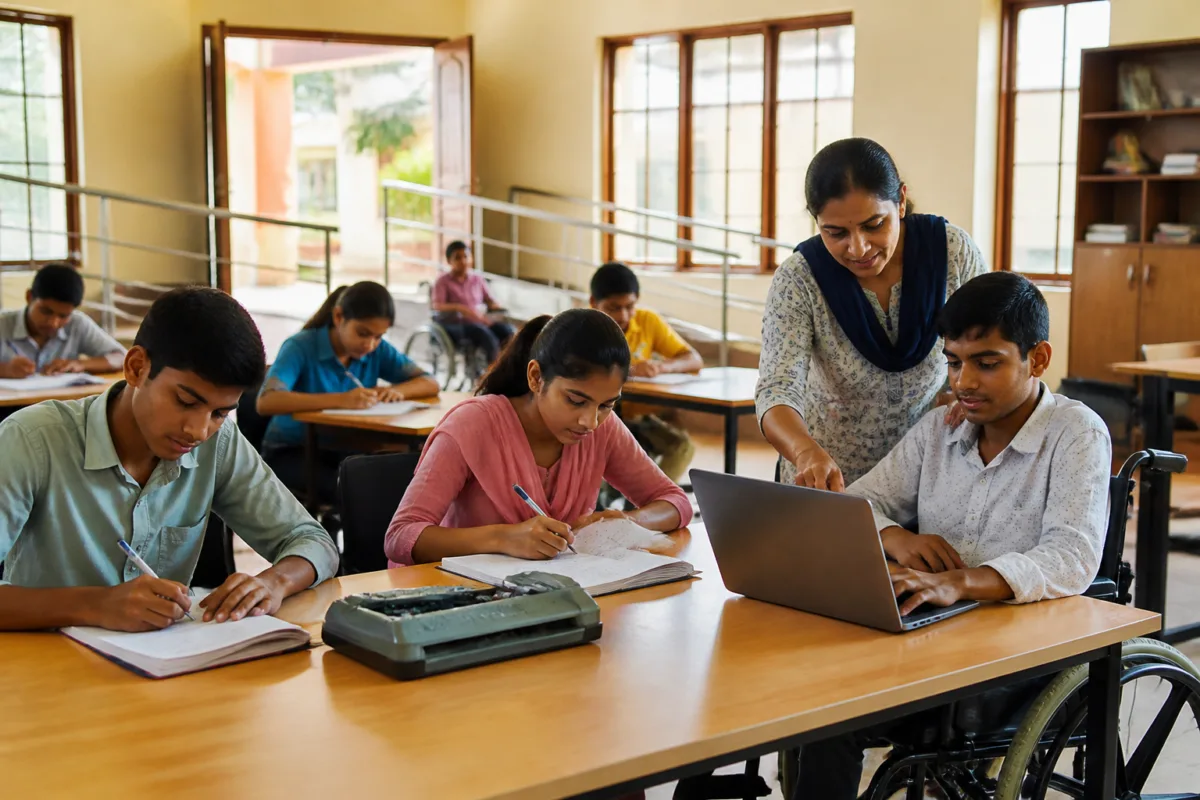
The Deepsthamb Foundation began with a simple but consequential observation: ambition was widely available, but the ability to pursue it was not. In 2005, while teaching at a competitive-exam coaching centre in Pune, Yajurvendra Mahajan saw students from poor backgrounds struggle with fees, food and cramped accommodation. He left his job, returned to Jalgaon and sold the house and farm he had inherited from his father to support 10 underprivileged students. All 10 cleared the Maharashtra Public Service Commission examination the following year and became Class I and Class II officers.
That first experiment has since developed into an educational and residential support network for persons with disabilities, orphans, transgender students and economically disadvantaged learners. The foundation now operates campuses in Jalgaon, Pune and New Delhi, alongside online programmes reaching students across 16 states. Its work illustrates a wider urban challenge: access to competitive education is shaped not only by classroom instruction, but also by housing, food, counselling, assistive technology, safety and the availability of institutions willing to support students through setbacks.
The foundation’s model is significant because it treats education as an ecosystem rather than a coaching service. Its Manobal programme provided Renuka Kekan, who is more than 80% hearing impaired, with three years of free accommodation, counselling, subtitled lectures and customised training. Kekan secured All India Rank 948 in the civil services examination and was described in the report as the first girl from her village or taluka in Akola district to achieve that result. Nineteen students from the same programme appeared on the Union Public Service Commission list.
Those outcomes are linked to a form of support that is often missing from mainstream education systems. A student may qualify academically but still be unable to continue because of inaccessible accommodation, lack of money, social isolation or discrimination during recruitment. The foundation’s residential campuses attempt to address these barriers together. The organisation says it accepts students from 14 of the 21 recognised disability categories and provides teaching, counselling, assistive technologies and employment support.
The need for such an arrangement becomes clearer through the experiences of students who reached the foundation after moving through several disconnected institutions. Rajesh Pille lost both arms as a child after an electric shock and lost his parents soon afterwards. He moved between an orphanage, a home for persons with disabilities and educational institutions before finding employment difficult despite completing a diploma and engineering education. He told the Times of India that employers rejected him without an interview. Through Manobal, he obtained a job in an IT solutions company in Pune and now works as a software engineer at Infosys.
Mauli Adkur’s experience shows a similar gap between educational achievement and employment access. Born without arms in Kolhapur, she was initially not expected to attend school. After completing a diploma in information technology and graduating, she was repeatedly denied employment. She eventually trained for government examinations at the Jalgaon campus and secured a junior clerk position with Solapur Municipal Corporation in January 2025, after four practical demonstrations of her skills.
These cases show that the barriers faced by disadvantaged students do not end when a person enters school or completes a qualification. They continue through recruitment, workplace access and the social assumptions attached to disability. The foundation’s role therefore extends beyond examination preparation. It provides a temporary but comprehensive institutional environment in which students can study, live safely and prepare for public or private employment.
The organisation’s expansion also reflects the geography of opportunity. It began in Jalgaon, where Mahajan set up the foundation formally in 2009 after initially operating through rented houses. In 2019, donations funded a Rs 20 crore accessible residential campus in the city. A Pune branch was opened in 2019, while a Delhi branch in Mukherjee Nagar was established last year, according to the report. The campuses currently accommodate about 600 students, while online courses extend the programme beyond the cities where the foundation has physical facilities.
This spatial pattern matters. Competitive-exam preparation is concentrated in urban centres, but many students who seek access to it come from villages and smaller towns. Relocating to cities brings additional costs and risks, including rent, food, transport and the need to navigate unfamiliar environments. For students with disabilities, the challenge includes accessible buildings, suitable communication systems and support workers. A residential institution that combines these facilities reduces the number of separate arrangements a student must make before studying can begin.
The foundation also supports students whose exclusion is not captured by disability or poverty alone. Veena Kashid, a transgender woman who had cleared examinations but was fighting a legal battle over her appointment as a police sub-inspector, described the Jalgaon campus as a safe place where she could study without worrying about accommodation, food or money. She later cleared another government examination and works as an electrical instructor in the state government’s skill entrepreneurship department.
Kashid’s experience points to the importance of institutional belonging. A student may possess the educational qualifications required for public employment but still face exclusion because of gender identity, disability or social prejudice. In such cases, a campus functions not only as a classroom and hostel, but also as a protective social environment. The foundation says it teaches students to move beyond caste, religion and gender divisions, while accepting donations without affiliation to political parties or socio-cultural bodies.
The organisation’s programmes also include support beyond formal qualifications. Thanya Nathan, who is set to become Kerala’s first fully visually challenged woman judge, said the foundation’s Parivartan programme helped her through yoga and motivational reading. The foundation has also arranged marriages for some former students and maintains contact with women who return to the Jalgaon campus twice a year for three days. These activities indicate how the institution has assumed roles usually associated with family networks, especially for students who are orphans or have faced rejection from their communities.
This broader support comes at a measurable cost. Mahajan said the foundation spends almost Rs 2 lakh per student each year, covering food, accommodation, technology and teaching. He also said staff are paid well so that students are not treated as charity cases. The distinction is important: a charity model can provide temporary relief, while a professional residential institution requires recurring funding, trained staff and reliable infrastructure.
The foundation’s finances are based on donations. Its accessible Jalgaon campus was built through Rs 20 crore in donations, and the organisation continues to operate campuses and programmes through this funding model. That structure enables services that may not be available through ordinary coaching centres, but it also means the scale of support depends on sustained institutional and public contributions. The report does not establish the foundation’s total annual budget, the number of students who apply each year or the proportion of applicants who receive support.
The account also reveals the limits of individual institutions in addressing structural exclusion. Deepsthamb can provide accommodation, training and employment connections to hundreds of students, but it cannot by itself change how every employer evaluates disability, how accessible public buildings are or how government appointments are processed. Kashid’s continuing legal battle over a police appointment, and Adkur’s need to demonstrate her abilities repeatedly before securing a municipal job, show that educational success does not automatically produce equal access to public employment.
The foundation received the National Award for Best NGO for Empowerment of Persons with Disabilities in 2023, according to the report. Its work has also gained recognition through the achievements of students who have entered civil services, municipal administration, engineering, teaching and other professions. Yet the evidence supplied does not establish how many students have completed the programmes, how many have secured jobs or how outcomes compare across disability categories and locations.
That missing information is important for understanding the model’s wider applicability. The foundation’s experience demonstrates that inclusive education requires more than ramps or technology. It involves a connected chain of services: accessible housing, customised teaching, counselling, financial support, social acceptance and fair recruitment. If any link is absent, students may remain excluded despite having the ability to succeed.
The central urban question is therefore not simply whether disadvantaged students can reach coaching institutions. It is whether cities and public institutions are organised to allow them to remain, study, work and live independently once they arrive. Deepsthamb’s campuses provide one privately funded response by bringing multiple forms of support into the same institutional setting. The experiences of its students show both the possibilities of that model and the continuing barriers outside it.
Mahajan continues to live in rented accommodation with his wife and two school-going children and told the Times of India that he wants to help at least one crore children before he dies. The foundation’s next phase will depend on the expansion of its campuses and online programmes, the continuity of donations and the ability of public and private employers to convert educational achievement into equal opportunity. The available account confirms the value of an integrated support system, while leaving its long-term scale, finances and outcomes to be examined through further evidence.

