


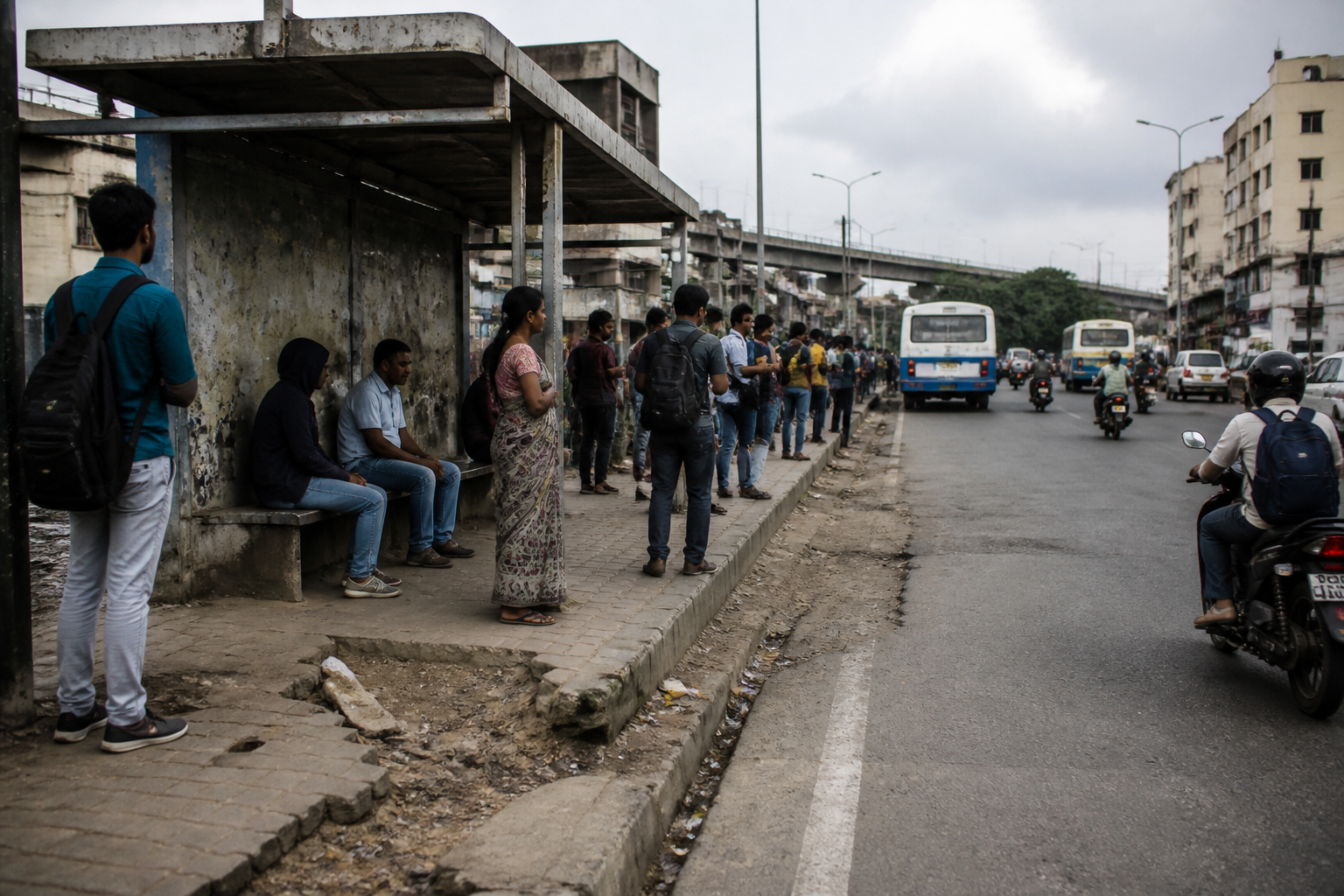
A bus-stop audit on Bengaluru’s Hosur Road has found widespread gaps in pedestrian access, passenger information, safety and maintenance across 16 locations on the six-kilometre stretch from Shoolay Circle to Silk Board.
The assessment by the Bangalore Political Action Committee (B.PAC) found that 14 stops had shelters, while two had none. Poor or damaged pavements were recorded at 88% of the locations, and 94% had inadequate signage, making it difficult for passengers to identify stops and reach boarding points safely.
The audit examined accessibility, passenger comfort, passenger information, safety and security, and maintenance. It found that only 31% of the stops provided route and timing information, while 44% had real-time estimated time of arrival displays. Just 13% of the locations were clean and the same proportion had waste bins.
The findings also pointed to broken footpaths, high kerbs and uneven level transitions near boarding areas. Some locations appeared to function as informal stopping areas or serve private buses without clearly marked waiting spaces. Shelters were reported to have dirty surfaces, deteriorating information boards and inadequate waste management.
Revathy Ashok, managing trustee and chief executive officer of B.PAC, said the audit showed that infrastructure along one of Bengaluru’s busiest public transport corridors remained fragmented, particularly at the point where pedestrians connect with buses. She said the assessment found inadequate seating and waiting areas, poor pedestrian approaches, limited stop identification and route information, insufficient lighting and CCTV, and gaps in cleanliness and maintenance.
Ashok also linked the bus-stop findings to an accessibility audit by B.MOBILE, which identified footpath continuity problems across all 12 audited segments and recorded more than 200 deficiencies. According to her, the combined findings showed that a bus stop was not functioning as a continuous, accessible part of the public transport journey when walking, waiting and boarding were treated separately.
The safety gap has also affected first-mile connectivity. Ashok said B.MOBILE observed that first-mile pickups fell by around 30% after 7 pm at locations where poor lighting and a lack of passenger information made commuters feel unsafe while waiting. She specifically cited the difficulties faced by women carrying bags, senior citizens and students travelling at night.
B.PAC has recommended that authorities combine small shelters serving the same location into larger structures with continuous weather protection, comfortable seating, leaning rails, lighting, route maps, BMTC stop identification and real-time arrival information. It has also called for obstruction-free footpath connections, tactile paving, accessible kerb ramps and marked boarding zones.
The recommendations include using solar panels to power lighting and passenger information systems. The report said bus stops should be planned as connected parts of an accessible journey rather than as isolated structures beside the carriageway. It did not identify a specific implementation timeline or assign individual recommendations to particular agencies in the material reviewed.
