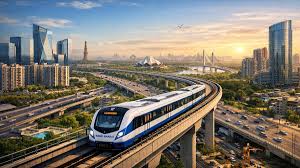
A proposed high-speed regional rail link connecting Gurugram, Faridabad and Noida is moving closer to execution, signalling a major shift in how commuters navigate the National Capital Region. The Haryana government has cleared the alignment for the Gurugram Noida RRTS corridor, a project expected to significantly reduce travel time while easing pressure on Delhi’s overburdened road network. For a region grappling with congestion, air pollution and uneven urban growth, the project could alter both mobility patterns and land use.
Planned as a 64-kilometre corridor with multiple stations across Haryana and Uttar Pradesh, the line is designed to support semi-high-speed trains alongside metro-style services. This hybrid approach aims to maximise capacity while keeping costs and land acquisition within limits. Transport planners note that such integration could improve first- and last-mile connectivity often a weak link in large transit systems if supported by local feeder networks and pedestrian-friendly infrastructure. The most immediate impact will likely be on travel time reliability. Journeys that currently stretch beyond an hour due to traffic bottlenecks could be reduced to under 45 minutes, offering predictability for daily commuters. For working professionals and service sector employees who move between Gurugram’s corporate hubs and Noida’s technology clusters, the Gurugram Noida RRTS corridor promises a more stable and time-efficient alternative to private vehicles.
However, mobility experts caution that speed alone does not guarantee sustainability. The corridor’s long-term value will depend on how well it integrates with existing metro lines, bus systems and non-motorised transport. Without coordinated planning, high-speed corridors risk becoming isolated transit islands rather than catalysts for low-carbon urban mobility. Ensuring seamless interchange points and safe access for pedestrians and cyclists will be critical. The economic implications are equally significant. Improved connectivity between key industrial and commercial zones could unlock new development corridors, particularly along underutilised stretches such as the Faridabad–Noida belt. Real estate analysts anticipate rising land values near proposed stations, but urban economists warn that unchecked speculation could widen affordability gaps unless accompanied by inclusive housing policies.
Environmental considerations also remain central. By shifting a portion of daily commuters from cars to electrified rail, the project has the potential to reduce vehicular emissions across NCR. Yet, construction-related impacts and increased urbanisation along the corridor will require careful mitigation through green building norms, transit-oriented development, and preservation of ecological buffers. With the detailed project planning phase underway and construction targeted within the next few years, the corridor represents more than a transport upgrade. It reflects a broader test for NCR’s ability to align infrastructure expansion with climate resilience and equitable urban growth. The coming decade will reveal whether such large-scale investments can deliver not just speed, but a more balanced and sustainable urban future.