


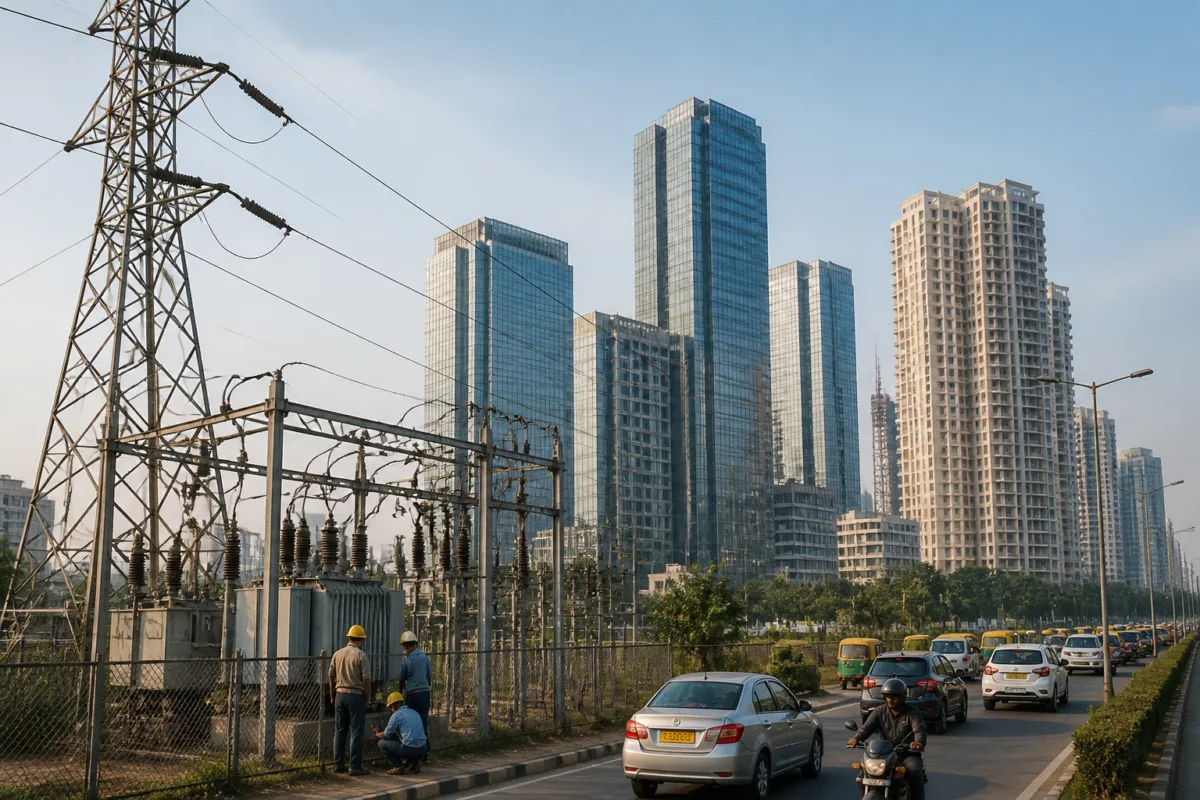
The halt to a proposed private power distributor in Gurugram and Nuh has exposed a fundamental conflict in Haryana’s electricity policy: whether public interest is best served by protecting state-run discoms from revenue and labour risks, or by allowing competition to challenge their territorial monopolies and address service backlogs.
The Haryana Electricity Regulatory Commission had granted Eleven Power Private Limited a 25-year distribution licence on October 19. Nine days later, the process was stopped after the state Energy Department issued binding directions under Section 108 of the Electricity Act, 2003. The regulator subsequently decided “not to proceed further” with rolling out the licence, rejecting the company’s request for a hearing.
The immediate dispute is about one licence, but the regulatory record shows that the decision raises a wider question about how electricity reform should work in rapidly urbanising districts. Gurugram is one of Haryana’s most economically important urban centres, with a large concentration of commercial, residential and industrial consumers. Nuh, by contrast, has different levels of infrastructure and service access. A single distribution decision for both districts therefore carries implications for the way electricity networks, consumer choice and public utility obligations are balanced across unequal urban and regional markets.
The initial approval followed an extensive examination. The official record ran to about 800 pages and included HERC’s 457-page approval order and a 282-page report by an Independent Expert Committee headed by retired senior IAS officer Alok Nigam. The committee considered parallel licensing under the Electricity Act as a mechanism for ending territorial monopolies, enabling consumer choice and addressing the state’s chronic electricity connection backlog.
That reasoning treated competition as a potential public-service instrument rather than merely a commercial opportunity. The committee held that public interest could not be reduced to protecting the commercial comfort of the incumbent utility. It also noted that consumer migration and the resulting effect on discom revenues were foreseeable consequences of market entry. In its view, those effects could be addressed through regular annual tariff revisions rather than by preventing a new distributor from entering the market.
The committee also rejected claims made by power employee unions under Section 133 of the Electricity Act. According to the report described in the regulatory record, the service protections under that provision applied to utility restructuring and not to competition between distributors. This distinction mattered because employee organisations argued that a parallel distributor could threaten government jobs and weaken the state electricity utility.
The evidence cited by HERC included a substantial backlog of pending electricity connections. Official records showed that, as of October 2025, 1.29 lakh applications involving a combined load of 2,412.95 MW were pending across Haryana. The backlog had remained virtually unchanged over the previous six months. The regulator treated timely access to an electricity connection as an essential service and considered alternative supply arrangements relevant to resolving that problem.
The state government adopted a different definition of public interest. Its Energy Department told HERC that the government was “gravely concerned” about the effect of a parallel licence on consumers and the broader public interest. It directed the commission “not to create, operationalise or effectuate a parallel distribution licence anywhere in the State of Haryana”. The direction was approved by Chief Minister Nayab Singh Saini and followed a state-wide strike by power utility employees.
Section 108 gives state governments the power to issue binding directions to electricity regulators on policy matters involving public interest. Section 108(2), as noted in HERC’s order, makes the state government’s assessment of what constitutes public interest legally final. That provision shaped the outcome: once the government issued its direction, the commission concluded that it had no remaining adjudicatory exercise to undertake.
This arrangement places the regulator between two forms of authority. HERC assessed whether Eleven Power met the requirements for a distribution licence and considered the implications of competition. The state government then used a statutory policy-direction power to stop the process on grounds that included employee unrest and the possible loss of high-paying consumers from state-run discoms. The reversal therefore was not simply a technical reconsideration of the licence. It was an assertion of executive policy authority over the direction of electricity-market reform.
The financial concern is central to the government’s position. If large commercial or industrial consumers moved to a new distributor, state discoms could lose some of their higher-paying customers while continuing to carry network, staffing and service obligations. The source material does not establish the projected scale of such migration or quantify the expected revenue loss. It does, however, show that protecting discom finances was one of the reasons cited for halting the rollout.
The regulatory record presents the opposite concern: an incumbent utility cannot use the possibility of losing customers as a reason to prevent market entry. That argument is particularly important where service performance is uneven or where connection applications remain pending for long periods. The 1.29 lakh pending applications are not proof that a private distributor would necessarily solve the backlog, but they explain why HERC and the expert committee treated alternative supply as a relevant public-interest issue.
For consumers, the immediate outcome is the continuation of the existing distribution arrangement in Gurugram and Nuh. The source does not establish any immediate change in electricity tariffs, supply schedules or connection procedures following the halt. It does establish that the proposed alternative distributor will not be rolled out under the licence approved on October 19 unless the decision is changed through a legal or administrative process.
The dispute also shows how labour mobilisation can influence infrastructure policy. Power employee unions argued that the private licence could draw consumers and revenue away from the state utility and threaten government employment. After the halt, union leader Subhash Lamba described the decision as a “historic and unprecedented victory” for the strike and said the joint front would intensify its campaign against other proposed changes, including the listing of power corporations on the stock market, smart metering and the establishment of an Agri DISCOM.
Eleven Power has indicated that it will pursue remedies available under law. A company spokesperson said the firm continued to hold the commission and state government in high regard, while maintaining that Gurugram and Nuh deserved reliable power and consumer choice. The company also said its investment commitment to the two districts remained unchanged. The source does not provide details of the proposed investment, the company’s planned network or the legal forum and timeline for its appeal.
The larger policy question is not simply whether Haryana should have a private distributor. It is whether the state’s electricity system can pursue competition, protect public utility finances, maintain employee protections and clear service backlogs through the same institutional framework. The initial approval and subsequent halt offer sharply different answers to that question, each relying on a different understanding of public interest.
What the record confirms is that the licence was approved after a detailed regulatory and expert examination, then halted through a binding state policy direction issued nine days later. What remains unresolved is whether the government’s decision will withstand the company’s legal challenge, whether the connection backlog will decline under the existing distribution structure, and how Haryana will address the financial and labour concerns that accompanied the proposed market opening. Those developments will determine whether the Gurugram case remains an isolated reversal or becomes a wider test of electricity-sector reform in the state.

