


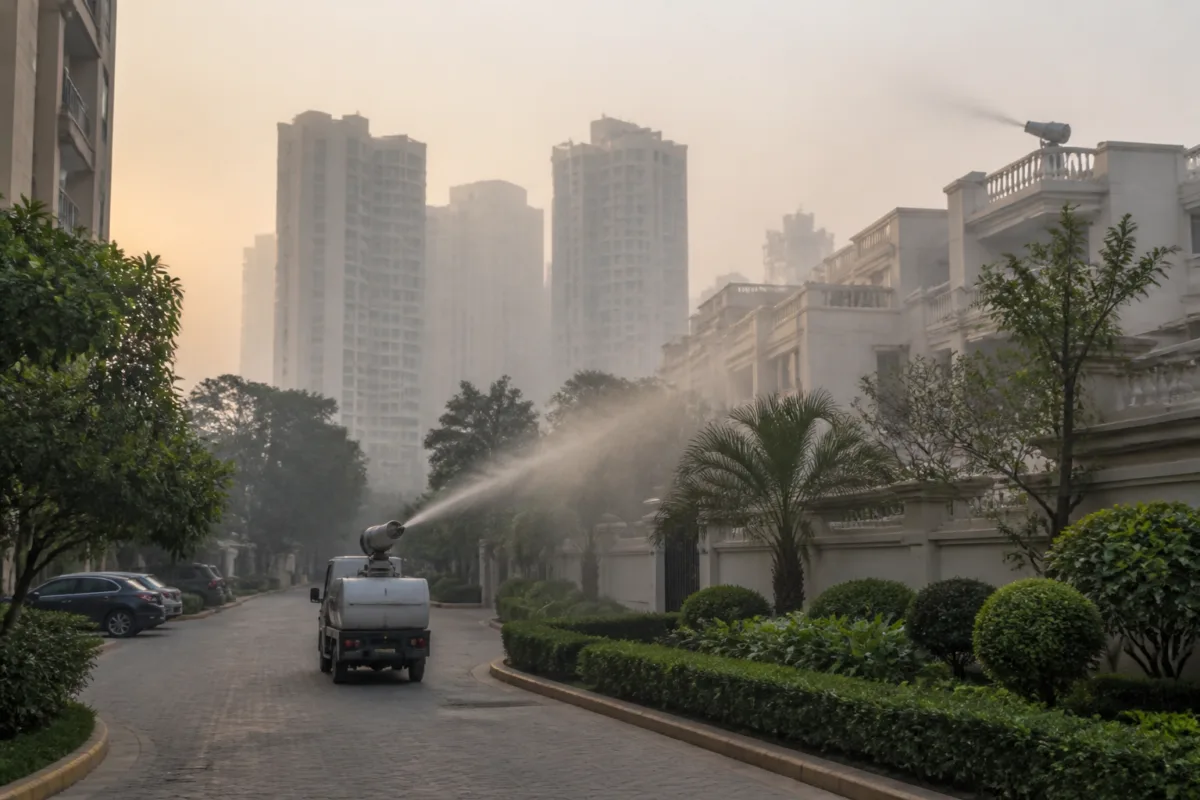
Gurugram’s pollution fight is increasingly being conducted behind the gates of private housing societies, where residents and management bodies are deploying anti-smog guns, sprinklers, misting systems and mechanised sweepers to make enclosed spaces more liveable. The measures show how wealthy residential complexes are responding to deteriorating air quality, but they also reveal a larger urban problem: private control over internal roads and landscapes cannot address pollution generated across the wider city.
The urgency is clear in the air-quality readings cited in the report. According to Central Pollution Control Board and Haryana State Pollution Control Board data, Gurugram recorded a 24-hour average Air Quality Index of 345 on November 7, 288 on November 8, 345 again on November 9 and 324 on November 10. These readings kept the city in the ‘poor’ to ‘very poor’ range, making outdoor activity difficult even for residents living in high-value developments with extensive internal amenities.
The response from these societies has been shaped by their physical form and their ability to mobilise private funds. In Sector 48, Central Park Resorts, where four-bedroom apartments are reported to cost more than Rs 20 crore, water is being sprayed through auto-rickshaws and e-rickshaws fitted to release fine mist. Anti-smog guns have also been installed on building rooftops and are being operated for 15 minutes every hour from 4 am after pollution levels increased.
These interventions are not uniform. They vary according to the design of each complex, the resources available to its residents’ welfare association or management, and the pollutants that the society is attempting to control. Sprinklers and misting systems can wet exposed surfaces and may help reduce locally generated dust. They cannot, however, filter the regional air entering a housing complex or remove pollution produced by traffic, construction and open areas beyond its boundary.
Rising Homes in Sector 92 illustrates how such measures can become part of a society’s long-term infrastructure. The residents’ welfare association spent Rs 2.5 lakh four years ago to connect the sewage treatment plant to a sprinkler network. The treated water is used for spraying across the complex, and the duration of spraying was increased by two hours after Diwali. The arrangement links two urban systems—wastewater treatment and dust management—but its effectiveness depends on how much pollution is generated inside the premises and how much arrives from outside.
At Vipul Greens on Sohna Road, where four-bedroom homes are reported to cost around Rs 4.5 crore and larger apartments up to Rs 8 crore, the response includes anti-smog guns, rooftop sprinklers and dust-compression units around trees. Sprinklers have reportedly been operating throughout the day since Diwali. DLF City, covering Phases 1 to 4, has set aside a winter pollution-control budget, deployed mechanised sweepers to remove dust and silt from roads, and combined water spraying with monitoring of dust-control measures at construction sites and open waste burning.
Taken together, these examples point to a form of fragmented environmental governance. The housing society is responsible for its internal roads, landscaped areas and common facilities. Municipal and regulatory agencies, meanwhile, have responsibility for public roads, construction activity, waste management and broader pollution control. The boundary between these systems matters because the measures that can be implemented inside a gated complex are not available in the same way across the city’s public realm.
The distinction is especially important in Gurugram, where residential developments exist alongside major roads, construction sites and open tracts of land. A society can deploy a vehicle to spray water within its compound, but it cannot control dust from an adjoining road unless the responsible agency acts. It can monitor construction within its premises, but it cannot directly enforce dust-control requirements at every external site. It can discourage open waste burning inside its boundary, but it cannot prevent the practice elsewhere.
This creates a two-level experience of the same air-quality crisis. Within a well-funded society, residents may encounter wet roads, misting vehicles, rooftop equipment and mechanically swept surfaces. Outside the gates, they remain exposed to the citywide conditions reflected in the AQI readings. The contrast is not evidence that private measures are irrelevant. It shows that their reach is spatially limited and that the quality of protection available to residents can depend on the financial capacity of the neighbourhood in which they live.
The use of sewage treatment plant water for sprinkling also highlights an institutional question about urban resource management. Reusing treated water for dust suppression can reduce the need for fresh water, but the report does not establish the quality standards, monitoring arrangements or volumes involved in these individual systems. What it does establish is that societies are attempting to connect existing utility infrastructure to an immediate environmental need rather than relying only on standalone pollution-control equipment.
The reported spending patterns reveal another difference between private and public responses. Rising Homes invested Rs 2.5 lakh in a sprinkler network four years ago, while DLF City has created a seasonal budget for mechanised sweeping, water spraying and monitoring. At Central Park Resorts, anti-smog guns and misting vehicles are being used as pollution intensifies. Such spending may be possible in developments with high property values and organised management structures, but the report provides no indication that comparable arrangements exist across all housing societies or lower-income neighbourhoods.
That gap is central to understanding the urban significance of these measures. Pollution is experienced collectively, but mitigation capacity is distributed unevenly. A private society can improve conditions on its internal roads, yet the city’s air remains connected across property boundaries. The AQI does not stop at a gate, and neither do emissions from traffic, construction or open burning. The private response therefore operates as a local buffer rather than a citywide solution.
The report also records a behavioural consequence of the pollution episode: residents of expensive homes are avoiding outdoor walks and exercise. This matters because the presence of parks, landscaped areas and internal roads does not guarantee that these spaces remain usable during severe pollution. A residential complex may offer a high-quality public realm within its boundary, but poor air quality can reduce the practical value of those amenities.
For regulators and city managers, the examples underline the importance of distinguishing between dust suppression and air-quality improvement. Spraying and sweeping may address dust deposited on surfaces or generated by movement within a site. They do not resolve every source contributing to the city’s AQI. The report specifically notes that pollution from main roads, construction sites and open areas remains beyond the control of individual societies.
This is also why the private measures should not be read as proof that technology has solved the problem for those who can afford it. Anti-smog guns, misting systems and sprinklers are visible responses because they can be installed and operated within a defined property. Their presence may provide a sense of action, but their citywide effect is constrained by the sources that remain outside the property’s administrative control.
The evidence currently supports a narrower conclusion. Gurugram’s housing societies are taking increasingly elaborate steps to manage local dust and improve conditions within their compounds while the city continues to record poor and very poor air quality. These actions demonstrate organisational capacity and, in some cases, the reuse of treated water and mechanised maintenance systems. They also expose the limits of a governance model in which residents can protect private spaces but cannot independently manage the public infrastructure and external activities shaping urban air.
The next question is not whether private societies will continue deploying such measures, but how these fragmented efforts fit into the responsibilities of civic agencies and pollution-control authorities. The reported AQI readings, the continued avoidance of outdoor activity and the stated limits of internal interventions all point to the same unresolved issue: Gurugram’s pollution problem is larger than the boundaries of the societies trying to contain it.

