


A reported road-rage pursuit near Gurgaon’s Sector 70 has become more than a disturbing account of one couple’s journey home. It has exposed a chain of urban-safety gaps: a vehicle allegedly followed another car for nearly a kilometre, the occupants reportedly tried repeatedly to force it to stop, the vehicle’s number-plate details were disputed, and the matter reached the police only after dashcam and CCTV footage were shared publicly.
The incident took place at about 11:55 pm near Darbaripur Road on the Southern Peripheral Road, according to Navbharat Times – Gurgaon. Shubham Jain, who moved to Gurgaon around seven months earlier, said he and his wife were returning home when a Maruti Eeco began following their car. He later shared dashcam footage from his vehicle and CCTV footage from his residential society. The report said he posted about the incident on X five days after it occurred.
Jain’s account, as reported, describes a sequence that began with what he initially understood to be an attempt to overtake. He said the Eeco then moved ahead, braked suddenly and appeared to try to make his car stop. He increased speed and continued towards his society, while the other vehicle allegedly kept moving into his path and leaving little room to pass. The pursuit reportedly continued until the society gate.
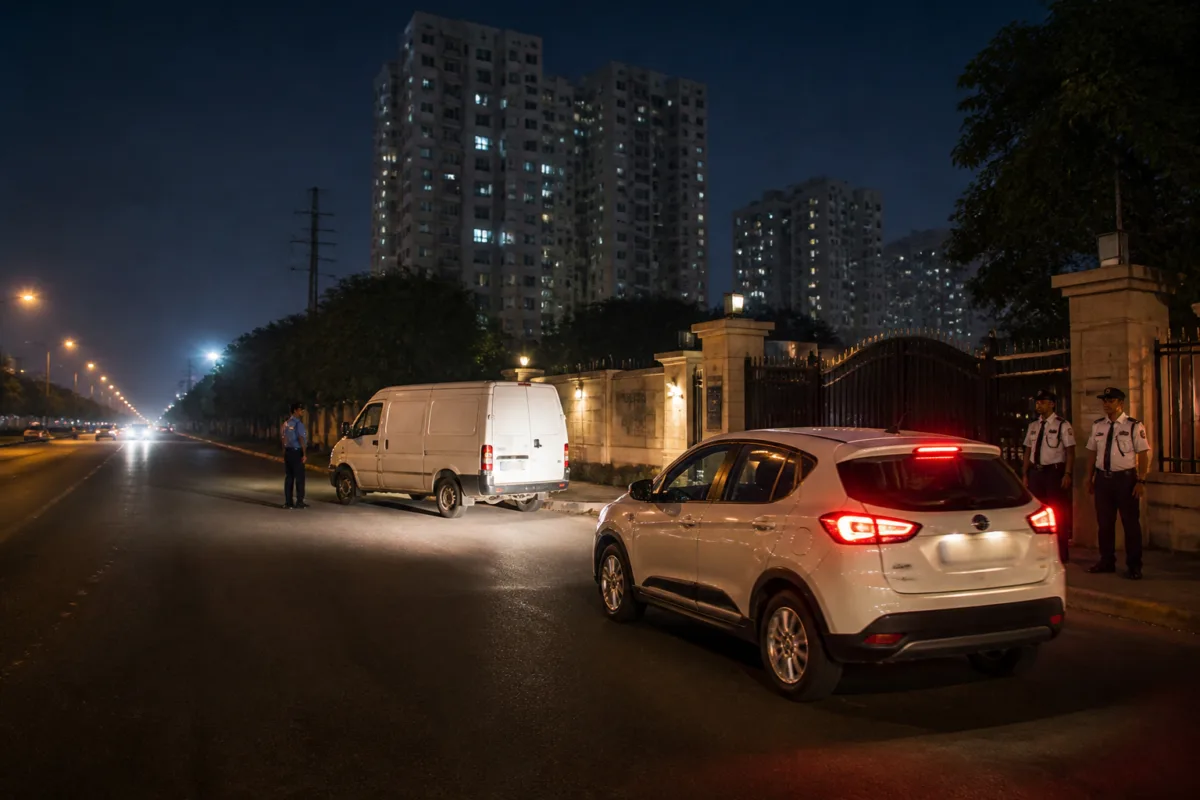
The details matter because the incident was not confined to a moving road. It extended into the interface between a public street and a privately managed residential entrance. Three guards at the gate reportedly intervened and stopped the Eeco from following the couple inside. CCTV footage was said to show one man getting out and arguing with the guards while Jain drove into the society. The report said the occupants remained at the gate for about 20 minutes and allegedly insisted on entering.
That transition from road to gate is an important feature of how safety is experienced in Gurgaon’s expanding residential districts. The account suggests that the society’s security team became the immediate barrier between the residents and the pursuing vehicle. But private guards are not a substitute for traffic enforcement, police visibility or a reliable process for identifying vehicles and suspects. Their role begins at the property boundary; the reported pursuit began on the road outside it.
The case also illustrates why video has become central to urban dispute reporting. Jain’s dashcam footage reportedly shows the Eeco overtaking his vehicle and attempting to block its path, while the society’s CCTV footage records the confrontation at the entrance. These recordings may help establish the sequence of events, but the report does not say that the footage has independently established the identities or intentions of the people inside the Eeco. The allegations therefore remain allegations, even as the police examine the matter.
Vehicle identification is another unresolved part of the case. Jain said the Eeco had no rear number plate and that the registration detail at the front was concealed. His post mentioned a person named Manoj Kumar and cited the registration number HR76D/0402, but the report said police had not established whether that number belonged to the vehicle visible in the footage. That distinction is central. A number visible in a video or supplied by a complainant cannot by itself establish ownership, unless investigators match it with the vehicle, registration records and other evidence.
Gurgaon Police responded to Jain’s post on X by seeking his contact details and complaint information. Jain later said that Badshahpur station house officer Manoj Kumar and head constable Samrita contacted him. Police spokesperson Sandeep Turan confirmed that the matter was being investigated. Jain, however, said he had decided not to file an FIR or submit a written complaint for personal reasons. The report does not provide a later police account identifying the vehicle or confirming that a criminal case had been registered.
This creates an institutional gap between public visibility and formal action. A widely circulated video can draw attention to an incident, but it does not automatically create a complete investigative record. Police still need a complainant’s account, footage in usable form, location and time details, witness statements, vehicle identification and an assessment of which provisions may apply. When the person involved chooses not to pursue a formal complaint, the ability of investigators to proceed may depend on the nature of the available evidence and the legal basis for taking action.
The reported decision not to file an FIR also shows the limits of measuring urban safety through crime statistics alone. A resident may contact police, share evidence online and still stop short of a written complaint. That does not prove that an offence did not occur. It does mean that the official record may not capture the full experience of residents who feel threatened, uncertain about the process or unwilling to continue with a formal case. In this incident, the source material does not explain Jain’s personal reasons beyond his statement that they were private.
The location adds another layer. The incident reportedly occurred near Sector 70 and continued towards a gated society, on a road network connecting fast-growing residential areas. The report does not provide data on lighting, police patrols, emergency response times, traffic enforcement or previous complaints along the stretch. Those omissions are significant because a single incident cannot establish a wider pattern. At the same time, they identify the questions that any serious urban-safety assessment would need to answer: how quickly can a threatening vehicle be identified, who monitors vulnerable road stretches at night, and what happens when a confrontation reaches a residential gate?
The episode also raises questions about the relationship between the city’s premium residential image and everyday security. Jain questioned the gap between Gurgaon’s marketed environment and the fear experienced by residents on their way home. That criticism is his view, not an independently measured assessment of the locality. Yet the underlying issue is concrete. A well-managed society gate may protect an entrance, but residents remain exposed during the journey between the public road and their homes. Urban safety cannot be assessed only by the condition of internal roads, lobbies or security cabins.
In practical terms, the reported chain of events involved several separate systems: road users sharing a carriageway, a vehicle allegedly attempting to stop another vehicle, a residential security team managing an external confrontation, digital footage preserving parts of the incident, and police seeking information through a social-media exchange. None of these systems, on its own, guarantees accountability. The footage may document conduct without identifying the people involved. The gate may prevent entry without resolving what happened outside. Police contact may begin an inquiry without becoming a formal case.
That fragmentation is the larger urban question raised by the Gurgaon road rage case. Residents often experience safety as one continuous condition, but administration divides it among traffic police, local police, private security agencies, resident welfare bodies and road authorities. When an incident crosses these boundaries, responsibility can become unclear. The supplied report does not establish which agency controls the specific road segment or whether any broader security review has been ordered. It does show that the first visible response came from private guards, while the subsequent official response began after the resident’s public post.
The evidence currently confirms that Jain shared dashcam and CCTV footage, that Gurgaon Police sought details and that a police spokesperson said the matter was under investigation. It does not confirm the identity of the people in the Eeco, the ownership of the vehicle, the authenticity of the registration number cited in the post, the precise legal classification of the incident or the outcome of the inquiry. Those facts remain important before the allegations can be treated as established findings.
For Gurgaon’s growing residential corridors, the next meaningful developments are therefore procedural rather than rhetorical: whether investigators identify the vehicle, whether the footage is formally examined, whether the couple or security guards provide statements, and whether police announce any further action. Until then, the case remains a reported pursuit supported by publicly shared footage and an ongoing police inquiry—but it has already shown how quickly a perceived road confrontation can become a test of the city’s connected safety systems.

