


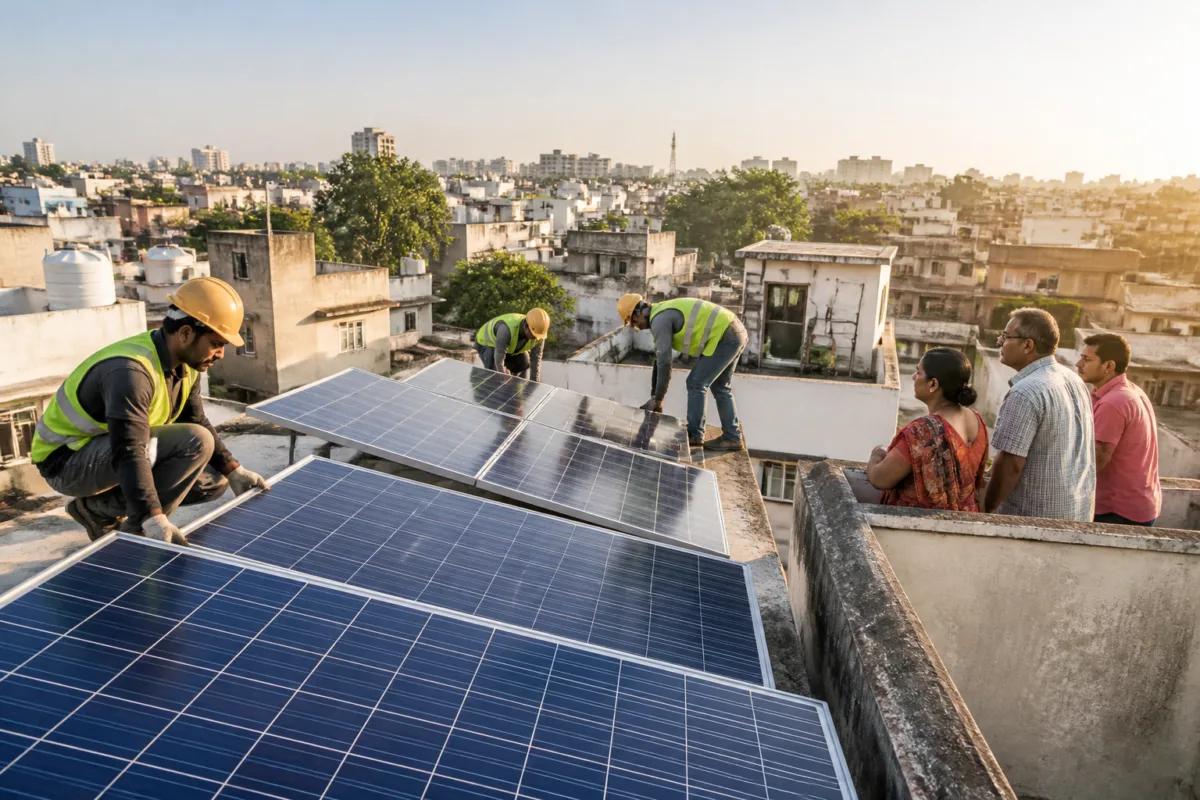
Gujarat’s new solar subsidy could make rooftop power accessible to a much larger group of households, with the state government announcing additional support that may reduce the customer contribution for a 1kW system to Rs 5,400. The decision is being presented as both an energy-cost measure and an expansion of the state’s already substantial rooftop-solar programme.
According to a report by Gujarat Samachar, the state cabinet has decided to add a state subsidy to the assistance available under the Centre’s PM Surya Ghar: Muft Bijli Yojana. Together, the central and state support is expected to cover about 90% of the prescribed cost for general consumers. Consumers from the Scheduled Caste and Scheduled Tribe categories would reportedly have to pay only about 5% of the cost.
The immediate significance of the announcement is that it changes the way household rooftop solar is financed. Earlier, the report says, beneficiaries receiving central assistance were not eligible for separate state support. The new arrangement combines the central scheme with additional Gujarat assistance, reducing the share that households must finance themselves.
For a 1kW installation, the reported customer contribution for a general consumer is Rs 5,400. The figure is important because the upfront cost of a rooftop system is one of the clearest barriers to adoption. A subsidy can reduce that barrier, but the final financial benefit for a household will depend on factors that are not detailed in the supplied announcement, including the applicable system cost, installation conditions, electricity consumption and the process for receiving the assistance.
The state government has estimated that more than three lakh families will benefit from the decision. It has also announced an additional expenditure of approximately Rs 1,000 crore. This places the policy beyond the scale of a limited consumer incentive. It represents a significant public commitment to expanding decentralised electricity generation through household roofs.
That commitment builds on Gujarat’s existing rooftop-solar base. The report states that more than 8.5 lakh homes in the state already have rooftop solar systems and describes Gujarat as a national leader in this area. The new subsidy therefore operates on two levels: it could bring new households into the programme while also extending a model that has already achieved considerable adoption in the state.
The numbers also show the administrative challenge ahead. If more than three lakh families are to receive support against an additional state expenditure of about Rs 1,000 crore, the government will need to manage a large pipeline of applications, approvals, installations and subsidy payments. The announcement supplied by the report does not provide a detailed implementation calendar, district-wise allocation, installer capacity or payment schedule. Those details will determine how quickly the announced benefit becomes an operational benefit for households.
This distinction matters because rooftop solar is not delivered through a single government payment alone. It requires coordination between the household, the installation agency, the electricity distribution system and the authorities administering the subsidy. The more households a programme covers, the more important the application, verification and connection processes become. Any delay in one part of that chain can postpone the household’s access to the promised reduction in upfront cost.
The policy also gives a sharper distributional role to rooftop solar. The report says that general consumers would pay around 10% of the prescribed cost, while consumers in the SC/ST categories would pay around 5%. This creates a larger subsidy for households identified as requiring additional support. However, the supplied material does not specify the income criteria, documentation requirements, household eligibility rules or whether the category-based benefit is subject to additional conditions.
The absence of these details does not diminish the importance of the announcement, but it limits what can be concluded about its reach. A headline subsidy percentage does not by itself establish how many households will qualify, how many can install systems on suitable roofs or how quickly the benefit will be paid. The reported target of more than three lakh families is the government’s stated beneficiary estimate; its delivery will depend on the rules and administrative process that follow.
The policy is also significant for the way it connects household economics with the state’s electricity system. Rooftop solar shifts part of electricity generation closer to the point of consumption. In the Gujarat announcement, the stated public objectives include reducing electricity bills and addressing the state’s energy pressures. The supplied report does not quantify the expected reduction in household bills or the amount of electricity that the new installations could generate, so the scale of those outcomes remains unspecified.
What is established is the direction of policy. Gujarat is using public funds to accelerate household-level solar adoption, rather than relying only on consumers to bear the initial cost. The additional Rs 1,000-crore commitment makes the state an active financial participant in the expansion of rooftop generation. It also means that implementation, monitoring and transparent reporting will be central to assessing whether the subsidy produces the intended public value.
The subsidy structure further raises questions about coordination between national and state programmes. The decision described by Gujarat Samachar does not replace the central scheme; it adds state assistance to it. This layered model can improve affordability, but it also requires clear communication so that applicants understand the total assistance, their own contribution and the steps needed to claim the benefit. The report does not yet provide the full cost tables for larger systems, although it indicates that comparisons for 1kW and 2kW systems form part of the government’s calculation.
For Gujarat’s cities and towns, the measure could expand the role of rooftops as energy infrastructure. The state’s existing figure of more than 8.5 lakh rooftop-solar homes suggests that the programme is already operating at a substantial scale. The next phase, if the announced target is achieved, would add more than three lakh beneficiary households to that base. That would make the quality of delivery as important as the size of the announcement: households will need timely approvals, capable installers, functioning connections and predictable subsidy processing.
The evidence currently confirms a major financial decision, a stated target of more than three lakh families and an additional state expenditure of about Rs 1,000 crore. It also confirms the reported customer contribution of Rs 5,400 for a 1kW system under the new arrangement. What remains to be established is the detailed eligibility framework, implementation timeline, district-level rollout, payment mechanism and measurable effect on household electricity bills. Those details will determine whether Gujarat’s expanded solar subsidy becomes simply a larger announcement or a durable expansion of affordable urban energy infrastructure.

