


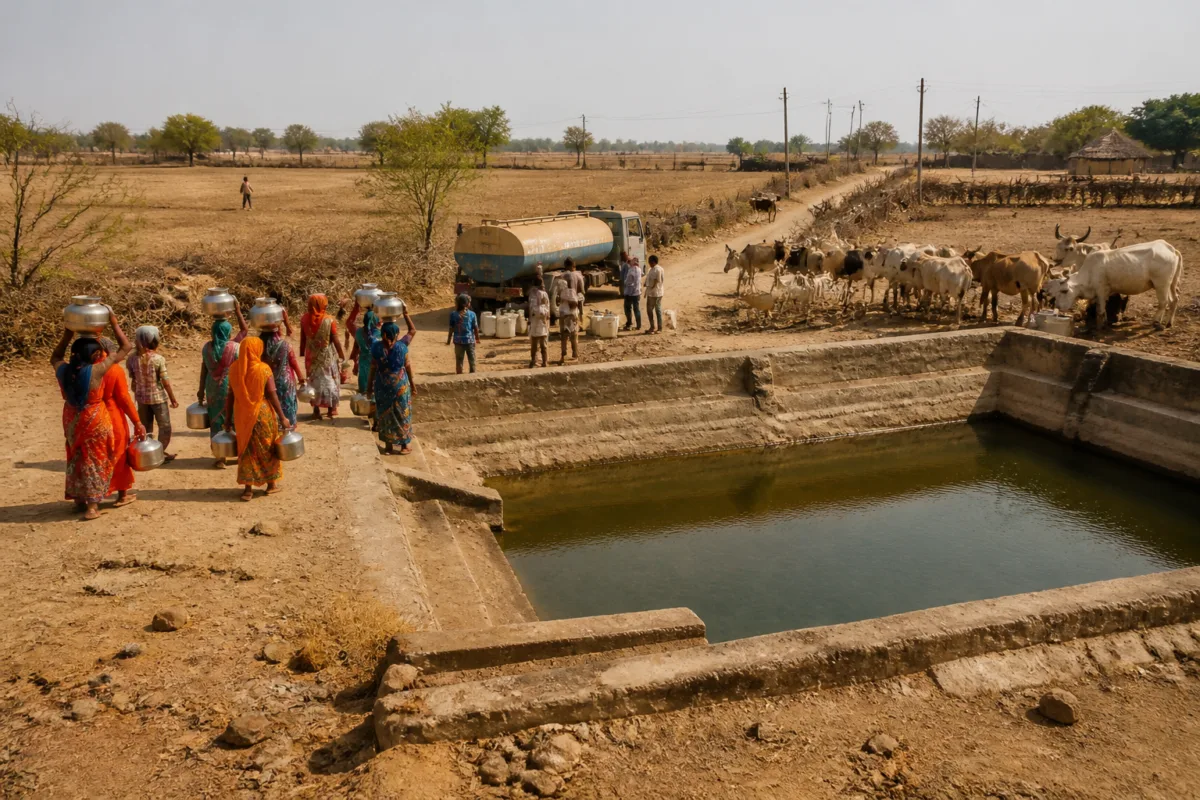
Gujarat has completed preliminary surveys in areas facing deficient rainfall across Saurashtra and Kutch and may declare them scarcity-hit or drought-hit if conditions warrant, state minister Kunvarji Bavaliya said, as opposition leaders claimed that villages in Devbhumi Dwarka had gone without water for as many as 28 days.
Bavaliya, the minister for labour, skill development and employment, said the government was supplying water and fodder wherever required. He was speaking to reporters on the sidelines of an event in Rajkot on Sunday. “Water and fodder are being provided in areas where the requirement is arising. Govt will continue providing water and fodder in such areas,” he said.
The minister said the government would formally declare affected areas scarcity-hit or drought-hit if the situation warranted such action. The preliminary surveys cover parts of Saurashtra that have recorded significant rainfall deficits, including Devbhumi Dwarka, Porbandar, Jamnagar and Gir Somnath, as well as Kutch.
The possible declarations would determine how the state administration responds to the developing water and agricultural stress. The government has also assured increased water supplies for irrigation in the affected districts, according to the report. The issue was discussed at a Gujarat cabinet meeting last week.
The government’s account was challenged by Pal Ambaliya, president of the Gujarat Kisan Congress, who called on Bavaliya to visit the affected villages. Ambaliya claimed that several villages in Devbhumi Dwarka had not received water for periods ranging from eight to 28 days.
He also alleged that farmers and villagers were travelling 15 to 20 km to reach fodder distribution centres. According to Ambaliya, the applicable rule requires such centres to be located within a maximum distance of 7 km from any village. The claims were not independently verified in the report.
The competing accounts point to two immediate administrative questions: whether water and fodder supplies are reaching the villages identified in the surveys, and whether the scale of the rainfall deficit meets the threshold for formal scarcity or drought declarations. Such declarations would provide the official framework for relief measures in affected areas.
The pressure is particularly significant in districts where rural households depend on reliable water supplies for domestic use, livestock and irrigation. Any prolonged gap in supply can also increase the distance residents must travel for essential water and fodder, although the report does not provide district-wide figures on the number of affected villages or households.
For now, the state government has said that surveys are complete in deficient-rainfall areas and that water and fodder distribution is continuing wherever the need arises. The next formal step is the government’s decision on whether to classify specific areas as scarcity-hit or drought-hit.

