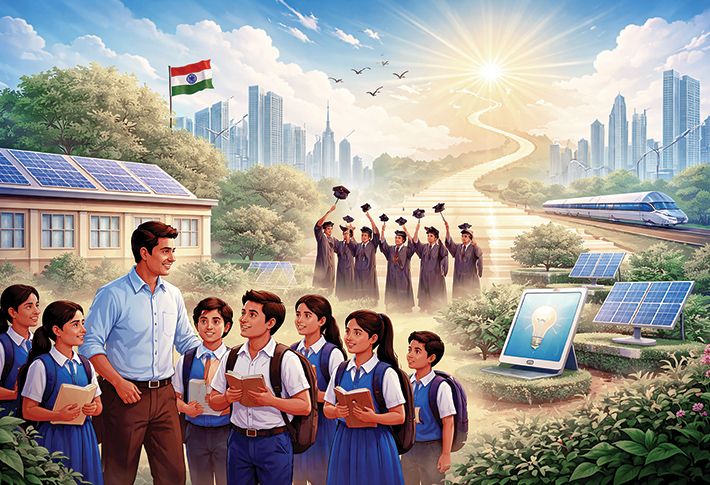
Gujarat has set its sights on a audacious goal: universal access to schooling by 2047. The ambition comes against a sobering backdrop. While primary enrolment remains robust, gross enrolment ratios crash to 74 percent at the secondary level and a mere 44 percent in higher secondary education. Nearly one in two students disappears from the education system before completing Class 12.
A state official confirmed that short-term and long-term strategies are now being drawn up to reverse this leaky pipeline. At a workshop attended by national and state education authorities, policymakers examined systemic gaps — from teacher quality to infrastructure deficits — that push adolescents out of classrooms. The demographic stakes are enormous. India records approximately 23 million births annually, compared to China’s 8.7 million. Gujarat alone accounts for 12.3 lakh live births each year. A senior bureaucrat framed the choice starkly: these children can become either a national asset or a liability, depending entirely on how they are educated and trained.
For urban planners and economists, the link between secondary school completion and sustainable cities is direct. Dropouts are more likely to cycle through low-skill, informal employment, face housing precarity, and lack the resilience to adapt to climate-induced economic shifts. A city with 44 percent higher secondary enrolment is a city leaving half its young people without the tools for climate-resilient livelihoods. The state’s reform blueprint includes both immediate fixes and long-term structural changes. In the short term, the focus is on foundational literacy and numeracy under a national proficiency initiative, alongside strengthening teacher training and expanding secondary school access. Over the longer horizon, the plan envisions world-class infrastructure, stronger institutional capacity for educational research and training, and technology-led transformation.
But experts who study education outcomes caution that infrastructure alone does not retain adolescents. Girls, in particular, drop out due to lack of safe transport, inadequate sanitation facilities in schools, and early marriage pressures. A gender-inclusive, people-first education policy would address these barriers explicitly. The Gujarat blueprint mentions holistic education — integrating physical fitness, moral values, and environmental awareness — but has not detailed how it will tackle the specific reasons teenagers leave school. What changes next is execution. Universal access by 2047 is a noble target. But for the 12.3 lakh children born in Gujarat each year, the clock is already ticking. They will be 21 years old in 2047. The question is whether the system will be ready for them before they drop out.
Gujarat Aims Universal School Access By 2047