


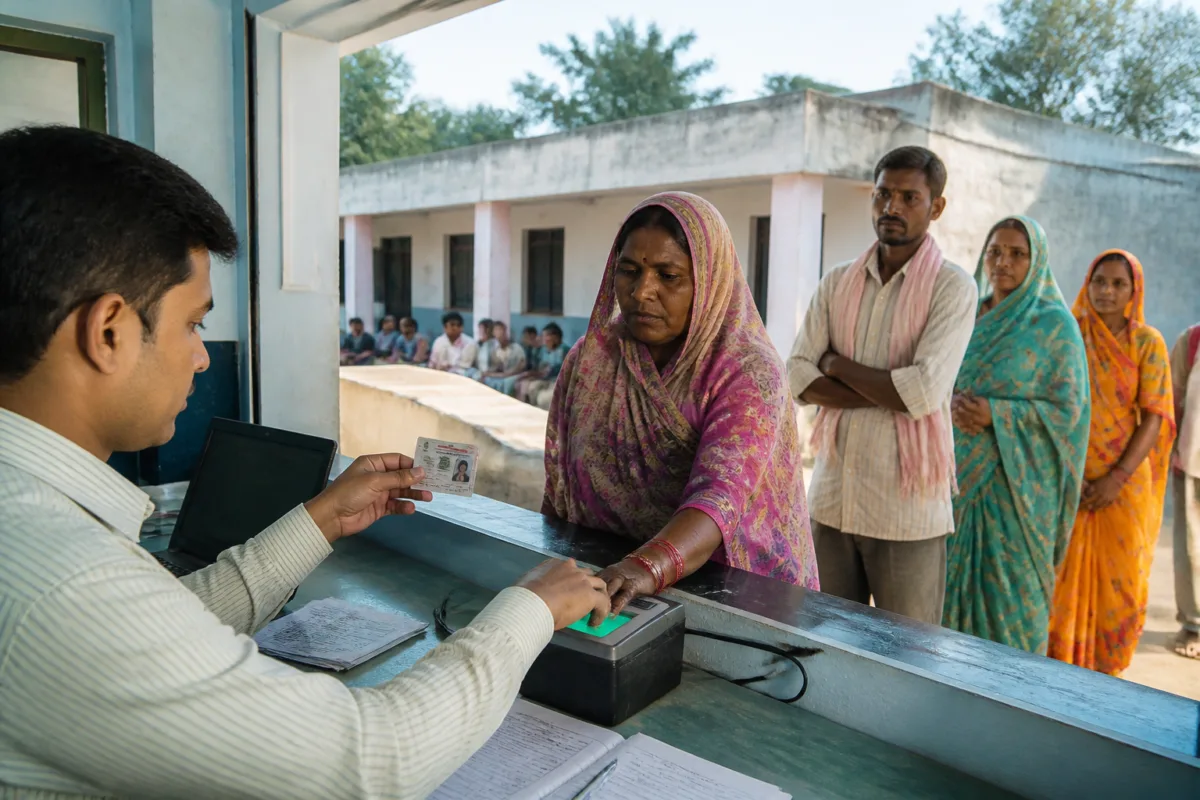
A Union minister’s suggestion that government beneficiary payments could eventually use biometric identification and voter ID numbers instead of Aadhaar has opened a major question about how welfare delivery is authenticated. The proposal could affect schemes linked to rural housing, farm support, pensions and employment, but the government has not yet specified which programmes would change or when any new system would begin.
The indication came from Rajiv Ranjan Singh, the Union minister for Panchayati Raj, Fisheries, Animal Husbandry and Dairying, during a national workshop held on 30 October for the People’s Plan Campaign 2026-27. According to Aaj Tak Business, Singh said Aadhaar would no longer be the basis for beneficiary payments and referred to biometric identity and the Elector Photo Identity Card, or EPIC, number as possible alternatives.
The statement is important because beneficiary payments are not only a question of transferring money. They also depend on how a person is identified, how eligibility is established, how a bank account is linked and how the state prevents duplicate or incorrect payments. Changing the identity layer could therefore alter the administrative chain behind several public programmes, even if the payment mechanism itself remains unchanged.
At present, the minister’s remarks do not amount to a notified policy change. The report does not identify a government order, revised scheme guideline or implementation circular. It also does not establish whether the proposed system would apply across all central welfare programmes or only to schemes administered by particular ministries. The date of implementation, the agencies responsible and the process for existing beneficiaries remain unspecified.
That distinction matters for citizens. A ministerial indication can start a policy discussion, but beneficiaries continue to operate under the rules formally prescribed for their schemes. The report specifically advises people to complete documentation and electronic know-your-customer requirements according to current rules until official instructions change them.
The schemes potentially affected are among the most visible points of contact between the state and rural households. Aadhaar is currently used for beneficiary identification and bank transfers under programmes including the Pradhan Mantri Kisan Samman Nidhi, or PM-Kisan; the Pradhan Mantri Awas Yojana-Gramin, or PMAY-G; and the rural employment guarantee programme identified in the report as VB-G RAM G. Aadhaar-linked bank accounts are also used for pensions under the National Social Assistance Programme, including old-age, widow and disability pensions.
The report also points to schemes under the Ministry of Fisheries, Animal Husbandry and Dairying. Under the National Livestock Mission Entrepreneurship Development Programme, applicants are required to provide proof of an Aadhaar number or complete Aadhaar authentication, according to the report. Any change to the identity requirement in such programmes would therefore need to address more than one administrative department and more than one type of beneficiary.
The central proposal combines two different forms of identification: biometrics and the EPIC number printed on a voter identity card. The report does not explain whether both would be required together, whether one would be an alternative to the other, or how either would be connected to a beneficiary’s bank account. It also does not state what biometric database or verification architecture would be used.
Those unanswered questions are not technical details at the margins. They determine whether an eligible person can successfully receive a payment. A beneficiary may be known to a local administration, eligible under a scheme and linked to a bank account, yet still face difficulty if the identity record cannot be matched or if the verification process is unavailable at the point of service. The supplied report does not provide evidence about how such cases would be handled under the proposed arrangement.
The minister’s stated concern relates to the way Aadhaar cards are issued. Singh questioned the process by saying that Aadhaar-issuing institutions are now available widely and that a card can be made within minutes. His remarks appear to frame the proposed shift as an attempt to strengthen confidence in beneficiary identification. However, the report does not provide further details about the alleged weakness, the scale of any irregularity or the evidence on which a replacement system would be designed.
This leaves the policy discussion at an early and largely conceptual stage. The government has not, according to the report, announced that Aadhaar authentication has failed across the listed programmes. Nor has it said that Aadhaar will immediately cease to be accepted. The present position is that the minister has indicated a possible future basis for payments while the operational framework remains undefined.
The institutional challenge would be coordination. PM-Kisan, rural housing, employment assistance, social pensions and livestock-related programmes serve different groups and are implemented through different administrative channels. A common identification change would need to be reflected in scheme rules, beneficiary databases, payment systems and local verification procedures. The report contains no indication that this transition has been formally approved or scheduled.
The reference to EPIC also brings the electoral identity system into the welfare-delivery debate. The report does not say whether the use of an EPIC number would involve any change in voter records or whether it would simply function as an additional identifier for welfare administration. It likewise does not establish how people without an EPIC, people whose details require correction, or beneficiaries whose records differ across systems would be treated.
For rural housing and employment programmes, these questions have a direct administrative consequence. A payment identity is useful only when it can be matched reliably with eligibility, work records, sanction orders or housing-related assistance. A new identifier may reduce one type of uncertainty while creating another if databases are not aligned. The supplied material does not contain performance data comparing Aadhaar, biometrics or EPIC-based verification, so no conclusion can yet be drawn about which system would work better.
The same limitation applies to pensions and other recurring benefits. A one-time correction in an identity record and a regular payment obligation are different administrative tasks, but the report does not explain whether the proposed system would distinguish between them. It also does not say whether beneficiaries would need to enrol again, submit new documents or visit a government facility for biometric registration.
The most significant fact at this stage is therefore not that Aadhaar has been replaced. It has not. The significant development is that a senior Union minister has publicly indicated a possible shift in the basis for welfare-payment authentication. The absence of a scheme-wise notification means the statement should be read as a policy signal rather than an operational instruction.
The next stage will require formal clarification on the affected schemes, the legal and administrative basis for the change, the role of banks and implementing departments, and the safeguards for beneficiaries whose records cannot be matched. It will also need to establish whether the proposed identity combination is mandatory, optional or transitional. Until those details are issued, beneficiaries should continue following the existing Aadhaar, documentation and electronic verification requirements applicable to their schemes.

