


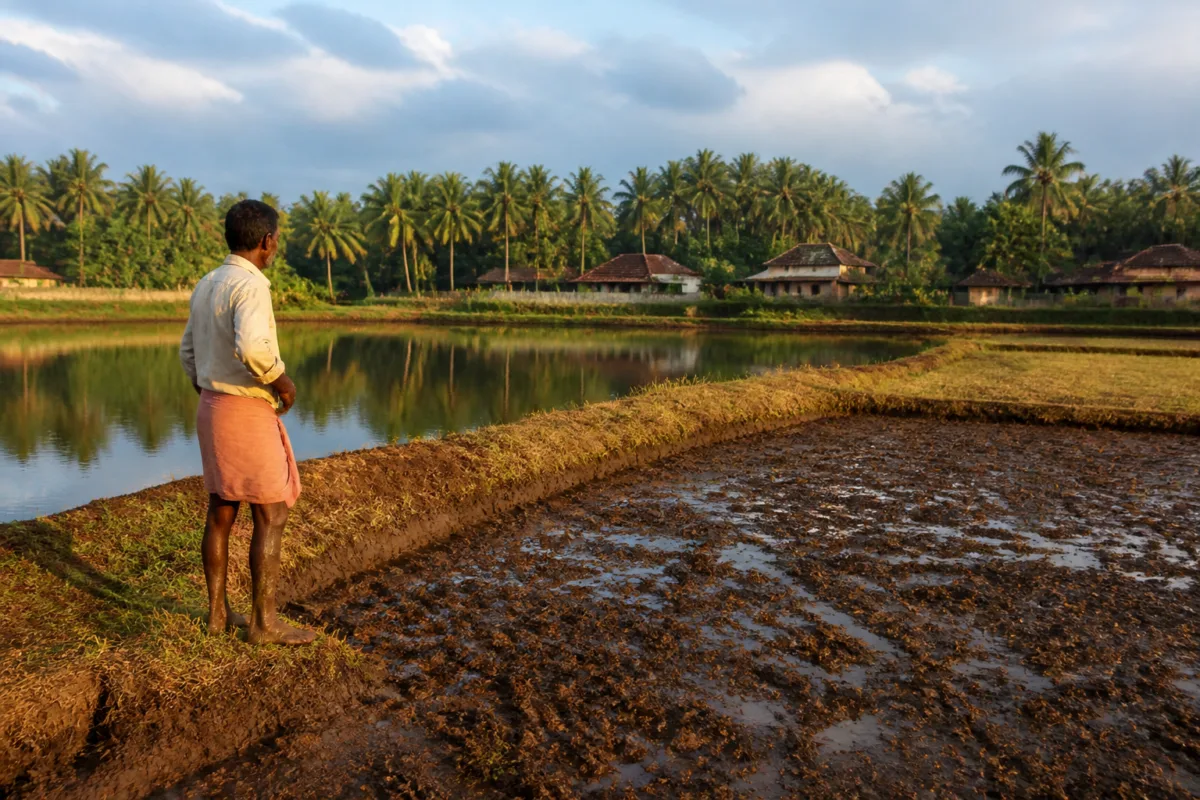
Goa’s rabi cultivation is being forced into an early and riskier adjustment after erratic rainfall damaged the kharif season, but the advice to shift towards moong, bajra and other low-water crops also exposes a deeper weakness: the state’s farm water systems are not reliably storing, distributing or accounting for the water available to them.
Agriculture experts have advised farmers to begin rabi sowing while residual moisture remains in the soil. The window is narrow. If sowing is delayed by 20 days to a month, the soil could dry out and seeds may not germinate, according to the experts cited in the report. The immediate concern is agricultural, but the underlying issue is one that affects Goa’s wider built and administrative environment: how villages capture monsoon water, maintain bunds and lakes, manage irrigation networks and prepare for a season in which rainfall does not follow the usual pattern.
The pressure is visible in the latest production figures. According to the Economic Survey 2025-26, Goa’s kharif paddy production fell to 77,768 tonnes in 2024-25 from 1,01,688 tonnes the previous year. Average yield declined from 4,335 kg per hectare to 3,257 kg per hectare. Total paddy production, including rabi output, fell to 1,14,878 tonnes from 1,42,056 tonnes.
Those numbers do not describe only a bad agricultural season. They show how dependent production remains on the timing and distribution of water. Fr George Quadros of Don Bosco Loutolim Society estimated that about one-third of the paddy area was affected, including fields that farmers did not plant because rainfall arrived late and unevenly. Higher fields, which depend almost entirely on rainfall, are expected to suffer more, while low-lying fields in which much of Goa’s paddy is grown may be less affected.
The distinction between high and low fields is important because it shows that rainfall alone does not determine agricultural resilience. Terrain, storage, drainage, bund management and access to local water bodies decide whether the same weather event becomes a production loss or a manageable disruption. In Curtorim, described in the report as the granary of Salcete, early closure of bunds and full lakes have created more favourable conditions. Elsewhere, some lakes were not desilted and some bunds were closed too late to capture available water.
This unevenness makes Goa’s rabi season a test of local water infrastructure rather than simply a test of farmers’ choices. Fr Quadros expects rabi paddy production to fall by as much as 50% on average in areas that depend on water bodies. Former agriculture director Nevil Afonso is less pessimistic, saying the rabi crop may not be affected if post-monsoon rains fill water bodies. The different assessments point to the same operational fact: the outcome depends heavily on whether water is stored in time and remains available through the crop cycle.
The state’s existing crop pattern also makes the water question more complex. After harvesting kharif paddy, farmers typically move towards vegetables or chawli. Sandy soils with stronger water-holding capacity can support chawli with limited moisture. Watermelon is cultivated in areas such as Nuvem, Majorda and Cansaulim under similar conditions, while farmers in hinterland areas need regular watering. In hilly areas, agriculture depends on streams, ponds, wells and, in parts of South Goa, the Salaulim dam.
Vegetable cultivation adds another layer of demand. According to Afonso, about 80% of the vegetable crop is chilli, along with radish, onion and other produce. Many Salcete fields are irrigated from lakes, making cultivation dependent on the condition of streams, lakes and nallahs. A shift away from paddy may therefore reduce pressure in some fields, but it does not automatically create a low-water agricultural system. The water requirement depends on the crop, soil, location and reliability of the local supply.
The Economic Survey figures show the scale of the alternatives without proving that they can immediately replace paddy. Rabi pulses were cultivated on 3,829 hectares and produced 3,539 tonnes, while vegetables grown on 8,863 hectares yielded 1,10,880 tonnes. These figures establish that pulses and vegetables are already part of Goa’s agricultural economy. They do not, however, establish how quickly farmers can expand these crops, what market support they would receive or whether local water systems can sustain a larger area under vegetables.
That uncertainty is why the experts have called for demonstration plots. Dr Sachin Tendulkar, an agro researcher, recommended short-duration crops such as moong, which can use residual moisture. He also suggested bajra, which can serve as fodder, and said farmers could consider ancillary crops rather than limiting themselves to field crops. The proposed demonstration plots would allow farmers to see how alternate crops perform under local soil and moisture conditions before taking on the full risk themselves.
Tendulkar also urged the agriculture department to select alternate crops and bear the input costs of demonstration plots. This is more than an extension-service request. It is a question of how the state allocates the risk of adaptation. If farmers are being asked to move away from a familiar crop because water conditions have become uncertain, the transition cannot depend entirely on individual experimentation. At the same time, the report does not provide details of a government-approved crop transition programme, its budget or an implementation timeline.
The water-management concerns are more direct. Fr Quadros said preparations for a poor season were inadequate and called for investment in ponds and water preservation through village-based plans prepared with farmers and tenants. He argued that funding should go to villages with credible planning and execution rather than through a purely top-down scheme. The proposal places local institutions and users at the centre of infrastructure planning, but the report does not identify a specific government mechanism through which such village plans would be approved or funded.
Tendulkar pointed to another administrative gap: water distribution societies, he said, exist “just for name’s sake” and have not been revived or strengthened. He called for a water audit to determine how much released water is actually used and where it is lost. That recommendation shifts attention from creating new infrastructure to measuring the performance of existing systems. Without information on releases, usage and leakage, authorities cannot establish whether a crop failure reflects insufficient water, poor storage, weak distribution or delayed field-level management.
His suggestion of a citizen alert system for reporting leaks also shows how agricultural water management intersects with wider civic administration. Traffic and garbage reporting systems were cited as possible models. Such a system could create a record of local failures, but the report contains no evidence that this mechanism currently exists for irrigation or that the responsible agencies have committed to creating it.
Traditional water-conservation systems are part of the same institutional question. Tendulkar said their revival could help make fields more self-sufficient, while Afonso called for long-term conservation supported by communities. The report does not define which traditional structures would be revived, who would maintain them or how they would be integrated with lakes, bunds, ponds, wells and larger water sources such as the Salaulim dam. Those details matter because storage infrastructure is useful only when maintenance responsibilities and operating rules are clear.
Goa’s immediate rabi decision therefore has two levels. At the farm level, early sowing and short-duration, low-water crops may help farmers use remaining soil moisture. At the governance level, the season is exposing the cost of delayed desilting, late bund closure, weak water-user institutions and limited preparation for rainfall variability. The production data provides a measurable warning, while the expert recommendations identify several possible administrative responses.
What remains uncertain is whether the suggested responses will move beyond advice. The supplied evidence confirms a sharp fall in kharif paddy output, uneven exposure across Goa’s fields and a dependence on local water bodies for the rabi crop. It also records calls for demonstration plots, village-based water plans, water audits, leak reporting and conservation investment. The developments to monitor are whether the agriculture department establishes the proposed demonstration plots, whether farmers receive support for alternate crops and whether water bodies, bunds and distribution societies are managed before the next critical sowing window.

