


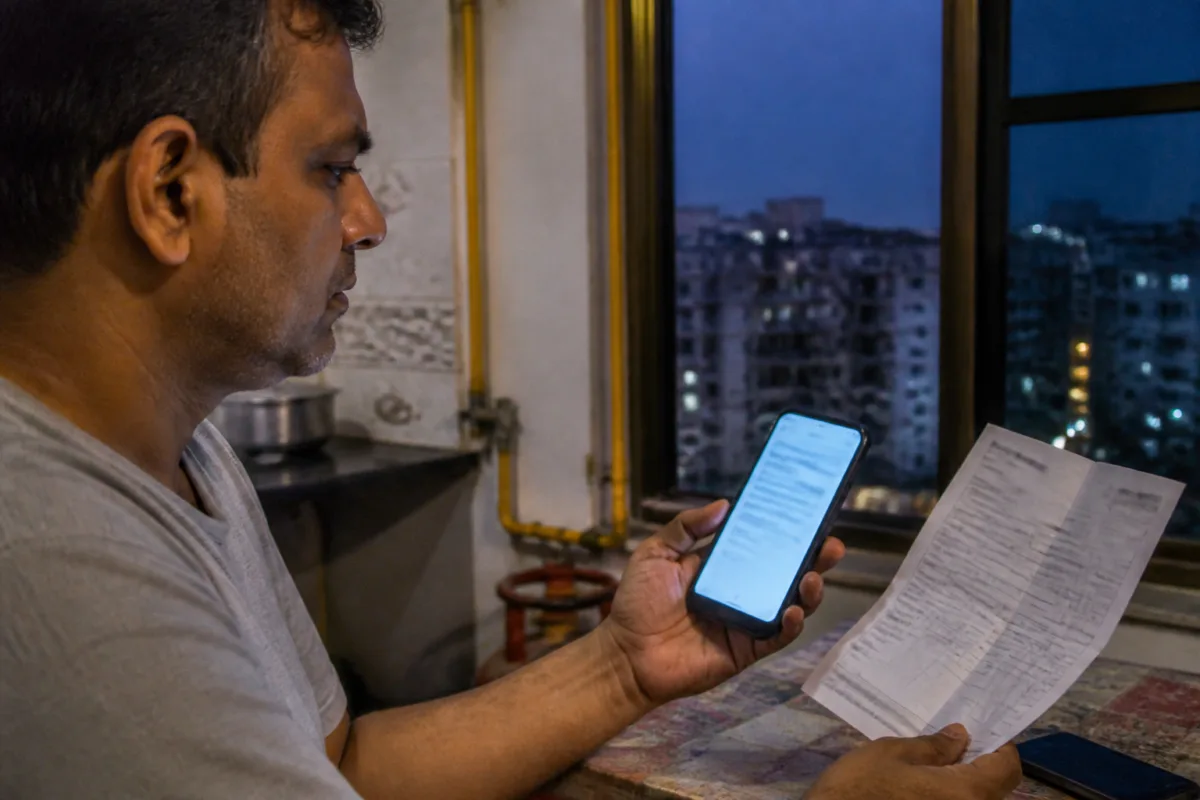
A ₹71,000 gas connection cyber fraud case in Ahmedabad shows how a routine utility message can become the entry point for a wider attack on a resident’s phone and bank accounts. According to a report by Nav Gujarat Samay, Vatva GIDC police have registered a case after a 37-year-old farmer living at Panchratna Homes on S.P. Ring Road alleged that cyber fraudsters sent him a WhatsApp message claiming that his Adani Gas connection would be disconnected unless his bill was updated.
The case is significant not because of the amount alone, but because of the way the fraud was structured. The alleged offenders did not begin with an obviously suspicious investment offer or a direct request for a large payment. They used a familiar urban service: a piped-gas connection, a bill and the threat of disconnection. The message created an administrative emergency, after which the victim was directed towards a second step—installing an application to cancel a supposed notice.
The report identifies the complainant as Bhaumikbhai Popatbhai Patel, who lives at Panchratna Homes and works in agriculture. At around 4 pm on September 17, he received a message from an unknown number stating that his Adani Gas connection would be discontinued and that his bill needed to be updated. After he sent the paid bill to the number provided, the sender allegedly told him that the bill had already been paid but that an application had to be installed to cancel the notice.
A link was then sent to his WhatsApp account. The report says that when Patel opened the link, his mobile phone switched off. On checking his accounts, he found that money had been transferred in instalments from accounts held with the Ahmedabad Mercantile Co-operative Bank, the State Bank of India and HDFC Bank. The total amount reported to have been taken was ₹71,000. Patel subsequently reported the incident through the 1930 cyber-fraud helpline, and Vatva GIDC police began an investigation.
The sequence matters because it reveals how urban service systems are experienced by residents. A gas connection is not an abstract infrastructure asset. It is linked to monthly billing, household operations and the possibility of a service interruption. A message that invokes disconnection can therefore appear plausible even when it comes from an unknown number. The fraud allegedly succeeded by placing a digital action—opening a link and installing an application—inside a familiar service interaction.
This also makes the case different from a conventional payment dispute. The reported loss involved three separate bank accounts rather than a single payment made knowingly by the victim. The report attributes the transfers to the activity that followed the opening of the link. It does not establish the technical method used to access the phone or accounts, and the police investigation is still under way. Those details remain important because the exact mechanism will determine whether the incident involved an unauthorised application, compromised credentials, remote access or another form of digital intrusion.
The urban governance question is therefore broader than whether one resident should have recognised a fraudulent message. Utility communication is increasingly mediated through mobile phones, messaging platforms and online payment systems, while the underlying services remain administered by companies, banks and public authorities operating through separate institutional channels. A consumer may see one seamless interaction, but responsibility for the message, the bill, the payment and the service connection can sit with different entities.
That institutional separation can create confusion during an emergency. In the reported case, the fraudster presented the communication as if it were an official gas-service notice and then introduced an application as the solution. The report does not say whether the message used official branding or whether the sender was connected to the gas company. It does, however, show how the credibility of a utility provider can be borrowed by someone outside the formal service system.
The case also underlines the importance of the last mile in urban infrastructure. The physical gas connection may be functioning normally, but the customer interface around it has become a potential risk point. Billing messages, service reminders, payment links and disconnection notices are all part of the infrastructure through which residents interact with utilities. Security failures at that interface can cause financial harm even when there is no physical failure in the gas network.
For the consumer, the warning signs described in the report were concentrated in a short sequence: an unknown number, a claim that a paid bill required correction, a demand to install an application and a link that immediately preceded the phone switching off. Yet the pressure created by the threat of disconnection appears to have made the request seem urgent. The case demonstrates why utility-related digital communications need to be treated as a distinct public-safety concern rather than merely as generic online fraud.
The response in this case moved through two channels. Patel approached the 1930 cyber-fraud helpline after noticing the unauthorised transfers, while Vatva GIDC police registered a complaint and began investigating. The report does not provide details of whether any funds were frozen, whether the application or link was traced, or whether the gas provider issued a confirmation. Those outcomes will determine how much of the financial loss can be addressed and how the alleged method is identified.
The three-bank dimension further shows why response time matters in such incidents, although the supplied report does not specify the timing of each transfer or the actions taken by the banks. Once money moves across accounts, the matter requires coordination between the complainant, banks, the cyber-fraud reporting system and the police. The case therefore sits at the intersection of urban utility administration and financial-security enforcement.
There is also a documentation issue. The complainant had a bill and was able to identify that his accounts had been debited. Such records can help investigators reconstruct the sequence of events. The report does not state whether the original WhatsApp message, the phone number, the link or the downloaded application has been preserved as evidence. Those details are not established in the supplied material, but they are central to determining how the alleged fraud operated.
The larger lesson is that digital trust has become part of everyday urban infrastructure. Residents do not only depend on pipes, roads, electricity networks or transport systems; they also depend on the messages and interfaces through which those systems are accessed. When a fraudulent communication imitates a legitimate service interaction, the risk is created at the point where institutional identity meets personal technology.
This does not establish that the reported incident reflects a wider pattern across Ahmedabad or among gas consumers. No broader incident data, official advisory or statement from the gas provider is included in the supplied report. The evidence supports a narrower conclusion: one resident reported losing ₹71,000 after responding to a fake gas-disconnection communication, and police opened an investigation.
The case should therefore be followed through the next official milestones: the police investigation, any identification of the sender or application, the status of the transferred funds and any response from the banks or gas provider. Until those details are established, the incident remains a reported instance of utility-themed cyber fraud—but it clearly shows how a familiar urban service can be used to create digital urgency and financial exposure.

