


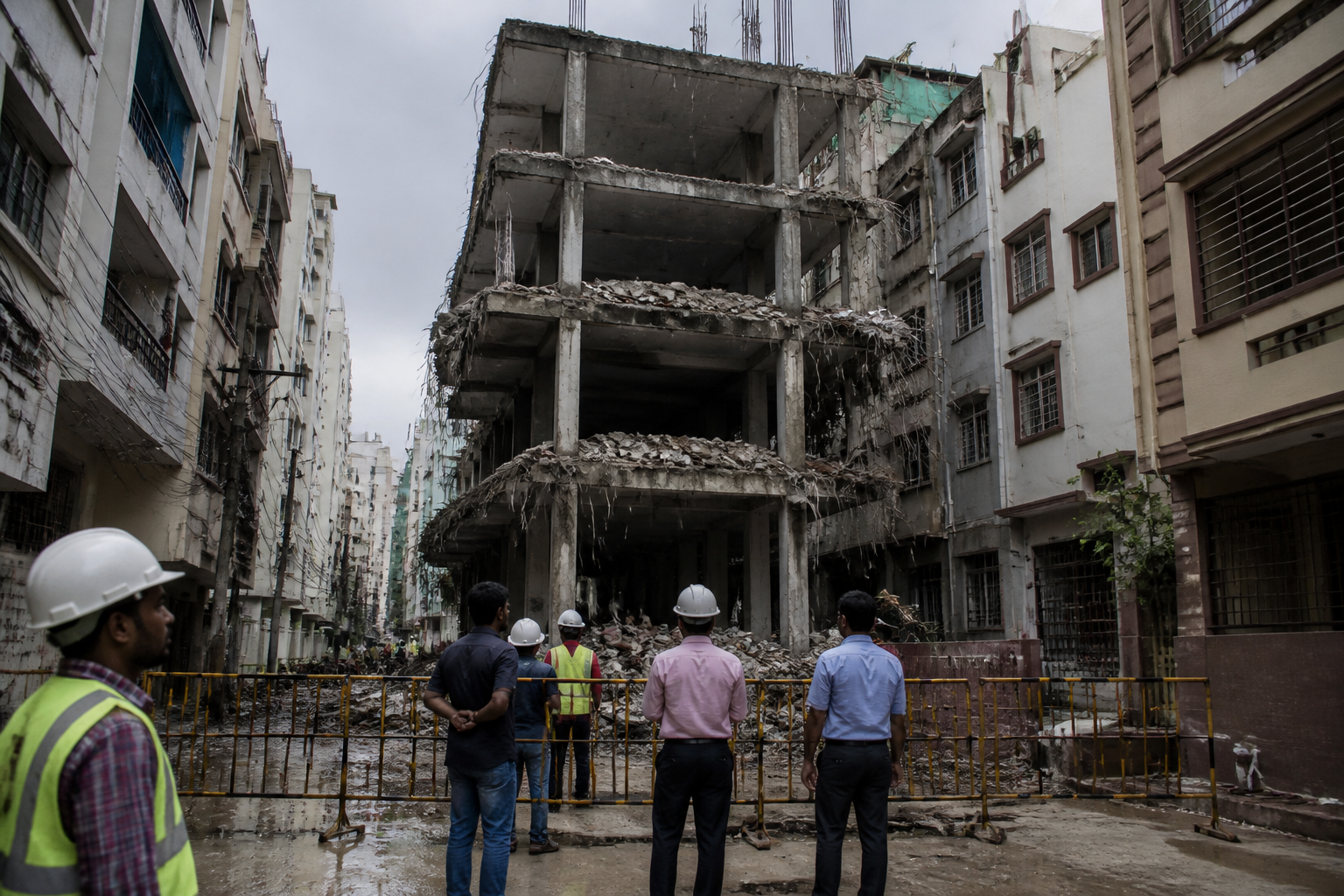
The Gachibowli building collapse that killed two workers has become more than an isolated construction accident. A month after an unauthorised G+6 structure came down in Anjaiah Nagar, residents and resident welfare associations (RWAs) are asking how multi-storey buildings on plots as small as 50 square yards receive approvals, rise beyond permitted limits and remain occupied despite possible structural risks.
The concern gained urgency after a four-storey building in NTR Nagar, Gopanpally, developed a dangerous tilt and was evacuated before civic authorities demolished it. Taken together, the two incidents have shifted attention from the failure of individual buildings to the system that permits, monitors and certifies them.
The available account, reported by Telangana Today, does not establish the cause of either structural failure. It does, however, document a pattern of allegations from residents and RWAs about unauthorised construction, inadequate inspections, questionable building data and weak enforcement. That distinction matters. A collapse investigation must determine the technical cause, while a governance review must examine whether warning signs were visible much earlier in the approval and construction process.
The central urban question is how a digitised permission system and a municipal enforcement structure operate when construction takes place on very small plots but produces buildings with several floors. Residents in Anjaiah Nagar and other areas within the Cyberabad Municipal Corporation’s limits allege that unauthorised multi-storey buildings have proliferated on 50- and 75-square-yard plots. They also question how permissions were generated for restricted 50-square-yard sites.
The allegations point to a possible mismatch between the scale of the plot and the intensity of development being permitted on it. Small sites leave limited room for setbacks, access, light, ventilation and emergency response. The article reports that several buildings have been constructed edge-to-edge, with little or no setback between structures. It also records resident concerns that narrow high-rises may have been built without adequate soil testing or proper structural engineering.
These conditions are not merely matters of planning aesthetics. Setbacks and spacing affect access for emergency services, ventilation, daylight, drainage and the ability to inspect a building’s external condition. Where buildings stand tightly against one another, construction activity can also make it difficult for officials or neighbours to identify unauthorised additions and deviations from approved plans.
The reported concerns also expose the limits of treating building approval as a one-time administrative transaction. RWAs allege that developers or builders have used altered or fake blueprints to add floors beyond approved plans. Some residents further allege that incorrect structural information and plot dimensions were uploaded on automated approval portals to circumvent scrutiny.
Those claims remain allegations in the supplied report and require documentary and technical examination. But they identify a specific vulnerability in a digitised approval process: automation can speed up permissions, but it cannot by itself guarantee that the information submitted is accurate or that construction on the ground matches the approved design. That requires field verification, stage-wise inspection and consequences when deviations are detected.
The report also raises questions about fitness certificates. RWAs allege that such certificates were issued without adequate checks on structural stability and foundation strength. It does not identify the certificates, officials or buildings involved, nor does it establish that any particular certificate was improperly issued. The issue nevertheless highlights the difference between documentary compliance and actual structural safety.
A building may have a permission record, a submitted plan and a certificate, yet still present risks if the foundation, materials, load-bearing system or built form differs from the approved submission. The allegations made by residents therefore concern the entire chain: the accuracy of applications, interpretation of zoning rules, approval decisions, construction monitoring, inspections, certification and enforcement.
The municipal response described in the report appears to have included enforcement teams, demolition drives and notices to under-construction sites. Some RWAs in Gachibowli and Madhapur said the commissioner had deployed teams and issued notices. Their criticism is that enforcement was focused on construction in progress while risks posed by occupied buildings were allegedly overlooked.
That distinction is important for municipal administration. Notices and demolition action at active sites can address visible violations, but occupied buildings require a different form of risk management. Authorities must identify structures that may be unsafe, determine whether they conform to approved plans, assess their structural condition and communicate clearly with residents where evacuation or other action is necessary. The evacuation and subsequent demolition of the tilted Gopanpally structure show the consequences of intervention after a visible danger has emerged.
Residents have called for a comprehensive audit and the identification of hazardous and unauthorised structures, particularly those built on small plots. According to the report, the CMC has not yet compiled such a comprehensive database for Anjaiah Nagar and other areas within its limits. Without a reliable inventory, enforcement is likely to remain incident-driven: action follows a collapse, a tilt, a complaint or a media report rather than a systematic assessment of risk.
An inventory would not, by itself, make buildings safe. Its value would depend on the information it contains and the action that follows. A meaningful database would need to distinguish between approved and actual floor counts, construction status, plot size, occupancy, inspection history, certificates and any notices or violations. The supplied material does not state that such a system exists or that a citywide audit has begun.
The administrative structure described in the report also appears fragmented. Residents have questioned the functioning of town-planning and other wings responsible for enforcing building norms and monitoring compliance. The issue is therefore not limited to the performance of one enforcement team. It concerns how responsibilities are divided and whether information moves effectively between approval, inspection, certification and enforcement functions.
Digitised approvals can create an appearance of transparency while leaving unresolved questions about accountability. If a portal accepts plot dimensions or structural data, the municipality still needs mechanisms to validate those details. If officials are responsible for site inspections, the process must record when inspections occurred, what was checked and whether the physical structure matched the approved plan. If deviations are found, the system must show who acted and when.
The report provides no data on the number of unauthorised buildings, the number of approvals granted for 50-square-yard plots, the frequency of inspections, or the number of notices and demolitions issued. It also does not provide the findings of a technical investigation into the Anjaiah Nagar collapse or the Gopanpally building’s tilt. These gaps prevent a quantitative assessment of the scale of the problem.
What can be established is narrower but significant. Two separate building-related incidents within the Gachibowli area and surrounding urbanising localities have prompted residents to question the relationship between rapid vertical construction and civic oversight. The affected locations include Anjaiah Nagar, NTR Nagar and Gopanpally, while RWAs in Gachibowli and Madhapur have raised concerns about wider enforcement practices.
The geography is relevant because the complaints are not about a single isolated site alone. They refer to a broader pattern of construction on small plots across the corporation’s limits. The evidence supplied does not prove that every such building is unsafe or unauthorised. It does indicate that residents believe the municipality lacks a comprehensive picture of which structures pose risks and whether approved plans are being followed.
For urban residents, the immediate concern is safety. For the municipal system, the deeper issue is whether compliance is being measured through paperwork or through the condition of buildings in the city. The difference becomes critical when additional floors, reduced setbacks, altered plans or inadequate foundations are alleged after construction has already advanced or residents have moved in.
The next step identified by residents is a comprehensive audit, alongside a review of the town-planning and enforcement wings. The supplied report does not confirm whether the CMC has accepted these demands, announced an audit, published a list of hazardous structures or released findings on the two incidents. Those developments will determine whether the response remains a series of site-specific actions or becomes a wider examination of how small-plot construction is approved, inspected and certified in Hyderabad.
