


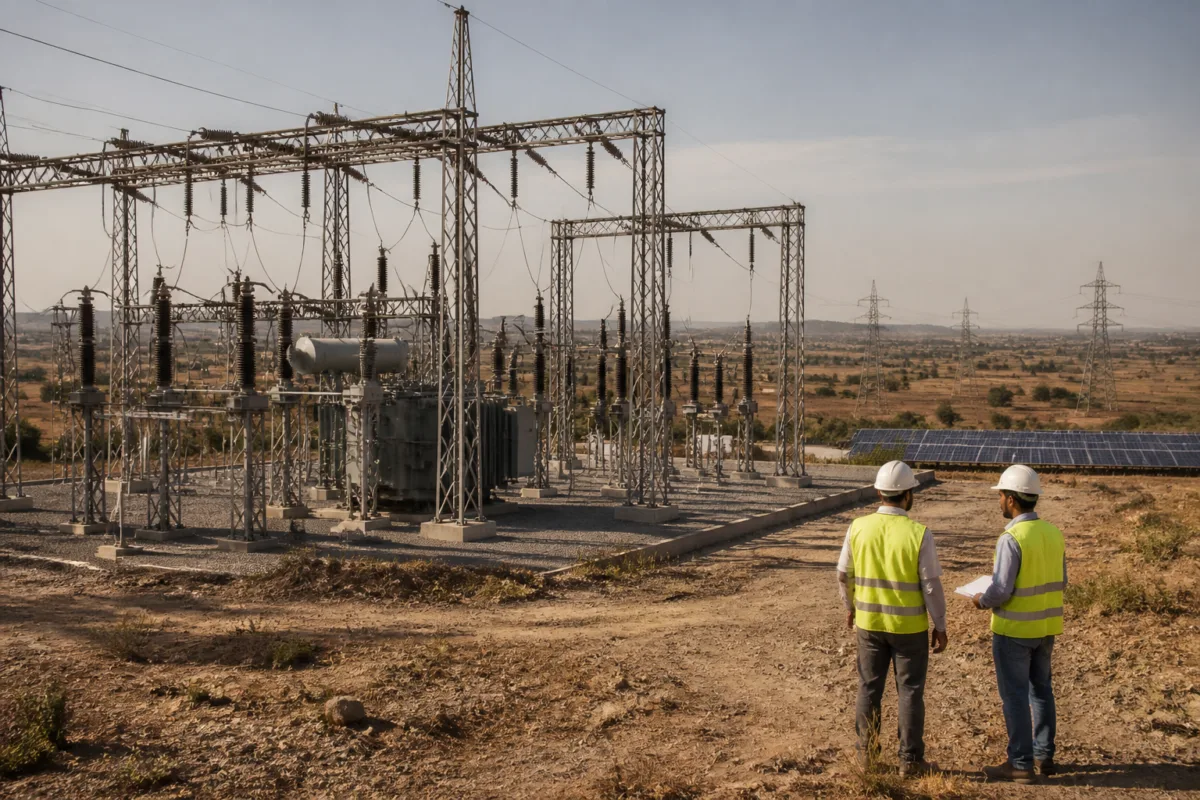
Madhya Pradesh’s power transmission expansion is facing delays in the availability of high-voltage insulators, transformers and other specialised equipment as renewable-energy projects increase demand for new grid infrastructure, according to officials cited by PTI.
The constraint affects the network that carries electricity from generating stations to substations operated by distribution companies supplying households, industries and commercial establishments. Madhya Pradesh Power Transmission Company Limited, or MP Transco, operates the state’s transmission system.
MP Transco Managing Director Sunil Tiwari said the shortage was not the result of declining production. Instead, he attributed it to the rapid pace of infrastructure development across India, which has widened the gap between demand and supply for transmission equipment.
High-voltage insulators are among the main pressure points. Industry sources cited by PTI said raw materials for porcelain insulators had become harder to obtain, while production at some facilities had been affected by gas shortages linked to disruptions in global energy supplies. Some specialised products also continue to be imported.
Delivery schedules for certain insulator categories have increased from about 12-15 months to roughly 18-20 months, MP Transco public relations officer Shashikant Ojha said. Manufacturers are increasingly using polymer and composite insulators, particularly in polluted and dusty environments. These products are lighter, easier to handle and require comparatively less maintenance, according to Ojha.
Transformer manufacturing is facing a similar squeeze. Equipment required for 400 kV, 220 kV and 132 kV substations includes extra-high-voltage transformers, auto-transformers and interconnecting transformers. Their production depends on components such as cold-rolled grain-oriented electrical steel, copper conductors, insulation materials, high-voltage bushings and on-load tap changers.
The delivery period for large extra-high-voltage transformers has increased from about 8-12 months to as much as 18-24 months, Ojha said. Rising prices of ceramics, toughened glass, silicone rubber, structural steel, aluminium, copper and electrical steel have also raised manufacturing costs.
The equipment bottleneck is significant because renewable-energy expansion requires more than generation capacity alone. New solar and other renewable projects need transmission lines, pooling substations and grid interconnections to move electricity to consumption centres. According to figures cited by Ojha, more than 88 gigawatts of renewable-energy capacity was auctioned across India over the past two years, creating demand for new 400 kV and 220 kV transmission corridors.
Madhya Pradesh is emerging as a renewable-energy destination, with several large solar and other renewable projects under development. Evacuating their output will require additional extra-high-voltage lines and substations, MP Transco said.
The immediate infrastructure concern is therefore not only whether generation projects are completed, but whether the supporting transmission network and its critical components are available at the same pace. Longer procurement cycles can complicate construction sequencing and defer the commissioning of lines or substations, although the report does not identify a specific project that has missed its schedule.
Industry experts cited by PTI said demand generated by India’s energy transition had outpaced manufacturing capacity in some equipment segments. They called for stronger domestic production under the Make in India initiative, assured supplies of critical raw materials and expanded manufacturing facilities to reduce import dependence. They also pointed to composite-insulator technology as one way of meeting future requirements.
For the state’s power system, the reported shortage highlights the importance of treating equipment manufacturing and transmission planning as linked infrastructure priorities. Renewable capacity can contribute to the grid only when substations, corridors and interconnections are delivered with suitable equipment. MP Transco’s assessment indicates that strengthening the domestic supply chain will be central to keeping grid expansion aligned with the growth of renewable generation.

