


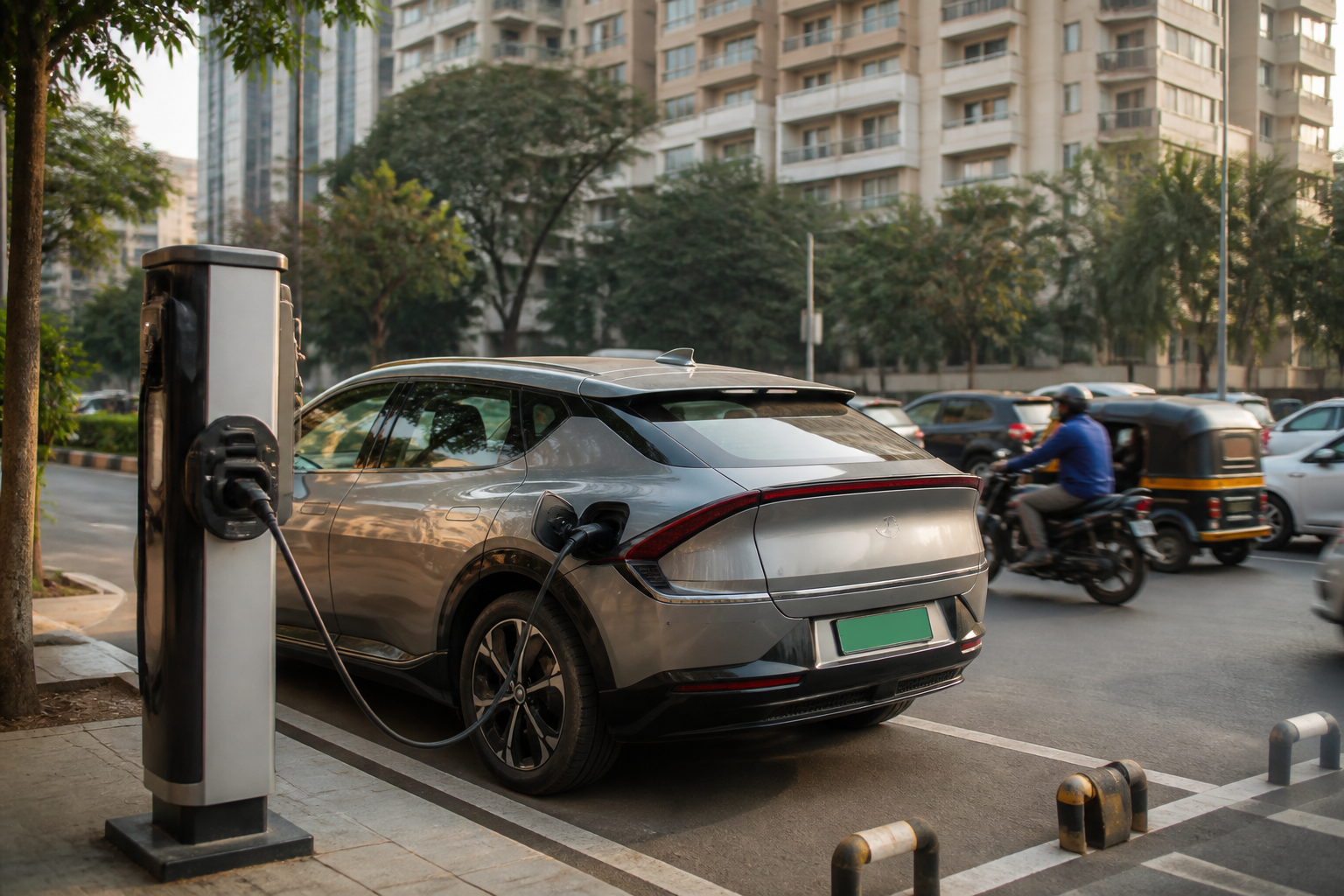
India’s electric-car market is entering a more complicated phase. The question is no longer only whether consumers are interested in electric vehicles, or whether manufacturers can persuade them of the environmental case. It is whether the market can make electric-car ownership feel affordable, convenient and dependable enough for wider adoption.
Recent findings cited in a report by The Times of India point to two developments moving in opposite directions. Established manufacturers such as Tata Motors are generating substantially more revenue per electric vehicle than per conventional internal-combustion-engine vehicle. At the same time, newer entrants such as Vietnamese automaker VinFast are confronting a set of practical barriers that continue to influence purchase decisions: upfront cost, charging anxiety, ownership cost and confidence in the brand and its service network.
Together, these trends reveal a value-convenience gap at the centre of electric-car adoption in India. The vehicles can produce stronger revenue for manufacturers, but that does not automatically mean they offer an easier proposition for buyers. For consumers, the decision involves more than the vehicle’s sticker price or emissions performance. It also includes the availability of charging, the cost and reliability of ownership, the perceived strength of the manufacturer and the likely resale value of the car.
The distinction between manufacturer revenue and consumer value is important. Tata Motors Passenger Vehicles sold 641,586 units in FY26, including 92,719 electric vehicles, according to the figures cited in the report. Electric vehicles represented 14.5% of the company’s passenger-vehicle volumes but contributed nearly 23% of its revenue. On the reported numbers, Tata’s electric cars generated about Rs 14.5 lakh per vehicle, compared with roughly Rs 8.2 lakh for internal-combustion-engine vehicles.
That difference suggests that electric cars occupy a higher-value position in Tata Motors’ vehicle portfolio. It also indicates why established manufacturers may have a strong commercial reason to expand their electric offerings even when the overall share of EVs remains limited. But revenue per vehicle is not the same as profit per vehicle. The available information does not establish that Tata’s electric cars are more profitable than its conventional cars, and that distinction prevents a simple conclusion that the economics of electric vehicles have already been resolved.
The figures instead show that EVs can have a disproportionate effect on revenue before they achieve a majority share of sales. With 14.5% of volumes accounting for nearly 23% of revenue, electric vehicles are contributing more heavily to the value of the portfolio than their unit share would suggest. For manufacturers, this creates an incentive to develop and sell EVs as premium or higher-value products. For the market, however, it also raises a question about affordability: if higher revenue is linked to higher transaction values, the same factor could make the technology harder for more buyers to access.
This is where VinFast’s market research, as described in the report, becomes significant. The company identified four barriers to wider adoption: the initial purchase price, anxiety about finding a charger or completing a journey, the cost of ownership and confidence in the brand and its network. These concerns cover the full ownership cycle, from the moment a buyer considers the purchase to the point at which the vehicle is serviced, used, transferred or sold.
Upfront cost is the most visible barrier. An electric car may be evaluated not only against another electric model but also against a conventional vehicle that offers an established ownership experience. A buyer therefore has to weigh the initial price against expected running costs and the practical advantages of electric propulsion. The material supplied for this analysis does not provide comparative operating-cost figures, financing data or purchase-price ranges, so it cannot establish how quickly those factors offset the initial expense. It does show, however, that manufacturers recognise the entry cost as a central obstacle.
Charging anxiety represents a different kind of problem. It is not simply a question of whether charging stations exist. It concerns whether drivers trust that charging will be available when needed, whether it will fit into their routines and whether the vehicle can be used without extensive planning. The report does not provide a national count of charging points, utilisation data or city-level access figures. What it establishes is that consumers’ perception of charging availability remains important enough for a major new entrant to treat it as a principal barrier to adoption.
The ownership-cost concern extends beyond energy use. Buyers may consider maintenance, warranty support, battery-related uncertainty and the accessibility of service facilities, although the supplied report does not quantify each of these factors separately. Its broader point is that consumers need reassurance about the total ownership experience. That is why VinFast is considering measures such as free maintenance and incentives for switching from internal-combustion vehicles to electric cars.
Brand and network confidence may be particularly important for newer manufacturers. An electric vehicle is not an isolated product: the purchase also establishes a relationship with a company responsible for service, software, parts, warranty support and future resale confidence. A new entrant must therefore build trust in both the car and the institution behind it. VinFast’s proposed buyback programmes appear aimed at addressing this concern directly by reducing uncertainty about what happens when an owner wants to sell or replace the vehicle.
Resale value is a crucial part of that calculation because it affects the effective cost of ownership. A buyer who is uncertain about the future value of an electric car may treat the initial price as riskier, even if the vehicle promises other benefits. Buyback programmes can offer a form of assurance, but the material supplied does not indicate the terms, duration or scale of VinFast’s proposed programme. It therefore supports the conclusion that resale confidence is a market barrier, not an assessment of whether the proposed response will succeed.
The environmental case for electric vehicles remains part of the market’s foundation, but it is not sufficient by itself to close the adoption gap. Tata Motors said a comprehensive life-cycle assessment found that the Nexon EV produced nearly 38% lower greenhouse-gas emissions over its lifetime than the comparable internal-combustion version. The finding gives consumers an emissions-related reason to choose an EV, while also illustrating that the comparison is based on the vehicle’s full life cycle rather than only its use on the road.
Yet the market evidence suggests that environmental benefits do not eliminate practical concerns. Consumers still need clarity on purchase costs, driving range, charging access, maintenance and resale. The next phase of adoption will therefore depend on whether these concerns are addressed together rather than through environmental messaging alone. A car may have a lower lifetime emissions profile, but a buyer making a household purchase must still be able to use it reliably and understand the financial consequences of ownership.
The policy landscape is only indirectly visible in the supplied material. The report refers to incentives for switching from internal-combustion vehicles to EVs, but it does not identify a specific government scheme, subsidy, municipal programme or regulatory framework. It also does not establish who would be responsible for expanding charging infrastructure or how such infrastructure would be funded. Those omissions matter because the barriers identified by consumers extend beyond the vehicle itself.
Electric-car adoption involves manufacturers, charging providers, service networks, consumers and public authorities. Automakers can provide incentives, maintenance packages and buyback arrangements. They can also improve the clarity of information on range and charging. But the source material does not show whether these measures are being coordinated with a wider public infrastructure strategy. Without that evidence, it would be premature to treat individual company initiatives as a complete solution to the market’s adoption challenge.
The available data also shows the limits of the current picture. Tata’s FY26 sales figures provide a company-level view of volume and revenue, not a complete account of India’s electric-car market. VinFast’s position among the top five electric-car brands by sales indicates competitive relevance, but the supplied material does not provide the ranking, market shares or sales figures for the other manufacturers. Nor does it offer evidence on regional differences, urban charging access, household income or the relative experience of EV owners across Indian cities.
That lack of broader data does not make the signals unimportant. It means they should be interpreted precisely. The evidence supports three conclusions. First, electric vehicles can generate higher revenue per vehicle for an established manufacturer. Second, a higher-value product position does not prove higher profitability or mass-market affordability. Third, adoption depends on an ownership ecosystem that includes charging, maintenance, brand support and resale confidence.
For cities, the issue is larger than the choice of a powertrain. As electric cars become part of urban mobility, the quality and location of charging access will influence how residents plan journeys and evaluate housing, workplaces and commercial destinations. The supplied material does not establish the scale of these effects, but it identifies the underlying dependence clearly: consumers must believe that an EV can function within everyday routines.
The market is therefore moving from awareness to reassurance. Manufacturers must demonstrate not only that electric cars are cleaner or technologically different, but that they are financially understandable and operationally dependable. Established companies may have an advantage in brand familiarity and service reach, while newer entrants may attempt to compensate through incentives, maintenance guarantees and buyback commitments. The relative success of these approaches remains unestablished in the supplied evidence.
What the current evidence confirms is a market with strong commercial potential but incomplete consumer confidence. Electric cars are already contributing disproportionately to Tata Motors’ revenue relative to their sales volume, while VinFast’s identified barriers show why that commercial opportunity has not automatically translated into mass adoption. The developments that merit monitoring are the actual terms of ownership incentives, the expansion and reliability of charging networks, the performance of buyback programmes and whether electric vehicles become more accessible beyond the higher-value segment. Until those questions are answered, India’s EV transition will continue to be shaped by the gap between the value manufacturers see in electric cars and the convenience consumers need before buying them.
