


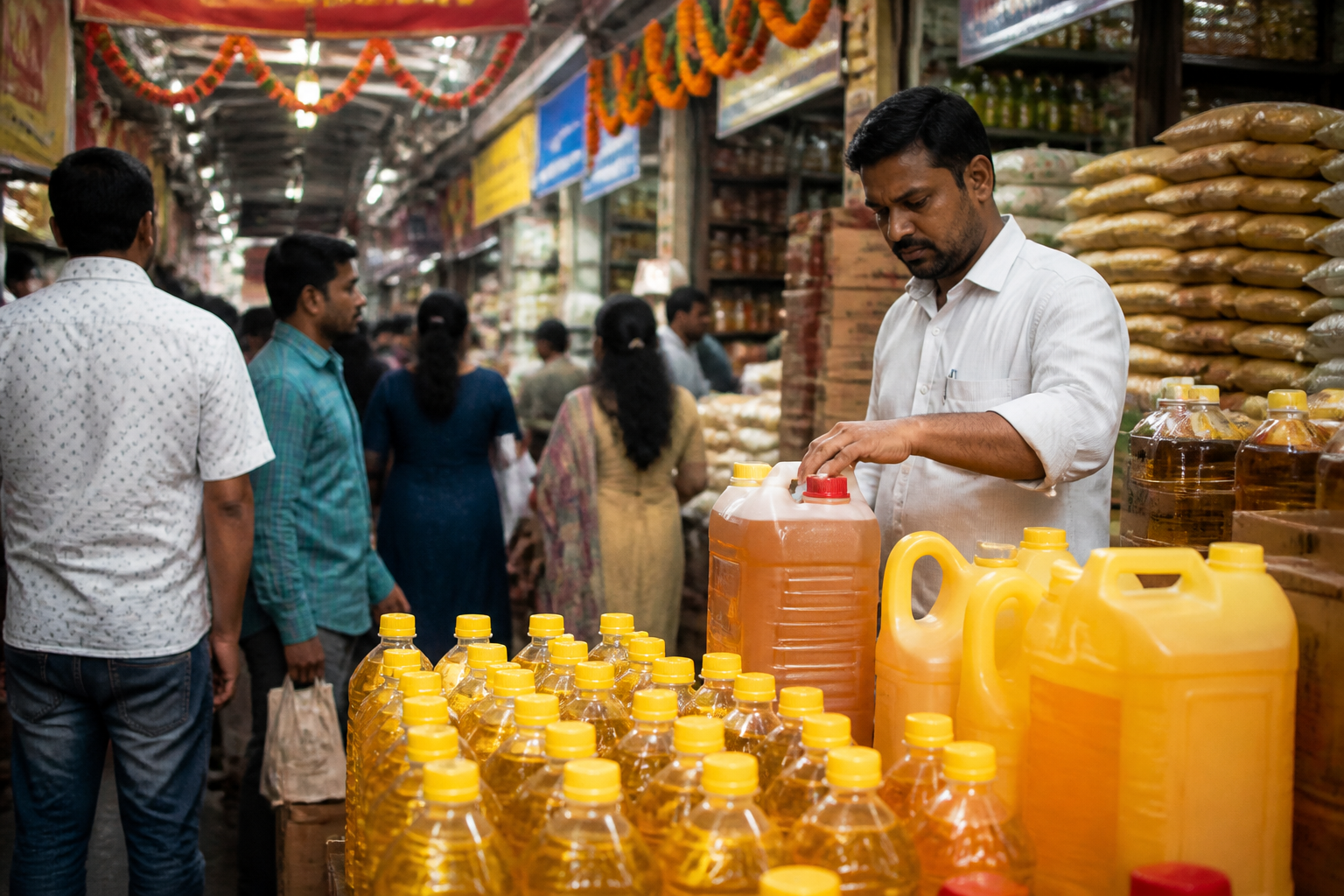
The edible oil import duty cut announced ahead of the festive season is being presented as immediate relief for Indian households, but its deeper significance lies in how strongly the country’s food prices remain tied to overseas supply. The government has reduced duties on crude and refined palm, soybean and sunflower oils, seeking to ease costs at a time when vegetable oil prices have risen by about 20% over the past year, according to the report by Aaj Tak Business.
The measure is important for cities because edible oil is not only a household kitchen staple. It is also a basic input for restaurants, street-food sellers, sweet shops, snack manufacturers and small food businesses. A change in its landed cost can influence the price of prepared food, festival purchases and the operating margins of businesses that serve urban consumers. However, the notification itself does not establish how quickly or fully the duty reduction will reach consumers. That pass-through will depend on international prices, inventories, refining costs, transport expenses and the pricing decisions of companies and traders.
According to the government notification cited in the report, the basic customs duty on crude palm oil and crude soybean oil has been reduced from 10% to 5%. The duty on refined palm oil and refined soybean oil has been lowered from 32.5% to 27.5%. The basic import duty on crude sunflower oil has been reduced from 10% to zero, while the duty on refined sunflower oil has been cut from 32.5% to 22.5%.
The report also states that the total import duty on crude palm oil and crude soybean oil will now be 11%, compared with 16.5% earlier. These distinctions matter because the effect of a tariff change is not uniform across the edible-oil market. Crude oil is imported for processing by domestic refiners, while refined oil enters the country closer to its final consumer form. The lower duty on crude sunflower oil, in particular, changes the relative economics of refining and sourcing different oils.
The policy therefore does more than announce a general reduction in food costs. It reshapes the price relationship between palm, soybean and sunflower oils. A statement attributed in the report to Ashish Acharya, vice-president of Patanjali Foods Ltd, says sunflower oil is likely to benefit the most from the change because it will become more attractive to refiners. The same statement suggests that this could reduce some demand for soybean and palm oils.
That shift is significant for India’s edible-oil system because the country imports nearly two-thirds of its vegetable-oil requirement, according to the report. Palm, soybean and sunflower oil are sourced particularly from Malaysia, Indonesia, Argentina, Russia and Ukraine. This import dependence means domestic consumers are exposed not only to Indian agricultural output and local distribution costs but also to international commodity prices, currency movements, shipping conditions and geopolitical disruption.
The tariff decision is thus a short-term price intervention within a structurally import-dependent food economy. Reducing the duty can lower the tax component of imported oil, but it cannot by itself remove the external risks that shape the final price. If global prices rise, the benefit of a lower tariff can be absorbed before it reaches the retail market. If supply conditions remain favourable and companies pass on the reduction, consumers may see greater relief. The report says prices could decline, but it does not provide a retail-price forecast or establish the size of the expected reduction.
The timing also connects the decision to the way urban demand changes during the festive period. The report identifies September to November as a period of major religious festivals and expects higher consumption of sweets, savouries and fried foods. This demand is spread across households and commercial establishments. In cities, the impact is visible through neighbourhood sweet shops, restaurants, caterers, snack producers and informal food vendors, many of whom operate with limited room to absorb input-cost increases.
For these businesses, edible oil is one component of a wider cost structure that includes flour, pulses, sugar, fuel, rent, labour and transport. The supplied report does not quantify how much oil contributes to the cost of a particular food item, so the tariff cut cannot be treated as a guaranteed reduction in menu prices or festive food prices. It can, however, alter the cost pressure faced by businesses at a period when demand is expected to increase.
The urban dimension is also visible in the gap between national policy and retail experience. A notification is implemented at the border, but households encounter its effect through wholesalers, refiners, distributors, retailers and food outlets. Each stage has its own inventory cycle and margin structure. As a result, a duty change may not appear immediately in retail prices, and the effect may differ between cities and markets. The report provides no city-level comparison, which means the actual distribution of relief remains unestablished in the supplied material.
This is why import-duty policy often operates as a price-management tool rather than a complete food-security strategy. It can respond quickly to a period of inflationary pressure, particularly when the government wants to contain costs before a high-consumption season. But repeated dependence on such interventions can also reveal the vulnerability of the underlying supply system. When a country imports nearly two-thirds of its vegetable-oil requirement, domestic affordability becomes closely connected to decisions made in global commodity markets.
The government’s choice to reduce duties on both crude and refined oils indicates an attempt to influence more than one part of the supply chain. Lower duties on crude oil may support domestic refiners by reducing the cost of imported feedstock. Lower duties on refined oil may increase competitive pressure on the domestic market by making finished imports less expensive. The supplied report does not explain the government’s stated policy objective beyond the effort to provide festive-season relief, nor does it specify how long the revised duties will remain in force.
That duration will be important for assessing the policy. A temporary reduction can provide short-term relief but may create uncertainty for refiners, importers and traders if businesses do not know how long the duty structure will apply. A longer-lasting change could have a more durable effect on sourcing and product demand, but it could also change the competitive balance between imported refined oil and oil processed domestically. The source material does not establish the government’s intended timeline or any review mechanism.
The report’s reference to Malaysia’s palm-oil futures and US soybean-oil futures also shows that Indian demand can influence international markets. Traders reportedly expect stronger Indian consumption to support prices for these commodities. This creates a possible tension within the policy: lower import duties may reduce the domestic tax burden, but increased demand can support global prices. Without data on current inventories, import volumes after the notification or retail pass-through, the net effect cannot yet be measured.
The clearest evidence available is therefore about the policy change and the exposure it reveals. The government has reduced import duties across key edible oils; the country remains heavily dependent on imports; prices have risen substantially over the past year; and the festive season is expected to increase demand. What is not yet established is the size, speed and geographical spread of the relief for households and food businesses.
The next stage will be visible in import activity, refinery choices and retail prices. Sunflower oil’s changed duty position may make it more attractive to refiners, while palm and soybean oils will continue to compete within a market shaped by global supply and domestic demand. For urban consumers, the real test of the notification will not be the headline reduction in duty but whether it produces a measurable decline in the prices paid for cooking oil and prepared food during the festive season.
