


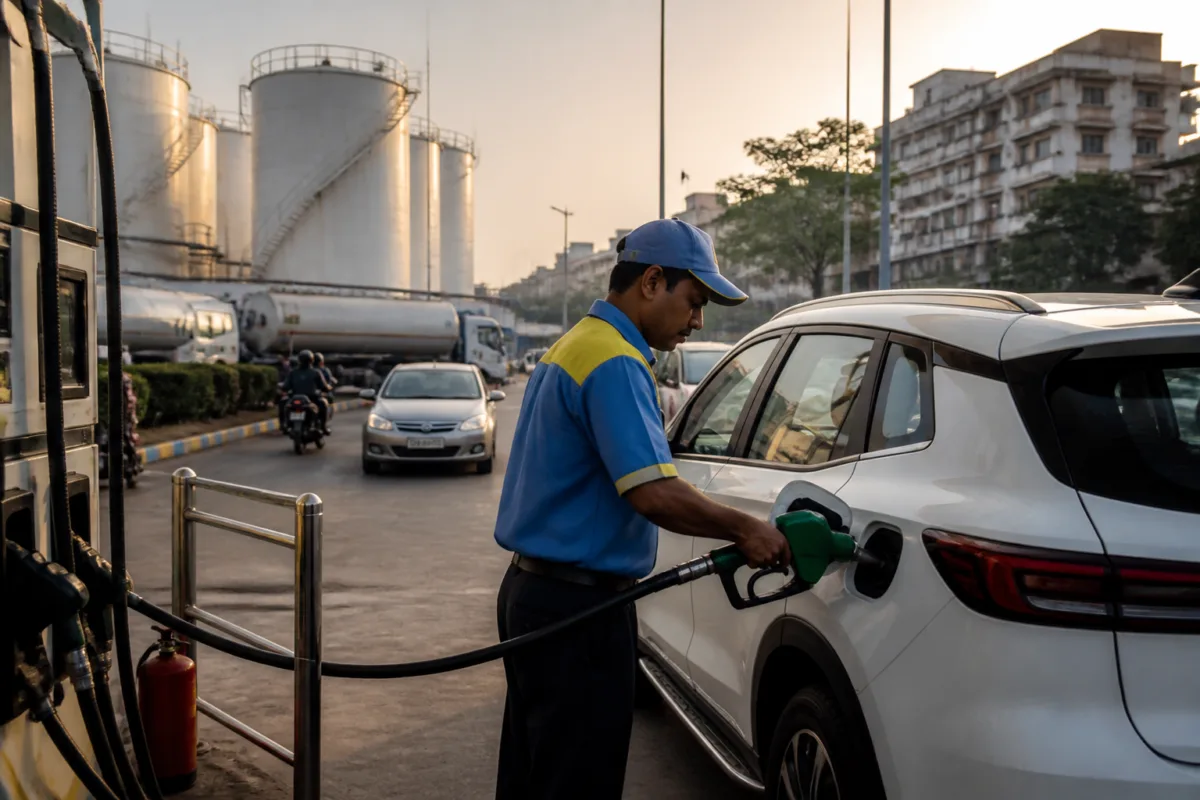
India’s move to permit vehicles capable of running on nearly pure ethanol has exposed a basic infrastructure question: whether the country can supply the fuel at the scale required. The Supreme Court has asked the Centre how fuel supply would be arranged if 100% ethanol-run vehicles are permitted, while the government has acknowledged that large-scale manufacturing rearrangements would be necessary.
The question is significant because the regulatory change and the fuel policy are moving at different speeds. On October 26, the Ministry of Road Transport and Highways amended the Central Motor Vehicles Rules, 1989, to allow flex-fuel vehicles capable of running on blends up to E100. E100 refers to fuel containing nearly pure ethanol. The amendment expressly included E100 alongside E85 in emission certification provisions. Existing E20 vehicles were not affected by the change.
A day later, Petroleum and Natural Gas Minister Hardeep Singh Puri said the Centre had no immediate plan to raise ethanol blending in petrol beyond the current 20% level. The combination of these two developments has created the policy tension now before the Supreme Court: manufacturers may be permitted to produce vehicles designed for much higher ethanol concentrations, even as the near-term national petrol-blending policy remains capped at 20%.
The court raised the issue while hearing pleas relating to ethanol allocation for Ethanol Supply Year 2025-26. A bench of Justices M M Sundresh and Prasanna B Varale referred to recent media reports about the E100 approval and asked how supply would be made available if permission had been granted for vehicles that run on 100% ethanol. The bench described the question as an academic inquiry, but its wider significance lies in the relationship between vehicle regulation, fuel availability and public policy.
Attorney General R Venkataramani told the court that the transition would require large-scale manufacturing rearrangements. That response indicates that E100 adoption is not only a matter of changing fuel specifications or vehicle certification. It would require coordination across automobile manufacturing, fuel production, distribution, retail infrastructure and the contracts governing ethanol procurement.
The supplied court proceedings do not establish a national timetable for E100 vehicle deployment or a detailed plan for making E100 available to motorists. They do establish, however, that the permission to certify such vehicles does not by itself guarantee that the fuel will be accessible through the existing retail network. That distinction is central to understanding the policy challenge.
Flex-fuel vehicles are designed to operate on higher ethanol blends such as E85, which contains 85% ethanol and 15% petrol, and E100. Conventional petrol vehicles are currently approved for lower ethanol concentrations. The amended motor vehicle rules therefore create a regulatory pathway for a different class of vehicles. They do not, according to the material supplied, announce a nationwide network of E100 pumps or an expanded blending mandate.
This creates a potential mismatch between vehicle capability and energy infrastructure. A vehicle can be technically approved for a fuel that is not consistently available to its owner. For urban transport systems, such a mismatch affects more than automobile manufacturers. It can influence consumer choice, fuel-station investment, maintenance systems, vehicle warranties and the practical value of new vehicle technology.
The issue is also tied to how ethanol is allocated. The Supreme Court was hearing a dispute involving the allocation of ethanol for ESY 2025-26. On June 30, the court ordered status quo on a Karnataka High Court direction concerning enhanced ethanol allocation. The case followed a plea by an oil marketing company, which argued that the High Court’s order could destabilise the national policy of 20% ethanol blending in petrol.
The Karnataka High Court had directed Bharat Petroleum Corporation Limited, Hindustan Petroleum Corporation Limited and Indian Oil Corporation Limited to consider and decide a representation from a dedicated ethanol manufacturer seeking enhanced allocation for ESY 2025-26. The High Court had held that dedicated ethanol plants established under government policy and contractually bound to supply ethanol exclusively to oil marketing companies could not be denied the benefit of preferential allocation contemplated under long-term offtake agreements.
That dispute shows why E100 cannot be treated as a standalone automobile policy. Fuel availability depends on contracts, allocation rules, oil marketing company procurement and the balance between national blending targets and the claims of individual producers. A change in vehicle technology would therefore have consequences for an already contested supply system.
The court also placed farmers at the centre of the discussion. Justice Sundresh said the larger public interest and environmental aspects had to be considered, but emphasised the need to empower farmers, describing them as a part of the issue that had not received enough attention. The Attorney General said he would address the farmers’ concerns during his arguments. Another advocate told the court that ethanol promotion would help farmers in some form, while counsel representing the central policy position said the government’s approach already took farmers’ interests into account.
This emphasis broadens the policy question beyond fuel substitution. Ethanol is being considered not only as an alternative or blended transport fuel but also as part of an agricultural and rural-economy framework. The hearing record supplied by Economic Times does not quantify the income effects for farmers or establish how additional ethanol demand would be distributed across producers. It does show that the court expects the policy to be assessed against rural livelihoods as well as transport and environmental objectives.
The environmental dimension is similarly present but not resolved by the regulatory amendment. The bench said the issue required consideration from an environmental point of view. The supplied material does not provide a lifecycle emissions assessment, a comparison between ethanol and petrol, or an estimate of the environmental impact of large-scale E100 adoption. Those questions remain separate from the immediate fact that E100 vehicles have been permitted within the motor vehicle rules.
The current policy position is therefore defined by three different institutional actions. The transport ministry has updated vehicle certification rules. The petroleum ministry has said there is no immediate plan to move petrol blending beyond 20%. The Supreme Court is examining ethanol allocation while asking the government to explain how a higher-ethanol vehicle fleet would be supplied. These actions are connected, but they do not yet amount to a single implementation framework.
For cities, the distinction matters because urban mobility depends on dependable, standardised and widely accessible energy systems. Vehicle approvals are visible to manufacturers and consumers, but the less visible parts of the system—fuel allocation, retail distribution, procurement agreements and supply continuity—determine whether a technology can function in daily life. The court’s question brings that institutional layer into view.
It also raises a sequencing issue. If vehicle production is permitted before fuel availability is planned, consumers could face uncertainty over where and how to refuel. If fuel procurement expands before demand is established, oil marketing companies and producers could face allocation disputes. The material supplied does not show that either outcome has occurred, but the competing policy positions explain why coordination is necessary.
The immediate facts are narrower than some of the broader claims being made around ethanol. India has permitted certification of flex-fuel vehicles capable of operating on E100; the Centre has said petrol blending will not immediately rise beyond 20%; and the Attorney General has acknowledged that large-scale manufacturing changes would be required. The Supreme Court is also examining how ethanol allocation should be handled for ESY 2025-26, including the position of dedicated ethanol plants and the interests of farmers.
What remains unresolved is the operational pathway from permission to availability. The supplied report does not identify an E100 retail rollout, a vehicle deployment target, a new national supply schedule or a settled allocation formula. The Supreme Court has posted the matter for hearing next month, when the government’s response on the farmers’ issue and the wider policy questions will be examined further.

