


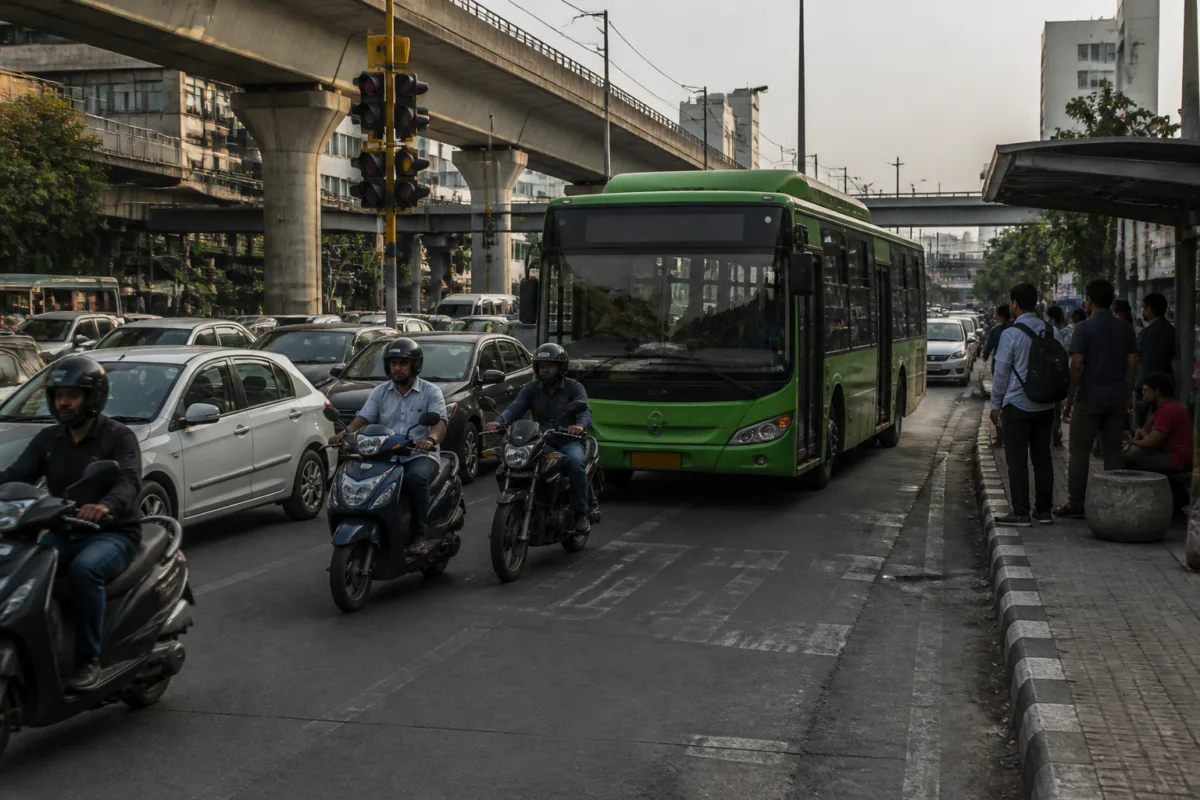
Delhi’s DTC bus safety problem is larger than the conduct of individual drivers. Three fatal accidents involving Delhi Transport Corporation buses in a month, alongside 1,271 on-the-spot challans issued till October 20 this year, point to a public transport system operating under pressure from congestion, weak lane discipline, schedule demands and road environments that do not consistently support safe bus movement.
The figures are significant because they combine two different signals. Fatal crashes represent the most serious consequence of unsafe operations. Traffic challans provide a wider record of everyday violations, including improper parking, signal jumping, stop-line violations, permit violations and failure to wear seat belts. Read together, they suggest that safety risks are not confined to exceptional incidents. They are also visible in routine interactions between buses, roads, junctions, bus stops and other road users.
The data reported by the Times of India shows that 814 of the 1,271 challans issued to DTC buses till October 20 were for improper or obstructive parking. Signal jumping accounted for 148 challans, while 82 were issued for stop-line violations. There were also 59 permit-related violations and 56 cases involving drivers not wearing seat belts. DTC buses received 1,487 on-the-spot challans in 2025, including 755 for improper or obstructive parking, 130 for jumping signals, 53 for stop-line violations, 252 for permit violations and 172 for not wearing seat belts.
The largest category in both periods was improper or obstructive parking. That does not by itself establish why each violation occurred, or whether the bus driver, road design, enforcement conditions or surrounding traffic was responsible in a particular case. It does, however, identify bus stopping and road-space management as central parts of the safety problem. A bus that cannot pull into, wait at or leave a designated stopping area without obstructing traffic is operating within a conflict between public transport operations and the physical organisation of the street.
That conflict is especially important in a city where buses share road space with two-wheelers, cyclists and other vehicles. Rohit Baluja, president of the Institute of Road Traffic Education, said Delhi lacks properly traffic-engineered bus lanes. In his assessment, requiring buses to remain in designated lanes does not make those lanes exclusive or safe. Buses continue to operate in mixed traffic, with frequent lane movements creating conflicts with vulnerable road users.
This distinction between a marked lane and a functioning bus priority system is crucial. A lane designation can impose an operational expectation on a bus driver, but it cannot by itself protect that lane from encroachment or provide a safe path through junctions and bus stops. If two-wheelers and other vehicles occupy bus lanes, buses may be forced to merge into adjacent lanes. The result is not simply slower travel. It can produce sudden lane changes, interruptions in bus movement and greater interaction with faster or less predictable traffic.
The report also connects safety to the way bus services are scheduled. A traffic officer said drivers often cite delays and pressure to get passengers to their destinations on time. In some cases, drivers reportedly move forward when they fail to stop at a designated bus stop but passengers are still waiting there, creating another operational dilemma. The officer said action is taken against drivers found guilty of negligence and other traffic violations, while drivers are also sensitised to road safety and informed about the legal consequences of violations.
These responses address individual behaviour, but the reported explanations indicate that behaviour is being shaped by operating conditions. Former Delhi deputy transport commissioner Anil Chhikara said contractual drivers face pressure to meet stipulated timings and complete assigned trips within their duty hours. Heavy congestion contributes to delays, he said, prompting drivers to make up for lost time. The same pressure can encourage dangerous overtaking, particularly when buses are trying to recover time in crowded traffic.
The distinction matters for accountability. A driver who jumps a signal, overtakes dangerously or fails to follow a stopping rule may still be responsible for that act. But a safety system that examines only the final act can miss the conditions that repeatedly create the risk. If schedules do not adequately account for congestion, if bus lanes are routinely blocked, or if bus stops require buses to merge across moving traffic, then enforcement against drivers alone cannot resolve the underlying exposure.
Baluja argued that crashes and traffic violations should be treated as symptoms through which systemic failures are identified. He called for a comprehensive audit of bus operations covering lane design, junctions, bus stops, schedule pressures and enforcement practices. His position extends responsibility beyond drivers to the authorities and operators responsible for providing a safe environment in which buses work.
The challan data supports the need for such a broader audit, although it cannot answer all the questions on its own. It records violations, not the full chain of events behind them. It does not show how many buses were operating during the periods covered, how many routes or trips were involved, where the violations occurred, whether they were concentrated at specific junctions or bus stops, or how many of the challans led to disciplinary action. It also does not establish whether the three fatal crashes shared a common location, vehicle condition, road design or driver-related factor.
Those missing details are important because the same headline number can represent different types of institutional problem. A high concentration of parking violations near poorly designed bus stops would point towards a road-space and stopping infrastructure issue. Violations distributed across routes and junctions could indicate broader enforcement or operational problems. A pattern involving specific vehicles, drivers or corridors would require a different response. Without this location- and route-level information, the city can identify the scale of the warning but not yet its precise geography.
Chhikara also flagged non-functioning speed-limiting devices as a safety concern. The report does not provide the number of buses affected, the duration of any malfunction or the enforcement mechanism for ensuring that such devices work. That limitation should not diminish the relevance of the issue. Speed management is one of the operational controls that can separate a difficult traffic situation from a fatal one, particularly when heavy vehicles are moving alongside pedestrians, cyclists and two-wheelers. But the available material does not establish how widespread the equipment problem is.
The institutional responsibilities are therefore divided. Traffic authorities issue challans and address violations. DTC is responsible for its buses, drivers and operating practices. Road agencies influence lane design, junction layouts and bus-stop conditions. Enforcement agencies determine whether bus lanes and stopping areas remain usable. Scheduling decisions shape the time pressure under which drivers work. A safety audit that considers only one institution will not capture the complete operating environment described in the report.
This fragmented responsibility is a familiar difficulty in urban transport governance. The bus is visible at the point of conflict, while the factors that shape its movement are distributed across the street network and the administrative system. The result can be a cycle in which drivers are penalised for violations, awareness sessions are conducted, and yet the same operational pressures remain. The reported figures for both 2025 and the current year show why recurring violations need to be examined as a system pattern rather than as isolated events.
The numbers also need careful interpretation. The 1,271 challans recorded till October 20 this year cannot be directly compared with the 1,487 challans reported for the whole of 2025 without knowing whether the figures cover equivalent periods and operating conditions. The categories also changed in their relative weight: improper or obstructive parking remained the largest category, while permit violations and failure to wear seat belts formed a larger share of the 2025 total than in the figures reported till October 20 this year. These differences may reflect enforcement patterns, operational changes or incomplete-year reporting, but the supplied material does not establish the cause.
What the evidence does establish is narrower and more useful. DTC buses are facing repeated traffic violations; three fatal crashes in a month have intensified scrutiny; congestion and schedule pressure are identified by officials and former transport authorities as operational factors; and an independent road-safety expert has linked the problem to bus-lane design, junctions, bus stops and institutional accountability. Together, these facts support a shift from a driver-only explanation to a full-system investigation.
For passengers, the issue is not abstract. Bus users depend on the service to stop predictably, move through traffic safely and complete trips without exposing pedestrians and other road users to avoidable danger. A bus that is delayed by congestion can create pressure to recover time. A bus that cannot access a safe stopping area can create conflicts at the kerb. A bus lane that is not protected can push a large vehicle into mixed traffic. Each problem affects the reliability and safety of the same public transport journey.
The immediate policy question is therefore not whether drivers should obey traffic rules. They should, and the traffic officer’s comments indicate that enforcement and sensitisation are already part of the response. The larger question is whether Delhi’s bus system is being given the road design, operating schedules, equipment and enforcement conditions required to make compliance practicable and consistent.
The available evidence does not yet identify the causes of the three fatal crashes or show whether the reported violations directly contributed to them. It does show that the city has enough warning signals to justify a comprehensive audit of DTC operations. The most important next step is the one identified in the report: examining lane design, junctions, bus stops, schedule pressures, speed-limiting devices and enforcement together, while preserving individual accountability where negligence or violations are established. DTC had not provided an immediate response when contacted, leaving the agency’s position and any planned corrective measures to be clarified.

