


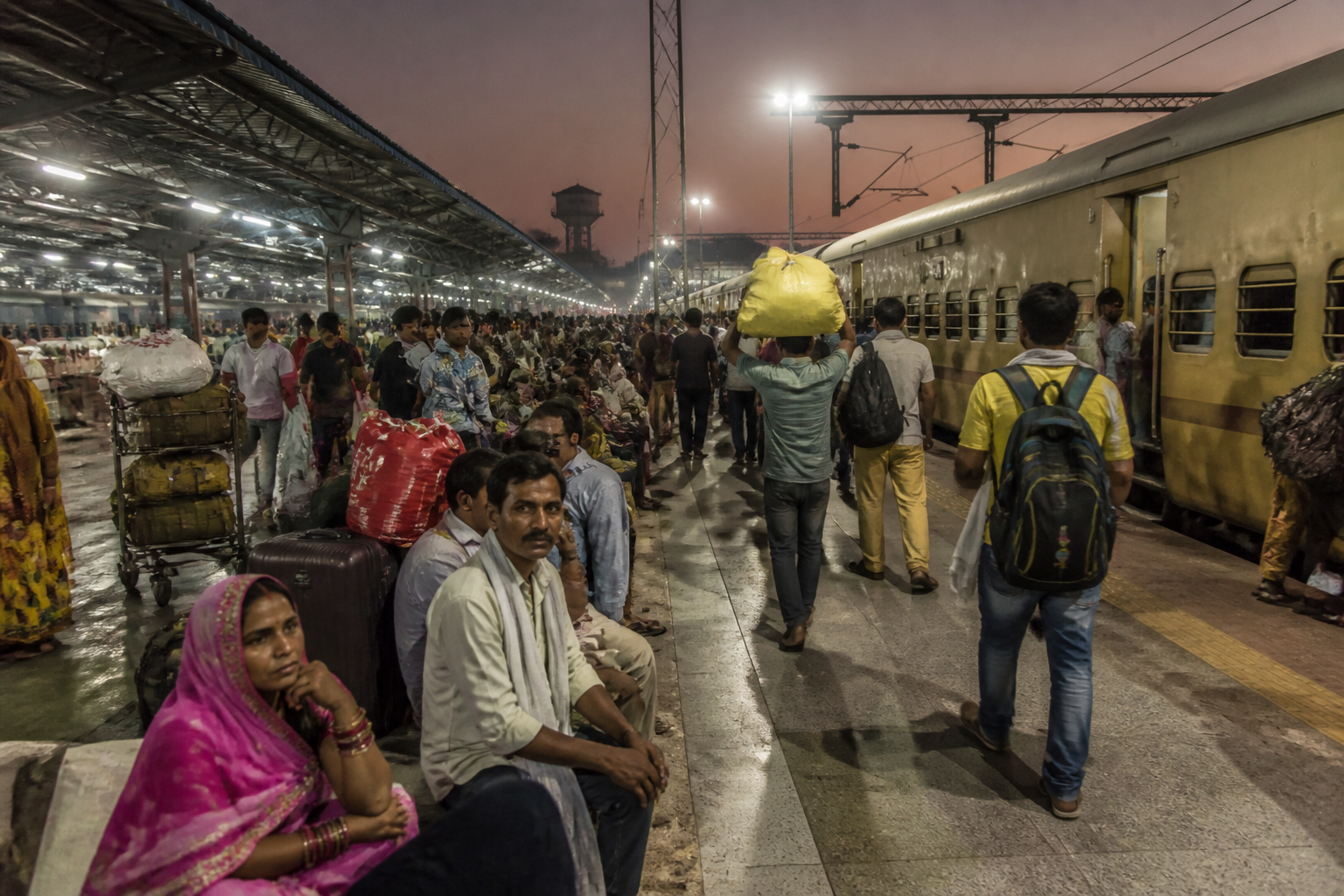
The Diwali Chhath travel rush is exposing a familiar weakness in India’s urban mobility system: millions of workers can reach jobs in major cities more easily than they can return home affordably during the country’s most important festival period. As railway bookings fill rapidly and airfares rise sharply on routes linking Delhi, Mumbai, Bengaluru and Hyderabad with Bihar and Jharkhand, the annual migration is becoming a test of transport capacity, affordability and planning.
This year, Diwali falls on 8 November, while Chhath Puja will be observed from 13 to 16 November. The evening arghya will take place on 15 November and the morning arghya on 16 November. These dates create a concentrated travel window rather than a uniform increase in demand. Workers and families living in other states attempt to travel within a few days before the festivals and return shortly afterwards, placing extraordinary pressure on specific corridors.
The supplied report describes the problem through the booking status of trains and the price of available flights. On several prominent services from Delhi to Bihar, including the Tejas Rajdhani Express, Sampoorna Kranti Express, Sampark Kranti Express, Vaishali Express, Purbiya Express, Magadh Express, Amrit Bharat Express and Garib Rath, tickets for November were reported as unavailable. In several cases, the booking display had moved beyond waiting lists to ‘regret’, indicating that passengers could no longer expect even a waiting ticket to become available.
That distinction matters. A waiting list still offers a formal possibility of travel if cancellations occur or additional capacity is added. A ‘regret’ status indicates that the booking system is no longer accepting passengers for that quota or service. For families planning travel around fixed religious dates, the loss of that possibility leaves few practical alternatives. The issue is not simply that trains are crowded; it is that the transport network has limited flexibility when demand rises simultaneously across multiple origin-destination pairs.
The Mumbai-Bihar corridor illustrates the pressure at a more granular level. The 13202 Lokmanya Tilak Terminus–Rajgir Express was reported to have waiting numbers beginning at 14 on 31 October and reaching 16 by 3 November. The service showed ‘regret’ from 5 to 10 November, followed by a waiting number of 17 on 11 November. On the 12336 Lokmanya Tilak Terminus–Bhagalpur Express, waiting numbers were reported at 40 on 1 November and 37 on 8 November, while ‘regret’ appeared on 3 and 10 November.
These figures show how demand is distributed across a limited number of long-distance services. The availability of one train does not necessarily solve the problem if its route, timing or destination does not match where passengers live. Travellers heading to areas around Patna, Bhagalpur, Rajgir or other parts of Bihar may not be able to substitute one service for another without adding road travel, transfers or additional cost.
The constraint is more severe for passengers travelling from Hyderabad. The 12791 Superfast Express, described in the report as a major option on the route, covers approximately 1,830 kilometres and takes about 32 hours and 50 minutes to reach Danapur. ‘Regret’ was reported for several dates in October. Dependence on a single prominent service turns the festival journey into a narrow scheduling problem: if a passenger misses the booking window, the remaining options may involve long detours, multiple transfers or expensive air travel.
Air travel is technically available, but the pricing reported on major routes makes it an unequal substitute for rail. Economy fares from Delhi to Patna were reported at approximately Rs 8,000 to Rs 13,000 for the beginning of November. Mumbai-Patna fares had risen above Rs 16,000, while Hyderabad-Patna fares were above Rs 23,000. On the Delhi-Darbhanga route, initial November fares were reported between Rs 9,000 and Rs 16,000.
The pressure extends into Jharkhand. The Mumbai-Ranchi fare was reported to have reached Rs 26,000. Fares from Delhi to Ranchi, Durgapur and Deoghar were described as roughly double normal levels for November, while fares from Mumbai and Bengaluru to these destinations were reported to have increased by up to three times. Passengers travelling to Dhanbad face an additional connectivity problem because they may need to use Ranchi, Durgapur or Deoghar as entry points before continuing by road or another mode.
The pattern reveals a hierarchy within India’s transport network. Large cities are connected by frequent services during ordinary periods, but festival mobility depends on whether the network can add capacity quickly on a small number of dates. The result is a sharp difference between regular and peak-period accessibility. A route may be affordable and manageable for most of the year but become inaccessible to lower- and middle-income travellers when demand is concentrated around a religious festival.
This is also a question of how urban India is organised. Employment is concentrated in metropolitan regions, while households, social networks and cultural obligations remain distributed across smaller cities, towns and villages. The annual movement from Delhi, Mumbai, Bengaluru and Hyderabad towards Bihar and Jharkhand is therefore not discretionary tourism. It is linked to the geography of work and family life. Transport demand rises because the labour market is spatially separated from the places where people maintain their strongest social ties.
Railways remain the principal mass-transit option for this movement because long-distance train travel can carry large numbers of passengers over extensive distances at prices that are generally more accessible than last-minute flights. When rail capacity is exhausted, however, passengers do not move into an equivalent public transport alternative. They are pushed towards air travel, private vehicles, buses or complicated combinations of modes. The supplied report focuses on trains and flights, but its details also indicate why road-based options become important for travellers who cannot secure either mode.
The institutional response has been to add temporary railway capacity. For Bihar, the railway plans to operate 16 pairs of special trains, with these services expected to make around 400 trips between 1 October and 30 November. One or two additional air-conditioned coaches may also be attached to regular trains where required. Reported routes include Chandigarh-Patna, Firozpur Cantt-Patna, Anand Vihar-Jogbani, Delhi-Sitamarhi and Patliputra-Anand Vihar.
For Jharkhand, the reported measures include preparations for an Ajmer-Ranchi special train and an extension of the special service operating from Anand Vihar via Ranchi to Santragachi. The Ranchi-Anand Vihar-Ranchi special train numbered 02977 is scheduled to run from 3 October to 29 November, leaving Ranchi on Saturdays and Anand Vihar on Sundays before reaching Ranchi on Mondays. The railway has also announced 102 additional festival special trains for high-demand routes, including services connecting cities with Bihar, Uttar Pradesh, Jharkhand and Bengal.
These measures address the immediate capacity shortage, but they also show the limits of a system that depends on seasonal intervention. Special trains can add seats, yet their usefulness depends on timely announcement, route coverage, departure times, terminal capacity and passengers’ ability to reach the stations. Additional coaches help only where regular services have operational and platform capacity to accommodate them. A train announced after the main booking surge may not benefit passengers who have already been forced to choose costlier alternatives.
The available evidence does not establish the total number of passengers affected, the exact number of additional seats created or the final occupancy of the special trains. It also does not provide a fare comparison across all modes or explain the precise factors behind each airline’s pricing. What it does establish is a consistent gap between concentrated festival demand and the capacity available on key rail corridors, alongside substantially higher reported airfares.
The larger urban question is whether festival travel should continue to be treated primarily as a recurring operational emergency. The railway response shows that authorities recognise the seasonal surge and can mobilise additional services. But the repeated appearance of ‘regret’ statuses and sharp fare increases suggests that the underlying mismatch is not removed by temporary additions alone. The annual nature of Diwali and Chhath provides a predictable planning calendar, even if the exact travel choices of passengers vary.
For cities, the issue connects transport planning with housing, employment and regional development. When workers live far from their families because jobs are concentrated in a few metropolitan centres, mobility systems become the infrastructure that holds those relationships together. The Diwali Chhath travel crisis therefore is not only a story about sold-out trains or expensive flights. It is evidence of how uneven urban opportunity creates predictable, large-scale movements that the transport system must absorb.
The immediate developments to monitor are the release and booking performance of the announced special trains, the addition of coaches to regular services, and the availability and pricing of travel during the festival dates. The supplied report confirms that capacity is being added, but it does not yet establish whether those measures will match demand across the busiest routes.
