


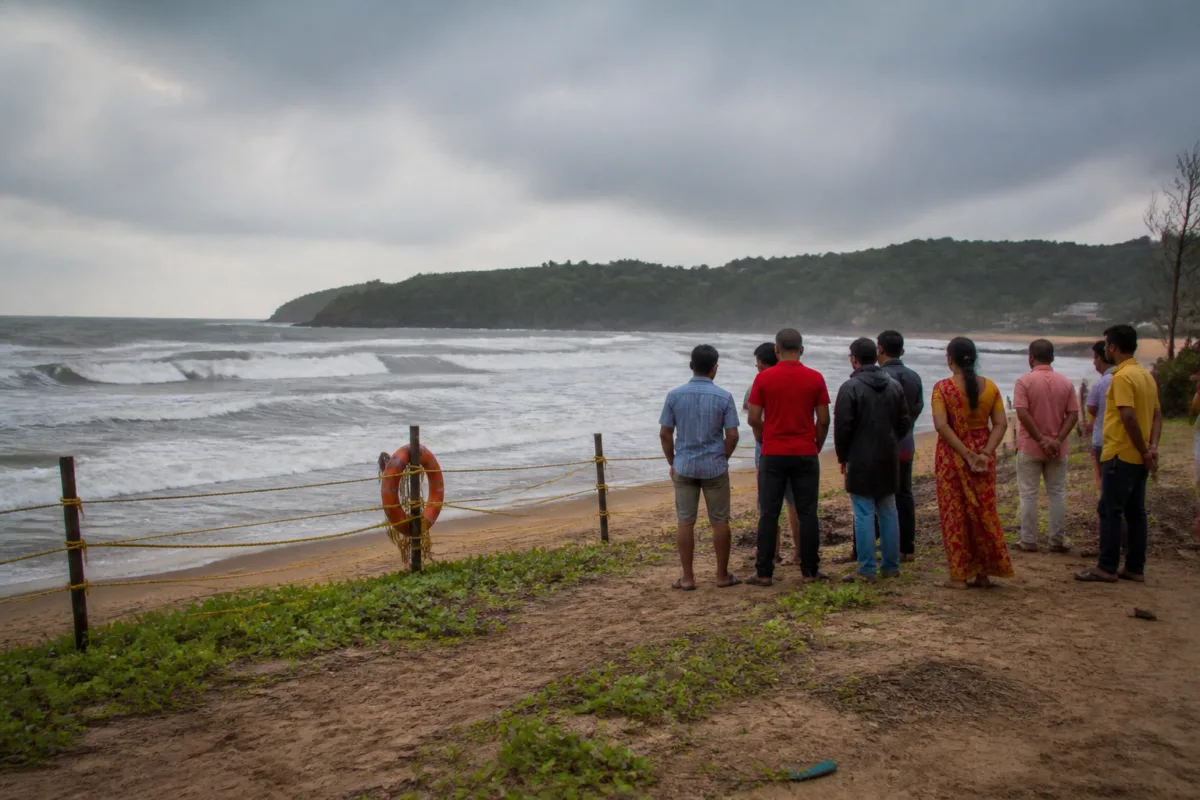
The deaths of eight 16-year-old students at Diveagar beach have moved from a reported drowning incident to a wider examination of how educational excursions are planned, supervised and governed. According to a report by Civic Mirror – Pune, a parent’s complaint led Dighi Coastal Police to register a case against five people associated with Alandi-based Winner Academy. The complaint alleges that parents had warned organisers that the students could not swim, yet the children were allowed to enter the sea without adequate safety equipment.
The central facts now before the police are serious but remain allegations under investigation. The students, all residents of the Alandi area, died after entering the water at Diveagar in Raigad district on 1 October. The report identifies them as Tanmay Vahile, Sumit Ahire, Pranav Bansode, Kaivalya Wasankar, Rajveer Vahile, Yash Wankhede, Soham Bhandwalkar and Kaustubh Daund. The initial police record treated the incident as an accidental death. After a written complaint from Rajveer Vahile’s father, Yuvraj Babasaheb Vahile, a case was registered on 18 October under provisions of the Bharatiya Nyaya Sanhita relating to death caused by negligence and acts carried out with a common intention.
What makes the case consequential for urban governance is not only the location of the tragedy, but the chain of decisions that preceded it. The complaint reportedly says that parents raised concerns about student safety at a meeting on 20 September. They asked what arrangements would be made, particularly for the safety of the girls, and were allegedly assured that staff would remain with the students and bring them back safely. The parent’s complaint further states that organisers were informed that the children could not swim and that they should not be allowed into the water. The family alleges that this condition was accepted before consent was given for the trip.
That alleged exchange is important because it points to the difference between general assurances and specific, enforceable safety conditions. A school or coaching institution may communicate that staff will accompany students, but a safe excursion also depends on whether the itinerary, locations and activities match the information given to parents. In this case, the complaint alleges that the students were taken to a beach different from the one included in the original plan and were later allowed into the sea despite the stated swimming risk. Police are now examining the planning of the trip, the arrangements made for student safety and the decision to permit the students to enter the water.
The itinerary itself also forms part of the complaint. The students reportedly left Alandi at around 3 am on 1 October for a trip that was planned to include Raigad Fort and Shrivardhan beach. When they arrived at Raigad, the ropeway was allegedly not operating even though parents had paid for it. The students therefore had to climb the fort using the stairs, and the complaint says they became tired. Later, at around 5 pm, they were taken to Diveagar beach instead of Shrivardhan. At approximately 5.30 pm, eight students began drowning after reportedly misjudging the depth of the sea.
The report attributes to the complainant the allegation that Winner Academy founders and teachers Amar Gotiram Adak and Mrunal Suresh Narkhede, despite being able to swim, did not attempt to rescue the children. Other students allegedly raised an alarm, after which local residents and police personnel began a search and brought the students out of the water. They were taken to the primary health centre at Bol Panchatan, where doctors declared all eight dead, according to the complaint cited in the report.
These allegations place supervision at the centre of the investigation. Supervision is not simply a question of how many adults accompany a group. It includes whether supervisors know the site, understand the hazards, maintain visual contact with students, prevent prohibited activities and have a workable emergency response. The supplied report does not establish the number of staff present, whether any trained lifeguards or rescue personnel had been engaged, whether flotation devices were available, or whether a formal risk assessment had been completed. Those are among the operational facts that will determine how responsibility is assessed.
The account also exposes a recurring weakness in excursion safety: the gap between a destination’s recreational image and its physical risk. A beach is not a controlled swimming facility. Sea depth, currents, waves, weather and the configuration of the shoreline can change conditions quickly. The report does not provide details of the tide, wave conditions, warning signage, lifeguard presence or local beach-management arrangements at the time. Without those facts, it would be premature to draw conclusions about the exact physical cause of the drownings. However, the alleged decision to permit non-swimmers to enter the sea without adequate safety equipment is a distinct question from the wider environmental conditions.
The case also demonstrates why itinerary changes require fresh consent and fresh risk checks. The reported plan referred to Shrivardhan, while the group was allegedly taken to Diveagar. The two locations are both coastal destinations, but that does not make them interchangeable from a safety-management perspective. A change in location can alter access to emergency care, the availability of rescue staff, shoreline conditions and the supervision required. The source material does not establish why the change was made or who authorised it. Those details will be relevant to the police investigation and to any institutional review.
The administrative chain is similarly significant. The FIR names the academy’s two founders and teachers, receptionist Saba Mehboob Inamdar, and the founders’ wives, Shilpa Amar Adak and Vaishali Mrunal Narkhede. The report does not explain the specific alleged role of each accused person. That distinction matters: an investigation must determine individual responsibility rather than treat the institution as an undifferentiated actor. The police will also need to establish who organised transport and accommodation, who selected the destinations, who communicated with parents, who supervised the students at the beach and who made the decision to allow them into the water.
For parents, the case raises a practical governance problem. Consent is meaningful only when the information provided is accurate and the conditions agreed upon are followed. If parents were told that children who could not swim would not enter the water, then the alleged departure from that condition would be central to the question of accountability. If the itinerary changed, parents would also reasonably need to know whether the new location introduced different risks. The supplied report records the allegations but does not include responses from the academy or the other accused individuals. Their positions, if provided, will be important to a complete account.
The tragedy further highlights the difference between emergency response and preventive safety. Local residents and police reportedly conducted the search after the students began drowning. That response may have helped locate the children, but it came after the critical failure alleged in the complaint. Preventive measures—keeping non-swimmers out of the water, ensuring trained supervision, checking the site and having rescue equipment available—are designed to prevent an emergency from becoming a mass-casualty event. The report does not establish whether such measures were present or absent in full; it records the parent’s allegation that adequate safety equipment was not provided.
The available evidence therefore establishes a sequence, but not yet a final finding of liability. Eight students died at Diveagar on 1 October. Their parent’s complaint alleges prior warnings, a change in destination, fatigue after climbing Raigad Fort, entry into the sea without sufficient safety equipment and a failure by two academy founders to attempt a rescue. Police registered a case on 18 October and are investigating the excursion’s planning, safety arrangements and decisions at the beach. The supplied report does not contain an official response from the academy, a completed investigation report or a judicial finding.
The larger urban question is how institutions that organise group travel manage risk when they operate across different local jurisdictions and public spaces. A student excursion can involve a private organiser, parents, police, local authorities, health facilities, transport operators and beach-management systems. When responsibility is not clearly documented before departure, the burden of reconstructing decisions falls on investigators after a disaster. The Diveagar case shows why the safety of an excursion must be treated as a formal operational process rather than as an informal promise to parents.
The next stage is the police inquiry into the allegations and the specific roles of those named in the FIR. The facts that remain to be established include the precise safety instructions given to parents, the reason for the itinerary change, the number and training of supervisors, the availability of rescue equipment, the condition of the beach and the actions taken when the students entered the water. Until those questions are answered, the case should be understood as an alleged failure of excursion safety under investigation—not as a completed finding of criminal responsibility.

