


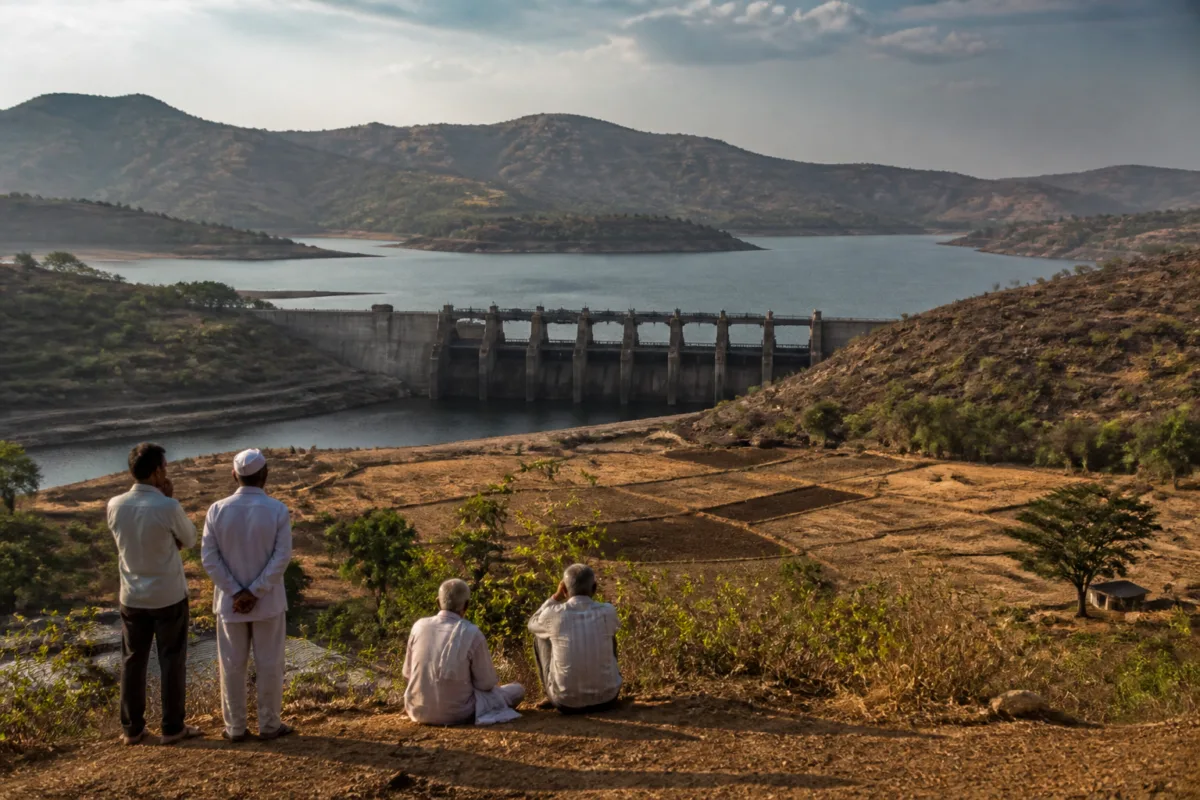
Dimbhe Dam water storage is close to full, but the villages around the reservoir are facing a very different reality. The dam in the Pune district reportedly holds about 99 per cent of its capacity, yet farmers in its catchment area say a weak monsoon has damaged paddy and other crops and raised concerns about drinking water. The contradiction is central to the emerging dispute: a reservoir can appear secure on paper while the communities living closest to it remain exposed to drought-like conditions.
The report by Lokmat – Pune places Dimbhe Dam within a wider irrigation and water-allocation system serving agricultural areas in Pune and Ahmednagar districts. The reservoir is described as an important source for farming in its command area, where demand for irrigation water could increase as rainfall remains uncertain. At the same time, villages located within the dam’s catchment and surrounding area must retain enough water for domestic use through the remaining winter and summer months.
This is not simply a question of whether the dam has water. It is a question of which measure of water security is being used, who controls the release of water, and whether local needs are protected before water is transferred to areas that depend on the reservoir for irrigation. The report indicates that these questions are likely to become more contentious as farmers in the command area seek releases to protect crops and residents near the reservoir seek assurances for drinking water.
A full reservoir does not automatically mean that every settlement connected to it has reliable access. Storage levels describe the quantity held behind the dam, but they do not by themselves establish how much water is practically available for different users, how much can be released safely, or how much must be retained for future domestic demand. The report specifically points to the need to consider drinking water requirements, the actual usable storage, future rainfall and anticipated demand together before deciding on irrigation releases.
That distinction matters because the rainfall deficit has already affected farming in the catchment. According to the report, rainfall this year is said to be around 100 to 200 millimetres lower than during the comparable period last year. The previous year’s storage at the same time was reportedly 100 per cent, compared with about 99 per cent this year. The small difference in reservoir storage therefore sits alongside a much more visible difference in field conditions, where an extended break in rainfall deprived paddy crops of the moisture they needed.
Paddy cultivation is particularly sensitive to the timing and continuity of rainfall. In the Dimbhe catchment, the report says that paddy and other crops are drying because the expected rain did not arrive. This creates a form of water stress that cannot be understood through reservoir storage alone. Farmers may be next to a large water body but still lack a straightforward mechanism to draw on it for their fields. The infrastructure that stores water and the arrangements that distribute it are therefore producing different outcomes for different parts of the same water system.
The prospective conflict is also institutional. The Water Resources Department will have to determine how much water can be released for command-area agriculture without compromising drinking water supplies in villages near the dam. The report says that some areas had already begun showing signs of water scarcity after a prolonged rainfall break in October, even though the winter and summer were still ahead. This places greater importance on advance planning rather than decisions made only after shortages become acute.
The relevant planning challenge is not limited to a single release order. Officials must assess the reservoir’s usable storage, expected demand, the water needs of villages inside the dam area and the possibility of further rainfall variability. The source report does not provide a formal operating schedule or a published allocation plan. It does, however, identify the competing claims that such a plan would need to address: crop protection in the command area, drinking water for catchment villages and the conservation of storage for later months.
The question of leakage adds another layer to the debate. The report says that substantial leakage from the dam is a subject of discussion and calls for a technical assessment of its extent, causes and implications. No quantified leakage figure or official technical finding is provided in the supplied material. That limitation is important. A large reservoir level cannot be treated as proof that the structure is performing efficiently, but claims about losses also need to be measured through an objective inspection.
From a water-management perspective, leakage has two distinct implications. If it represents avoidable loss, it can reduce the quantity available for both irrigation and domestic use. If it reflects a structural or safety concern, it requires a different level of engineering attention. The report links the issue to maintenance and repair, arguing that the dam’s upkeep should receive priority so that available storage can be used more efficiently. The exact nature of the leakage remains to be established through the technical review sought in the report.
The proposed water diversion tunnel has made the question of local water rights more sensitive. According to the report, the tunnel is intended to divert water from Dimbhe Dam elsewhere, but residents are concerned about how the stored water will be used and what the project could mean for villages near the reservoir. Their objection is tied to the history of the dam itself: local residents are described as having given up land for its construction while continuing to feel that nearby villages do not receive adequate water for drinking or agriculture.
This grievance points to a recurring issue in infrastructure governance. A project may be designed to serve a wider regional system, while the costs of land acquisition and displacement are concentrated in the host area. When local drinking water and farming needs remain unresolved, a new transfer project can be viewed not as an extension of public infrastructure but as another decision made without adequate local guarantees. The report says residents and farmer organisations have objected to diverting water elsewhere before local needs are secured.
The available material does not establish the current status, design capacity or implementation timeline of the proposed tunnel. It also does not provide an official statement setting out its allocation rules or the safeguards proposed for affected villages. Those details will be essential to any assessment of whether the tunnel can coexist with local water security. Transparency about the project’s purpose, water volumes and operating arrangements would directly address the uncertainty identified by residents.
Evaporation is another factor that could reduce available storage during the hotter months. The report notes that evaporation varies with temperature, wind speed and the surface area of the reservoir. It does not provide an estimate of the volume expected to be lost at Dimbhe. Still, its inclusion underlines why a 99 per cent storage figure should not be read as a guarantee of year-round supply. The usable quantity will change as water is released, lost and retained for future requirements.
The Dimbhe situation therefore exposes a measurement problem in reservoir-led water planning. Storage percentage is a useful operational indicator, but it is not the same as access, affordability, timing or security. For a farmer whose crop has already suffered because rainfall was interrupted, the presence of water behind the dam may offer little immediate relief unless there is an authorised and timely release. For a village dependent on local sources, the same storage may not remove the risk of summer scarcity if domestic supply arrangements are weak.
The dispute also shows why command-area planning cannot be separated from catchment-area governance. Irrigation systems often connect people who live far from the reservoir with communities that bear the direct environmental and social consequences of the dam. In Dimbhe, the two groups are entering the same allocation debate from different positions: command-area farmers may need releases to protect crops, while catchment residents want priority for drinking water and a stronger claim over water stored close to their homes.
The evidence supplied by Lokmat – Pune confirms the pressure points but leaves several administrative facts unresolved. The report does not state the official usable storage, the volume currently allocated for irrigation, the quantity required for domestic supply, the measured extent of leakage or the formal status of the diversion tunnel. These are not minor technical details. They determine whether the conflict is primarily about scarcity, distribution, infrastructure losses or the absence of enforceable local entitlements.
What is clear is that Dimbhe’s near-full reservoir is not resolving the region’s water insecurity. The immediate challenge for the Water Resources Department is to plan releases without treating drinking water as a residual demand, while also responding to crop losses in the catchment and likely irrigation pressure in the command area. The larger policy question is whether a reservoir can be considered successful when its storage is high but the communities around it remain uncertain about their next crop and their summer drinking water.
The next developments to monitor are the department’s assessment of usable storage and leakage, any decision on irrigation releases, the preparation of a drinking-water contingency plan for villages near the dam and an official clarification on the proposed diversion tunnel. Until those details are placed in the public domain, the 99 per cent figure will continue to present only one part of Dimbhe’s water story.

