


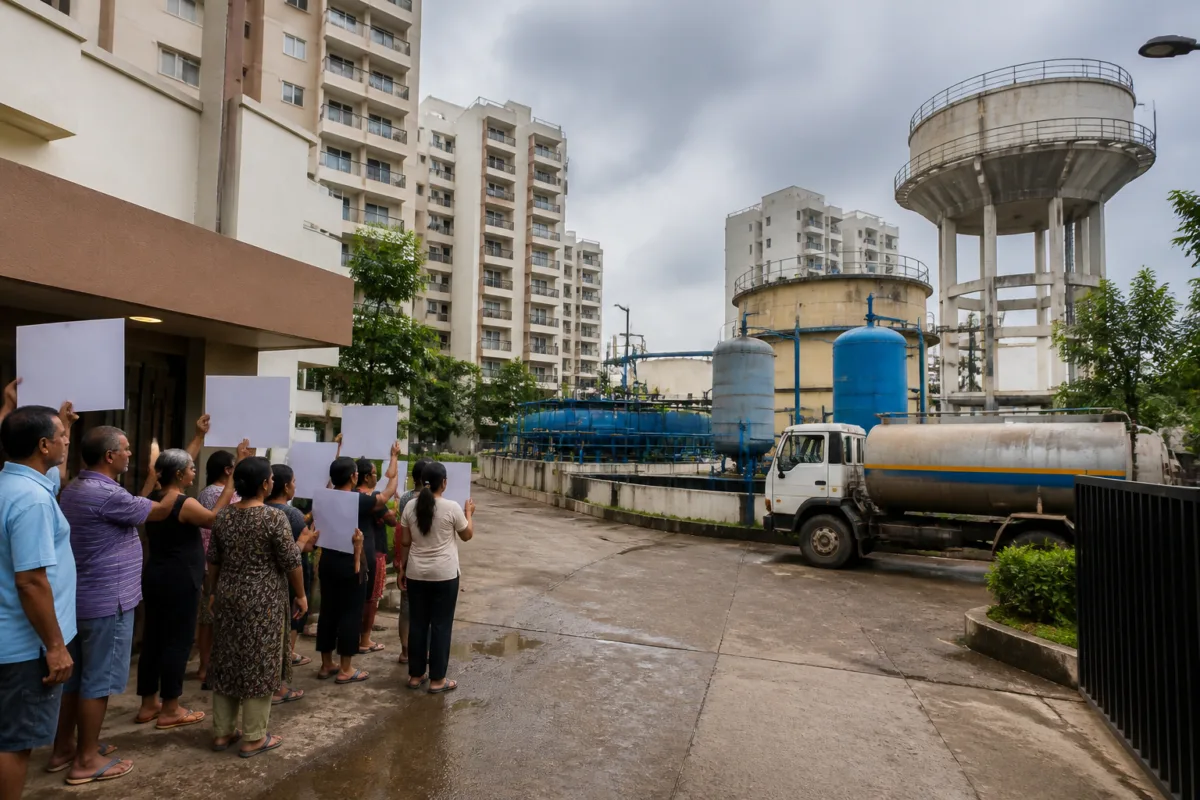
The Dhanori water crisis at Goel Ganga’s Ganga New Town has moved from a housing-complex complaint to a wider question about who is responsible when essential urban services inside a private residential project fail. Residents allege that foul-smelling, black or yellowish water has entered homes, that the sewage treatment plant has not functioned properly for nearly 18 months, and that disputed electricity billing and maintenance demands remain unresolved.
Residents demonstrated outside the developer’s sales office on Saturday, according to Pune Mirror. Their complaints concern services that are not optional amenities but basic components of a functioning housing project: potable water, sewage treatment, electricity metering and common-area maintenance. The immediate allegations are yet to be independently established in the supplied material, but their nature points to a recurring governance problem in India’s expanding private housing developments: the gap between possession of a flat and the delivery of reliable urban infrastructure.
A residential project may be privately developed, but its internal systems are connected to public health and municipal administration. Water supplied through taps affects health. A sewage treatment plant affects groundwater, odour, sanitation and regulatory compliance. Electricity meters affect billing transparency and proof of residence. Maintenance arrangements affect whether roads, pumps, treatment systems and other shared assets continue to work after residents move in.
That is why the dispute at Ganga New Town cannot be understood only as a disagreement between homebuyers and a builder. It also raises questions about inspection, certification, handover, monitoring and enforcement. Residents say they have held seven or eight meetings with developer representatives over approximately one and a half years, but that promised repairs and equipment replacement have not produced a permanent solution. The report does not include the developer’s response to these allegations.
The most serious complaint relates to the water supply. Residents told Pune Mirror that black and yellowish water with a foul smell and what they described as live larvae had flowed through taps. They also alleged health problems including skin issues, hair fall and urinary tract infections. These claims are allegations by residents and are not confirmed by laboratory results in the supplied report. A technical water-quality test, including the source, treatment process and distribution network, would be necessary to establish the nature and cause of any contamination.
The residents’ account also suggests that the problem may involve more than the visible quality of water at the tap. They allege that the sewage treatment plant has been effectively non-functional for nearly one and a half years and that its operation is largely symbolic. A sewage treatment plant is designed to process wastewater before treated output is reused or discharged. If it is not functioning, the consequences can extend beyond inconvenience: untreated or inadequately treated sewage can create odour, attract insects, damage local environmental systems and increase risks for people living near the facility.
Residents further claimed that tankers carrying relatively clean water are brought in when protests intensify or inspections are expected, and that this water is poured into the treatment plant. Pune Mirror explicitly notes that the claim of approximately five tankers a day, and the purpose of the tanker water, have not been independently verified. That limitation is important. It means the allegation should be treated as a matter requiring inspection rather than as an established practice.
The residents have sought a technical inspection by the Pune Municipal Corporation and the Maharashtra Pollution Control Board, along with independent testing of the incoming water and treated output from the sewage plant. Those demands point to the institutional division at the heart of the dispute. A developer may be responsible for constructing and operating project infrastructure for a defined period, while municipal and pollution-control authorities retain regulatory and public-health responsibilities. Residents, meanwhile, need access to records and a clear route for complaints.
The report also describes a dispute over electricity metering in buildings C1, C2 and C3. Resident Aniket Mane alleged that authorised individual meters have not been installed in several flats since possession and that common meters are being used instead. He claimed that some residents received demands of Rs 2,000 or more, including charges that residents said were linked to flat configuration or festive-season consumption. The report does not establish whether these demands comply with applicable electricity regulations, nor does it include the developer’s or electricity distributor’s explanation.
The metering complaint illustrates how building-level infrastructure can become an administrative problem for residents. Individual meters provide a basis for linking consumption to a particular home. Common meters can make it more difficult for residents to understand how charges are calculated, particularly when a project contains occupied and unoccupied flats, different household consumption patterns and shared services. Residents also said the absence of authorised individual bills had created difficulties in securing address proof for Aadhaar updates and other official documentation.
Electricity billing is therefore not only a question of monthly cost. It can influence a resident’s ability to demonstrate occupancy and address, challenge an incorrect demand, and distinguish private consumption from common-area use. In a housing project, unclear billing can also deepen distrust between residents, the developer and the body responsible for maintenance.
Maintenance is the third major part of the dispute. Residents questioned why the developer allegedly continued to raise maintenance demands while the residents’ society was independently undertaking maintenance activities and collecting funds. The supplied report does not provide the project’s agreements, handover documents, society records or accounting statements, so it is not possible to determine which party is contractually responsible for specific services. But the disagreement highlights a common transition point in housing projects: the shift from developer-controlled operations to resident-led management.
That transition can be particularly difficult when essential infrastructure is incomplete, defective or poorly documented. A residents’ association may be able to collect funds and manage routine services, but it may not have the technical capacity or financial resources to replace a sewage treatment plant, redesign a water system or resolve metering arrangements created before possession. If responsibility is disputed, the infrastructure can remain operationally neglected while each side waits for the other to act.
The residents’ provisional committee, described as having 14 to 15 active members, says it has repeatedly sought solutions from the developer. Committee members told the newspaper that commitments to complete work within two or three months have not resulted in lasting improvements. Chairman Prashant Sinha said women, children and elderly residents are continuously exposed to the problem. These statements establish the residents’ perspective, but the supplied material does not provide inspection reports, laboratory results, compliance notices or a formal response from the authorities.
The question for public agencies is therefore not simply whether a protest occurred. It is whether the systems inside the project meet the standards represented at the time of approval, construction and possession. An effective inspection would need to examine the water source, storage tanks, pipelines, treatment equipment, sewage inflow and treated discharge. It would also need to establish whether samples are collected independently, whether laboratory reports are shared with residents, and whether corrective actions are recorded and followed up.
The dispute also raises a broader planning issue for Pune. As the city expands through large private housing projects, more residents depend on infrastructure that sits between private management and public regulation. These projects can function like small urban settlements, with their own roads, water systems, sewage plants, electrical arrangements and maintenance structures. Yet residents may not have the same visibility into these systems as municipal officials or developers, even though failures affect daily life immediately.
The Dhanori case does not, on the evidence supplied, establish that the developer violated a specific rule or that the alleged health effects were caused by the water. It does show a prolonged conflict over services that residents consider essential, with demands for independent technical verification still outstanding. The difference between an allegation and an established finding will depend on water tests, sewage-treatment records, electricity documentation, inspection reports and responses from the developer and relevant authorities.
For residents, the next meaningful development is not another assurance but a documented assessment of the systems they use every day. For the authorities, the case tests whether approvals and compliance mechanisms continue to operate after homebuyers occupy a project. And for Pune’s growing housing market, it raises a structural question: whether possession should be treated as the end of construction, or as the beginning of accountable, monitored service delivery. The requested inspections and independent testing will determine how much of the dispute is a service failure, a regulatory failure, or both.

