


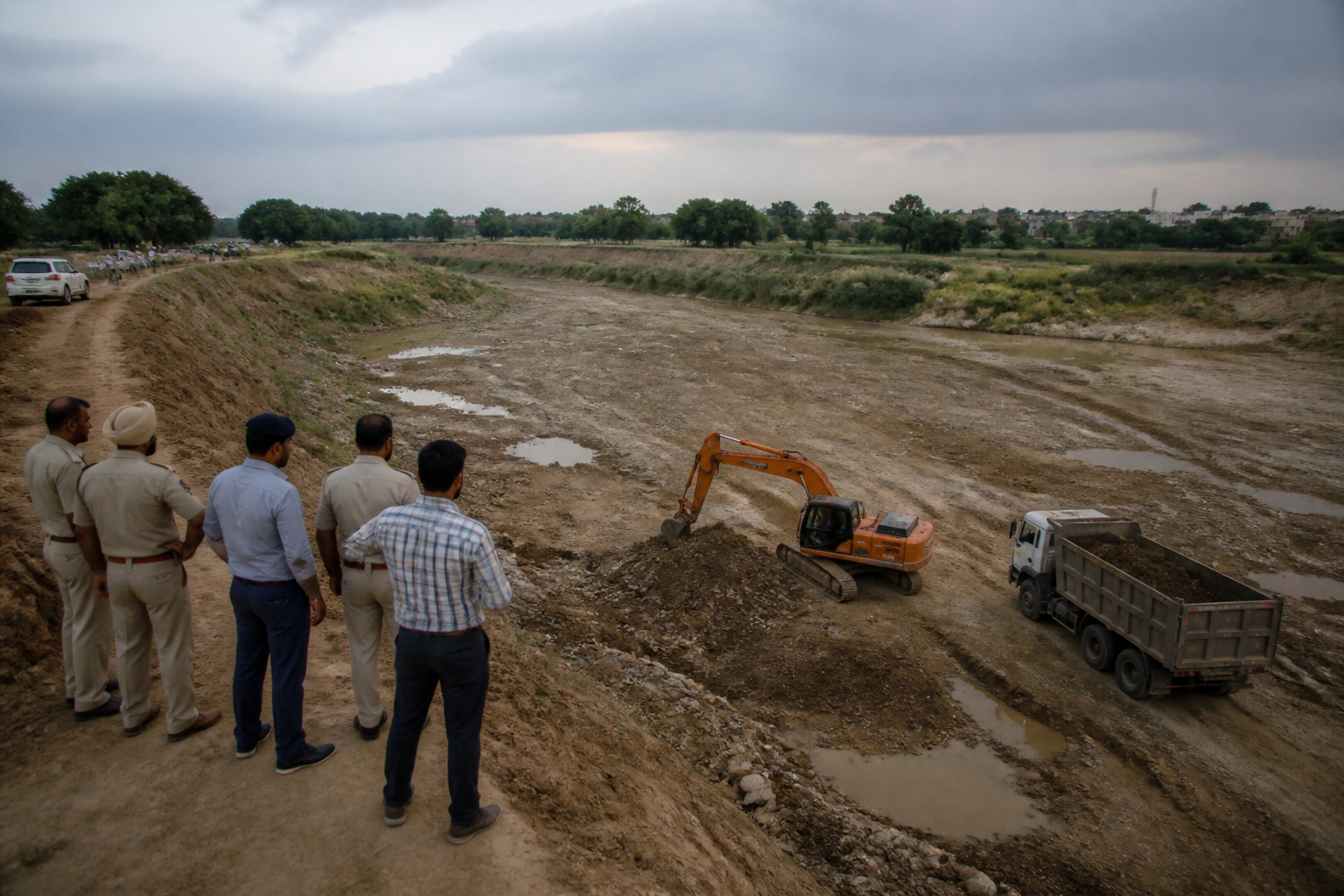
The Derabassi illegal mining crackdown has uncovered 23.7 lakh cubic feet of excavated minor minerals across 11 vulnerable locations, but the most important fact is not only the volume seized or the penalties recovered. The two-month enforcement drive shows how riverbeds, village common land, private parcels and rural transport corridors sit at the intersection of environmental protection, land administration and construction-material supply.
The operation was conducted by the mining department and local administration between July 28 and September 30. It resulted in five FIRs, the seizure of heavy earth-moving machinery and the recovery of more than Rs 20 lakh in compounding penalties from vehicles allegedly involved in transporting mined material. Police registered cases at Handesra and Derabassi police stations over alleged excavation from riverbeds and village common land.
The locations identified in the drive were spread across the Tangri river basin and adjoining rural areas. Inspections covered Jaula Kalan, Nimbuan, Bir Dandrala, Ballopur-Dharamgarh Road and several sites along the Tangri riverbed, including Sarangpur, Bijanpur, Mukandpur, Sundran, Badana and Bauda Baudi. The geographical spread matters because it indicates that enforcement was not limited to one isolated excavation site. It involved a network of vulnerable locations connected by land, watercourses and roads used to move mined material.
The supplied report does not establish how long the excavation had continued at each location, who owned or operated the sites, or where the extracted material was ultimately used. Those gaps are important. The enforcement figures establish the scale of the detected activity, but they do not by themselves establish the total quantity excavated in the wider basin or the full chain of actors involved.
## What the Derabassi illegal mining crackdown reveals
The action combined three forms of enforcement: site inspections, criminal cases and action against transportation. Authorities reported that five FIRs were registered and that eight vehicles were intercepted and challaned under the Punjab Minor Mineral Rules, 2013. During raids at Bijanpur and Antala, officials seized a Poclain excavator, a tipper truck and a JCB machine allegedly being used for illegal mining.
This combination is significant from an administrative standpoint. Excavation and transportation are separate points in the enforcement chain. A site may be identified, but the extracted material still has to be moved. Conversely, a vehicle carrying material may be intercepted even when the original excavation site is not immediately visible. The reported drive therefore attempted to address both the source of the material and its movement through the local road network.
The use of heavy equipment also indicates that the authorities were dealing with mechanised activity rather than only small-scale manual extraction. The report identifies a Poclain excavator and a JCB among the seized machinery, along with a tipper truck. It does not state whether the equipment was owned by the alleged operators, hired, leased or linked to a larger supply operation. That information would be necessary to understand the commercial organisation behind the activity.
The administration described the locations as vulnerable and said enforcement would continue. However, the supplied material does not specify the criteria used to classify a site as vulnerable, how frequently inspections were conducted before the drive, or whether the 11 locations will remain under regular monitoring. These are central questions for a governance system in which illegal excavation can occur across riverbeds, common land and privately held land.
## Why land classification matters
Riverbeds and village common land are not administratively interchangeable with private land. Each category can involve different custodianship, permissions, records and enforcement responsibilities. The report’s reference to all three types of land points to a complicated operating environment in which mining regulation intersects with revenue administration, local government and policing.
The cases registered at Handesra and Derabassi police stations relate to alleged excavation from riverbeds and village common land. That means the enforcement response extended beyond the recovery of minerals or the movement of vehicles. It also addressed the alleged use of land where extraction may affect public or collectively held resources. The report does not provide the relevant ownership records, consent documents or mining permits, so the legal status of individual sites remains a matter for the authorities and courts.
This distinction is especially relevant in rural corridors that are being absorbed into expanding urban regions. The source describes locations along the Tangri basin, village roads and rural settlements around Derabassi, but it does not provide a planning map or identify specific development projects linked to the material. The broader administrative issue, therefore, is not proof of a direct connection to any particular construction project. It is the difficulty of supervising land and material flows across areas where rural land, transport routes and urban expansion meet.
## Enforcement figures and their limits
The reported figure of 23.7 lakh cubic feet gives the operation a measurable scale. More than Rs 20 lakh in compounding penalties and action against eight vehicles provide additional indicators of enforcement activity. Five FIRs and three seized machines show that the authorities used multiple legal and operational tools rather than relying only on spot fines.
At the same time, these figures need to be read carefully. The 23.7 lakh cubic feet refers to illegally excavated minor minerals detected across 11 locations during the stated two-month drive. It should not automatically be treated as the total volume removed from the Tangri river basin, the total quantity transported, or the total value of the material. The report does not state the valuation method, the quantity recovered from each site, or how the volume was measured.
The penalty figure also cannot be interpreted as a complete estimate of economic loss or environmental damage. It represents compounding penalties recovered from vehicles allegedly involved in illegal transportation, according to the report. The article does not provide details of restoration costs, damage assessment, unpaid royalties, court-ordered compensation or the final status of the seized machinery.
These distinctions matter because enforcement statistics can perform two different functions. They can demonstrate that authorities have acted, and they can help measure the scale of detected violations. They cannot, without additional documentation, show whether illegal activity is declining, whether repeat violations have been prevented or whether affected land and riverbeds have been restored.
## The institutional challenge beyond raids
The administration said its continuing focus would be to curb unauthorised excavation, prevent the transportation of illegally mined minor minerals and protect riverbeds and village common land from encroachment and mining activity. That statement identifies three connected responsibilities: monitoring extraction sites, regulating material movement and protecting land under public or community interest.
The operation involved the mining department and local administration, while police stations handled the FIRs. The reported division of roles suggests that illegal mining enforcement depends on coordination between departments rather than on a single agency. Mining officials may identify violations and assess minerals, local administrators may support land and field-level action, and police may investigate alleged offences. The source does not specify which agency is responsible for post-raid monitoring, restoration or prosecution follow-up.
That missing follow-through is the next institutional test. A seizure records intervention at a particular moment. It does not show whether the excavation site has been secured, whether access roads are being monitored, whether extracted areas have been assessed or whether the same machinery or operators have reappeared elsewhere. The administration’s statement that enforcement will continue is therefore important, but the supplied report does not provide a timetable, staffing plan or public monitoring mechanism.
The case also illustrates why transportation controls are central to mineral regulation. Eight vehicles were challaned under the Punjab Minor Mineral Rules, 2013, showing that the movement of material was treated as an enforcement point in its own right. Yet the report does not state whether authorities used transport permits, weighbridge records, route surveillance or digital tracking. Without that information, it is not possible to assess how the material chain was identified or how effectively future movement can be intercepted.
## The larger urban question
Derabassi’s mining enforcement drive sits within a wider urban-system question: how do authorities govern resources and land at the edge of expanding settlements? The locations named in the report are not confined to a formal city centre. They include riverbeds, village roads, panchayat land, private land and rural corridors. These spaces may be outside dense urban development, but their management affects the environmental and administrative conditions under which nearby settlements grow.
The source establishes that a substantial quantity of minor minerals was detected and that authorities took legal and operational action. It does not establish the downstream effects on the Tangri river basin, nearby communities, agricultural land, roads or buildings. Nor does it establish whether any urban construction project received the material. Those questions require land records, inspection reports, mineral transit documentation, environmental assessments and case updates that are not included in the supplied report.
What the evidence does show is a concentrated enforcement response across multiple land types and locations. It also shows that the administration views excavation, transportation and protection of riverbeds and common land as connected problems. The next measure of effectiveness will not be the number of raids alone, but whether the authorities publish follow-up information on the FIRs, seized machinery, detected volumes, penalties and continued monitoring of the 11 vulnerable locations.
For now, the Derabassi operation confirms the scale of the challenge detected during the two-month drive and the need for coordinated oversight across mining, land administration and policing. Officials have said enforcement will continue, with emphasis on unauthorised excavation, illegal transportation and the protection of riverbeds and village common land.
