


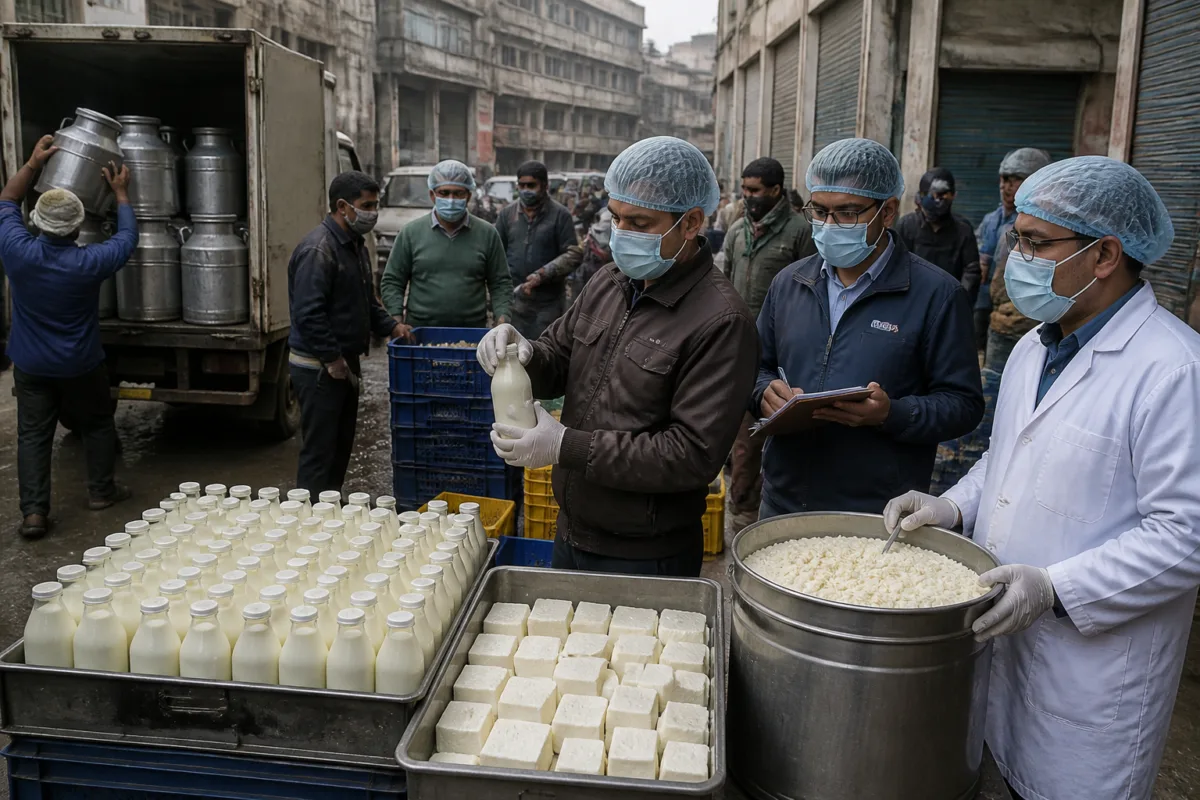
Delhi’s milk supply gap is no longer only a question of where the capital gets its daily dairy requirements. It is also a test of how a large city monitors food moving through an extended regional supply chain, particularly when demand for milk, mawa, paneer and ghee rises sharply during festivals and wedding seasons.
The city produces only about 15 lakh litres of milk a day, against estimated daily demand of 111 lakh litres, according to figures cited in the report. Around 80% of Delhi’s milk and dairy-product supply comes from Uttar Pradesh, Haryana, Rajasthan, Punjab and other states. This dependence makes external supply indispensable, but it also creates multiple points at which quality controls must work: farms, collection centres, processors, transporters, wholesale markets, retailers, sweet shops, restaurants and banquet facilities.
The immediate concern is the reported growth of adulterated milk products. Daily demand for mawa in Delhi has reached about 12,000 kg, while paneer consumption is reported at approximately 15,000 kg. The report says that meeting these requirements alongside the city’s milk demand has become difficult, and that the gap is being exploited through the sale of synthetic milk, adulterated mawa, paneer and ghee.
The numbers reveal the structural nature of the problem. Delhi’s local production meets only a small share of its estimated milk requirement. The balance must arrive through organised dairies, cooperatives, private dairies, wholesalers and distributors. A leading company is reported to supply approximately 25 lakh litres of milk daily and to hold about 66% of Delhi’s branded milk market. That figure illustrates the scale of the organised sector, but it does not account for the entire informal and semi-formal movement of milk and dairy products through the National Capital Region.
This distinction matters because dairy demand is not limited to packaged milk sold through formal retail channels. Mawa and paneer are used by sweet shops, hotels, restaurants, caterers, banquet halls, wedding venues and households. The report describes a chain in which products prepared in production units move through wholesale markets before reaching shops and wedding kitchens. Every additional intermediary can complicate traceability and make enforcement dependent on inspections at several locations rather than at the final point of sale alone.
The supply challenge is expected to become larger. Central government figures cited in the report estimated Delhi’s milk demand at 111 lakh litres per day in 2019 and projected it to rise to 173.5 lakh litres per day by 2030. The report does not provide a corresponding projection for local production or explain how the projected requirement will be met. But the gap between demand and local output already shows that Delhi’s food security is linked to production and regulation beyond its administrative boundary.
That regional dependence is not unique to Delhi’s dairy market, but it becomes more consequential when the supplying states also face their own demand pressures. The report notes that Uttar Pradesh, Haryana, Rajasthan and Punjab supply much of Delhi’s dairy consumption even though demand in those states is also higher than their production. The city’s regular availability of milk, mawa and paneer therefore raises a basic governance question: how is the required volume being assembled, and how consistently are its quality and origin being verified?
The reported locations associated with suspected production and supply include Delhi’s Mori Gate and Nihal Vihar, as well as areas in Modinagar, Hapur, Bulandshahr, Khurja, Baghpat, Shamli, Nuh-Mewat and adjoining Rajasthan districts. These locations indicate that the issue is not confined to a single market or a single municipal jurisdiction. Production, storage, transport and sale can occur across state and local boundaries, while enforcement responsibilities remain divided among food safety authorities and other agencies.
The report describes several forms of adulteration. Water can be added to milk to increase volume, reducing its fat and protein content. Vegetable fat or other external fats may then be used to alter the product’s composition, while starch may be added to thicken it. The report also mentions the use of urea to affect nitrogen readings and the use of water, white colouring, detergent and vegetable fat in synthetic milk. In mawa and paneer, skimmed milk powder, starch, flour, vegetable oil and non-dairy fat are described as possible substitutes or additions. These claims are attributed in the report to a retired food safety official and should be distinguished from laboratory-confirmed findings in individual consignments.
The enforcement record cited by the report shows repeated intervention rather than a one-off incident. In September 2025, officials reportedly seized 7,600 litres of suspected adulterated ghee and 900 litres of oil in the Bawana industrial area. In October 2025, about 5,000 kg of substandard mawa was seized in Raghubir Nagar, followed by the seizure of more than 2,600 kg of adulterated sweets and prohibited chemicals from a sweet-making unit in the same area. Before Holi in February 2026, 66 food samples were collected from Delhi’s wholesale and retail markets.
Further action was reported in August and September 2026. About 508 kg of suspected synthetic paneer was destroyed at the Okhla vegetable market in August. During a month-long campaign in September, more than 4,100 kg of mawa, chhena and paneer was seized and destroyed across Mori Gate, Okhla, Janakpuri, Shahdara, Ghazipur and Jhilmil. In October, 922 kg of food products, including rasgullas, mawa, chhena and milk cake, was destroyed in Nihal Vihar and the Mori Gate mawa market.
These seizures demonstrate enforcement activity, but they do not establish the total scale of adulteration in Delhi. Seized quantities are visible outputs of inspections, not a measurement of all products entering the market. The report also does not provide the number of inspections conducted, the proportion of failed samples by product, prosecution outcomes or the penalties imposed in each case. Those missing indicators are important because they distinguish between periodic seizure drives and a consistently monitored supply system.
National data cited in the report provides a wider context. In 2024-25, 33,405 samples of milk and milk products were analysed across the country. Of these, 12,780 were found not to conform to prescribed standards, and 12,057 cases were initiated against food businesses for violations. The figures show a substantial compliance problem, although they do not by themselves indicate how many cases involved deliberate adulteration, poor hygiene, mislabelling or other regulatory failures.
The policy challenge is therefore divided between supply capacity and enforcement design. Delhi’s food safety department has reportedly expanded festival-season inspections to markets, wholesale mandis, mawa and paneer shops, sweet-making units and consignments arriving from other states. The shift from sampling only at retail outlets towards wholesale markets and production units is significant because it moves enforcement closer to the point where products enter the distribution chain. The report also says that banquet halls and farmhouses have been warned against using substandard mawa and paneer.
However, the city’s institutional arrangement remains complex. Delhi authorities cannot regulate every stage of production in neighbouring states, while supplying states may not have complete visibility into the final destination of consignments. Effective control therefore depends on records, testing, transport traceability, coordinated inspections and action against both producers and buyers. The supplied report does not establish whether such an integrated system currently operates across Delhi-NCR.
Consumer-level testing can identify some forms of adulteration. The report describes an iodine test in which a blue or black colour may indicate starch in milk, mawa or paneer. It also cautions that several kinds of adulteration can be confirmed only through laboratory testing. Taste, texture and appearance may raise suspicion, but they cannot replace formal analysis. This distinction is important in a market where products can be made to resemble dairy foods through colour, fat and texture changes.
The larger urban question is how a city of Delhi’s scale can guarantee food quality when its consumption depends on a regional production network and when seasonal demand grows faster than routine oversight. The reported 2019 demand estimate and the projection for 2030 suggest that the volume challenge will intensify. Unless supply expansion and regulatory capacity develop together, enforcement will remain reactive: officials will seize products after they reach markets rather than preventing questionable consignments from entering the chain.
The evidence confirms a large and growing mismatch between Delhi’s local milk production and its consumption needs, along with repeated seizures of suspected adulterated dairy products. It does not establish the exact share of the market that is adulterated or identify how much of the supply chain is formally traceable. The next developments to watch are the results of laboratory tests, prosecution outcomes, the scale of inspections at wholesale and production points, and whether Delhi and neighbouring states create more systematic oversight of the dairy flows on which the capital depends.

