


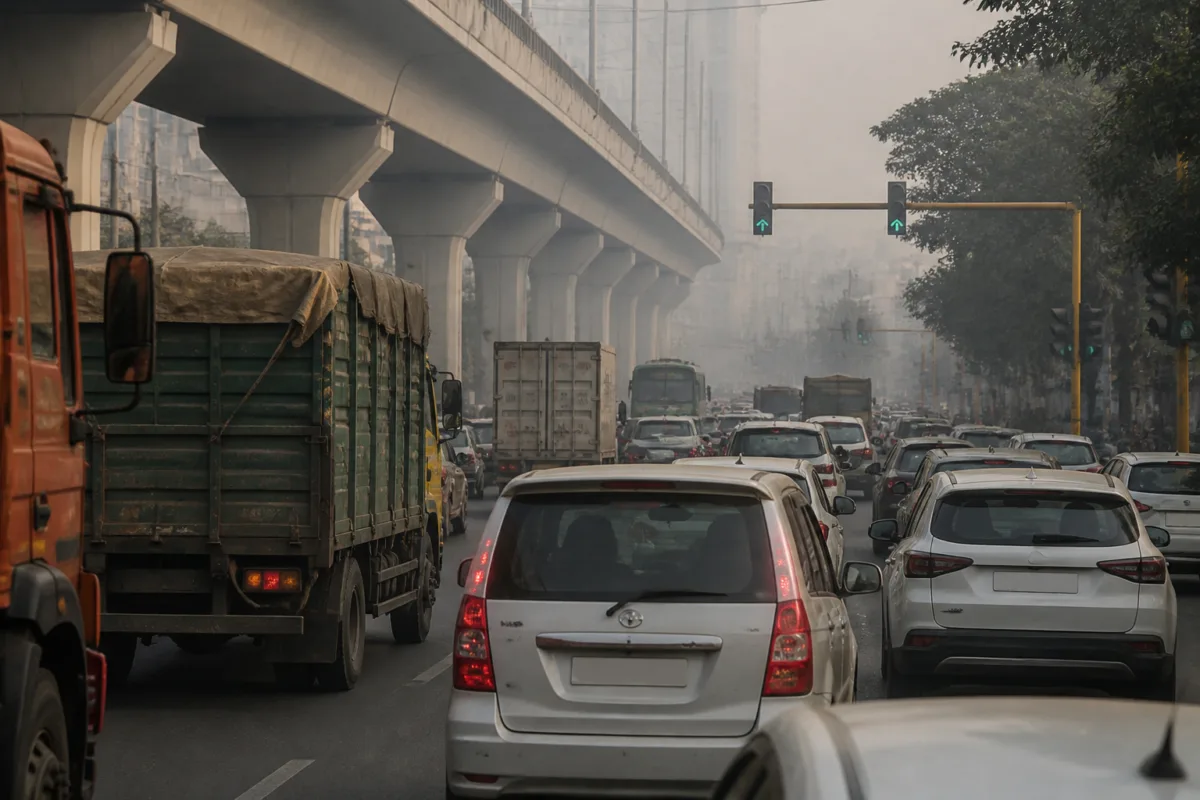
A possible winter ban on BS-IV diesel vehicles in Delhi is prompting questions over whether restricting an emissions category alone can deliver a substantial reduction in roadside pollution. The proposal has been discussed in the Supreme Court, but the court has not issued a final order on the measure.
The debate has shifted towards how vehicles perform in actual traffic rather than only under laboratory conditions. Experts cited by Jagran said the difference between BS-IV and BS-VI emissions exists, but may not be large enough to determine pollution outcomes by itself.
Anil Chikara, a former transport deputy commissioner, said Bharat Stage emissions standards are determined through mass-emission tests conducted under specified laboratory conditions. These standards also cover engine design and software. He said laboratory figures alone may not be sufficient to understand the difference between BS-IV and BS-VI vehicles on Delhi’s roads.
According to Chikara, the benefits of BS-VI technology may be more visible during conditions such as hill climbs, heavy loads and overspeeding. Delhi’s terrain is predominantly flat, he said, making comparative on-road testing important for understanding how the two vehicle categories perform in the city’s traffic environment.
Traffic conditions can alter emissions from the same vehicle. Vehicles moving through congestion use the brake and accelerator repeatedly, which increases fuel consumption. The report said emissions of carbon monoxide, hydrocarbons, nitrogen oxides and carbon dioxide can be affected by factors including engine load, speed, acceleration, fuel and the effectiveness of the exhaust after-treatment system.
This makes the proposed restriction a question not only of vehicle eligibility but also of how Delhi measures pollution from transport. The report said comparative testing of BS-III, BS-IV and BS-VI vehicles should cover congestion, crawling speeds and normal, steady movement. Such testing could help establish how much of the reduction comes from changing the vehicle category and how much is influenced by traffic conditions and maintenance.
Automotive expert Tutu Dhawan questioned the practicality of stopping BS-IV vehicles from entering Delhi, arguing that the emissions gap may not be sufficiently large to justify such a measure. He also said BS-VI vehicles still account for a limited share of the National Capital Region’s vehicle fleet, while electric vehicles are not yet numerous enough to immediately replace older vehicles.
The proposal therefore carries practical consequences for vehicle owners, commercial operators and commuters who travel between Delhi and the wider NCR. A restriction could affect access and operating costs for vehicles that remain in use, while its air-quality benefit would depend on enforcement, the availability of compliant vehicles and the conditions in which emissions are measured.
The report does not establish that a BS-IV restriction would be ineffective, nor does it provide comparative on-road emissions data. It instead identifies a gap between standards tested in controlled conditions and pollution generated in congested urban traffic. A final policy assessment would need to account for vehicle category, maintenance, traffic flow, engine load and the performance of emission-control systems together.

