


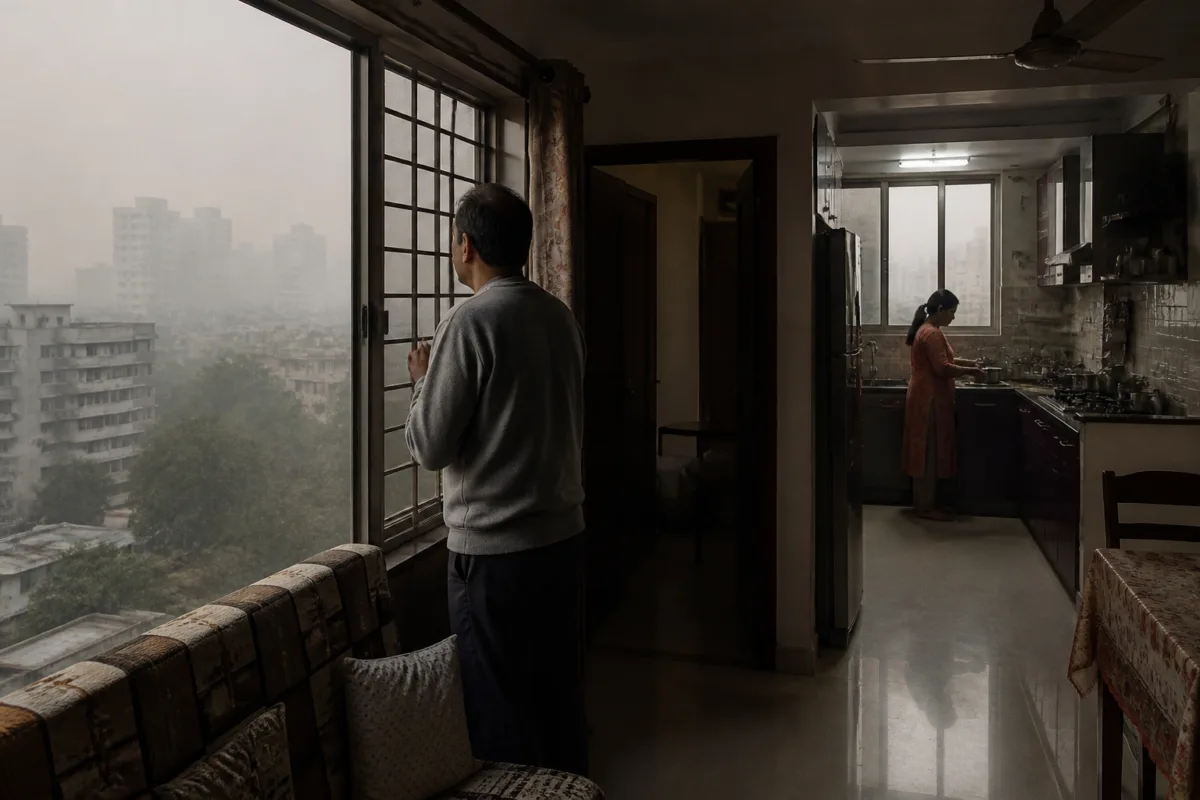
Delhi-NCR avoided the strictest fourth stage of the Graded Response Action Plan (GRAP) in November, but pollution controls and a reported study on indoor air quality point to continuing risks as winter sets in.
The region experienced its highest reported pollution level of the season on 6 November, when Delhi’s Air Quality Index (AQI) reached 382. The Commission for Air Quality Management (CAQM) subsequently imposed GRAP Stage 3 across the National Capital Region. The restrictions were withdrawn on 17 November after Delhi’s AQI improved to 204, while measures under GRAP Stages 1 and 2 remained in force, according to Navbharat Times.
The report said the Delhi government has scheduled additional restrictions from 10 December to 20 January. All construction and demolition activity is to be stopped during this period, except for essential government and emergency projects. Vehicles carrying construction materials, including sand, gravel, bricks and cement, are also expected to be restricted, with exemptions for eligible projects.
The restrictions are being planned ahead of the period when winter pollution typically intensifies. The report identified 15 to 31 December as one of the most polluted periods of the season, citing falling temperatures, lower wind speeds and the accumulation of pollutants in the atmosphere.
Delhi recorded its lowest minimum temperature of the season so far at Safdarjung on the Wednesday covered by the report, when the temperature fell to 10 degrees Celsius, 1.3 degrees below normal. Pusa recorded 9.8 degrees Celsius, Ghaziabad 9.7 degrees, Lodhi Road 10.1 degrees, Aya Nagar 10.4 degrees and Palam 11 degrees. The maximum temperature in the capital reached 28 degrees Celsius. The report said the India Meteorological Department forecast a modest rise in minimum temperatures between 28 and 30 November because of stronger easterly winds.
The report attributed November’s relative relief to warmer conditions associated with El Niño, repeated western disturbances bringing cooler air, early restrictions imposed by the Delhi government and tighter GRAP provisions. It also said that firecrackers during Diwali were limited to one day. These factors were presented as explanations for the improvement, rather than as a formal assessment by CAQM.
The report also highlighted pollution inside homes. A study by researchers from AIIMS, Safdarjung Hospital and Maulana Azad Medical College measured indoor and outdoor air quality in 90 homes in roadside, urban and rural areas, including Gokulpuri village and a rehabilitation colony. It found average indoor PM2.5 concentrations of 259 micrograms per cubic metre, compared with 280 micrograms outdoors. The report compared the indoor figure with the World Health Organization’s 24-hour guideline of 15 micrograms per cubic metre, describing it as about 17 times higher.
Average indoor PM10 was reported at 470 micrograms per cubic metre, which the article said was 10 times the WHO guideline. Indoor and outdoor AQI readings were reported at 362 and 405 respectively. Dr Shivani Rao, identified as one of the researchers, said homes located beside roads recorded PM2.5 levels of 389.5 micrograms per cubic metre.
A separate study involving researchers from Jamia Millia Islamia, Saudi Arabia’s Jazan University and Jammu and Kashmir’s Baba Ghulam Shah Badshah University found that homes with inadequate ventilation had PM2.5 levels about 50 per cent higher than outdoor levels in parts of south Delhi. Even homes with better ventilation recorded higher indoor pollution than outdoors, the report said. It identified cooking and incense burning among potential indoor pollution sources.
The findings widen the urban air-quality concern beyond roads and construction sites. Winter controls may limit some outdoor emissions, but the reported household measurements indicate that building ventilation, cooking practices and indoor air movement remain important factors for residents during the pollution season.

