


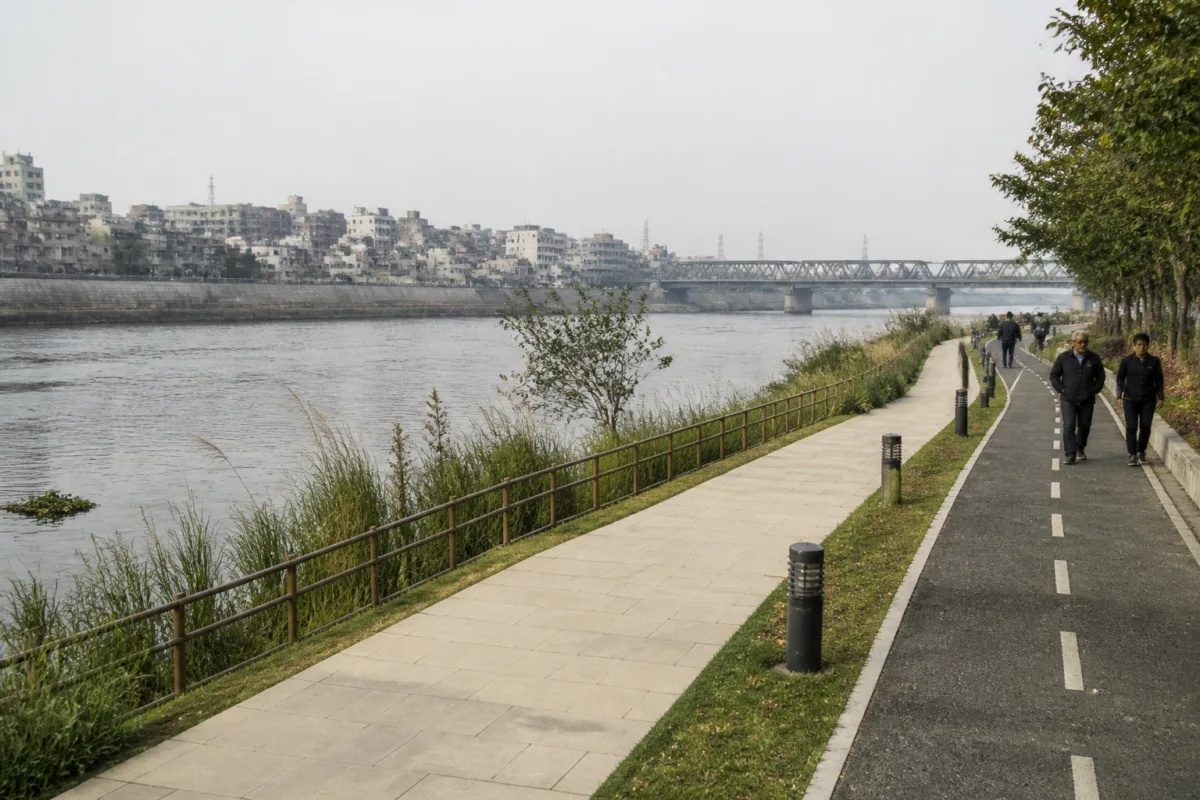
The proposed Delhi Yamuna riverfront project is being presented as a 52-km public-space transformation, but its success will depend on a less visible system beneath the promenades: sewage treatment, river flows, inter-departmental coordination and the ability to turn a proposal into an operating urban asset. The Delhi government is preparing a memorandum of understanding with the Sabarmati Riverfront Development Corporation to adapt Ahmedabad’s model along the Yamuna, with cycle tracks, walking paths, sports grounds and recreational spaces planned in two phases.
The proposal is significant because it links two different ambitions that are often announced together but delivered through different institutional and engineering processes. One is the creation of an accessible river edge for public use. The other is the improvement of the Yamuna’s water quality. The report makes clear that the government sees both as part of the same rejuvenation effort, while also indicating that consultants are still being engaged and that the proposed agreement with the Sabarmati corporation is still being moved forward.
That distinction matters. A riverfront is visible: paths, landscaped areas and recreational facilities can demonstrate physical progress quickly. Water quality is less immediate and depends on treatment capacity, network performance, interception and the effective management of sewage generated across the city. The government’s own description places both tasks within the project, but the evidence supplied so far establishes a plan rather than a completed implementation framework.
The first phase is planned from Palla to Wazirabad, while the second would extend from Wazirabad to Kalindi Kunj near the Okhla barrage. The Wazirabad barrage divides the proposed stretch, making the two-phase structure more than a construction sequence. It also reflects the way the city’s river corridor is being administratively and physically understood: as a long system with different sections, priorities and implementation requirements.
The government has said that the first phase will be taken up on priority and could serve as a model for the larger project. That approach may allow the authorities to test the design and management of public spaces before extending them across the full 52-km corridor. However, the report does not provide the proposed cost, land requirements, design standards, environmental clearances, maintenance arrangements or a detailed construction schedule. Those omissions do not invalidate the proposal, but they mark the difference between an announced direction and a project ready for execution.
The Delhi Yamuna riverfront project also reveals how public-space policy is being tied to a pollution-control programme. Water Minister Parvesh Sahib Singh said the Yamuna would become visibly cleaner in about two-and-a-half years. He also said that 28 of Delhi’s 37 sewage treatment plants had been upgraded over the previous 18 months. New treatment plants are being developed to add 250 million gallons per day of capacity, with the stated aim of ensuring that all sewage generated in the city is treated.
These figures provide the clearest evidence of the government’s implementation logic. The riverfront is not being described as a standalone beautification scheme. It is being placed alongside sewage-treatment expansion and upgrades to existing plants. If the proposed public spaces are to function as a riverfront rather than simply as an edge along a polluted waterway, the performance of this treatment system will be central to the project’s credibility.
At the same time, the supplied report does not establish how much of Delhi’s sewage is currently untreated, how much additional capacity is required beyond the proposed 250 MGD, or when the new plants will become operational. It also does not specify whether upgraded plants are already meeting their intended performance levels. These are important administrative questions because installed capacity and effective treatment are not necessarily the same thing. The government’s stated objective is clear, but the available information does not yet allow the outcome to be assessed.
The institutional structure is similarly important. The minister’s visit to the Sabarmati riverfront involved officials from the Delhi Jal Board and the Irrigation and Flood Control department. The proposed project would therefore involve more than a single department. Water treatment, river management, flood-related infrastructure and public-space development would need to operate within one broad programme, while consultants are expected to guide the planning process and the Sabarmati Riverfront Development Corporation is being approached for an MoU.
That arrangement suggests an attempt to transfer knowledge rather than simply reproduce Ahmedabad’s physical design. The minister has said Delhi would adopt the best practices of the Gujarat project while adapting them to the capital’s requirements. The word “adapting” is crucial. A riverfront model developed in one city cannot automatically become a template for another without accounting for different river conditions, barrage locations, sewage systems, flood-management needs, land uses and patterns of public access. The report does not yet detail which elements will be transferred or which will be redesigned for Delhi.
The 22-km stretch between the Wazirabad and Okhla barrages is identified as a major focus of pollution-control efforts. It is also part of the wider 52-km river course through Delhi that the government wants to make accessible as a public space. This overlap places the most publicly visible component of the proposal close to the area where water-quality interventions are already receiving attention. The project’s performance will therefore be judged not only by the continuity of its walking and cycling infrastructure, but also by the condition of the river alongside it.
The proposal to build huts along the Yamuna’s banks for birthday celebrations adds a participation and programming element to the plan. The minister has argued that people who bring their happiest moments to the river will be less likely to allow it to become dirty. This is a stated behavioural objective, not evidence that public participation will by itself resolve pollution. The proposal indicates that the government wants citizens to form a personal connection with the river, but the report does not explain how these facilities would be managed, how waste would be handled or how public access would be balanced with river safety and environmental requirements.
The broader urban question is whether Delhi’s riverfront can be planned as a functioning civic system instead of a linear destination. Cycle tracks and walking paths can improve access, while sports grounds and recreational areas can broaden use beyond ceremonial visits. But these facilities require regular maintenance, sanitation, waste management, lighting, safety arrangements and clear responsibility after construction. The supplied announcement identifies the proposed uses but does not yet set out the operating model.
The government’s proposed timeline is also expressed in two different ways: the minister said the riverfront model could take shape during the current government’s tenure if plans proceed as envisaged, while the Yamuna is expected to become visibly cleaner in about two-and-a-half years. These statements describe political and environmental milestones, but neither is accompanied in the report by a detailed, dated implementation schedule. The next concrete markers will be the proposed MoU, consultant-led planning, the first-phase design and the delivery of additional sewage-treatment capacity.
What the evidence confirms is a major shift in the framing of Delhi’s Yamuna agenda. The government is combining river-edge public space with sewage infrastructure and is proposing a phased 52-km intervention rather than a single isolated site. What remains uncertain is the project’s cost, statutory pathway, land and flood-management implications, maintenance structure and measurable water-quality baseline. Until those details emerge, the riverfront remains a significant urban proposal whose public-space promise is inseparable from the performance of the systems designed to clean and manage the river.

