


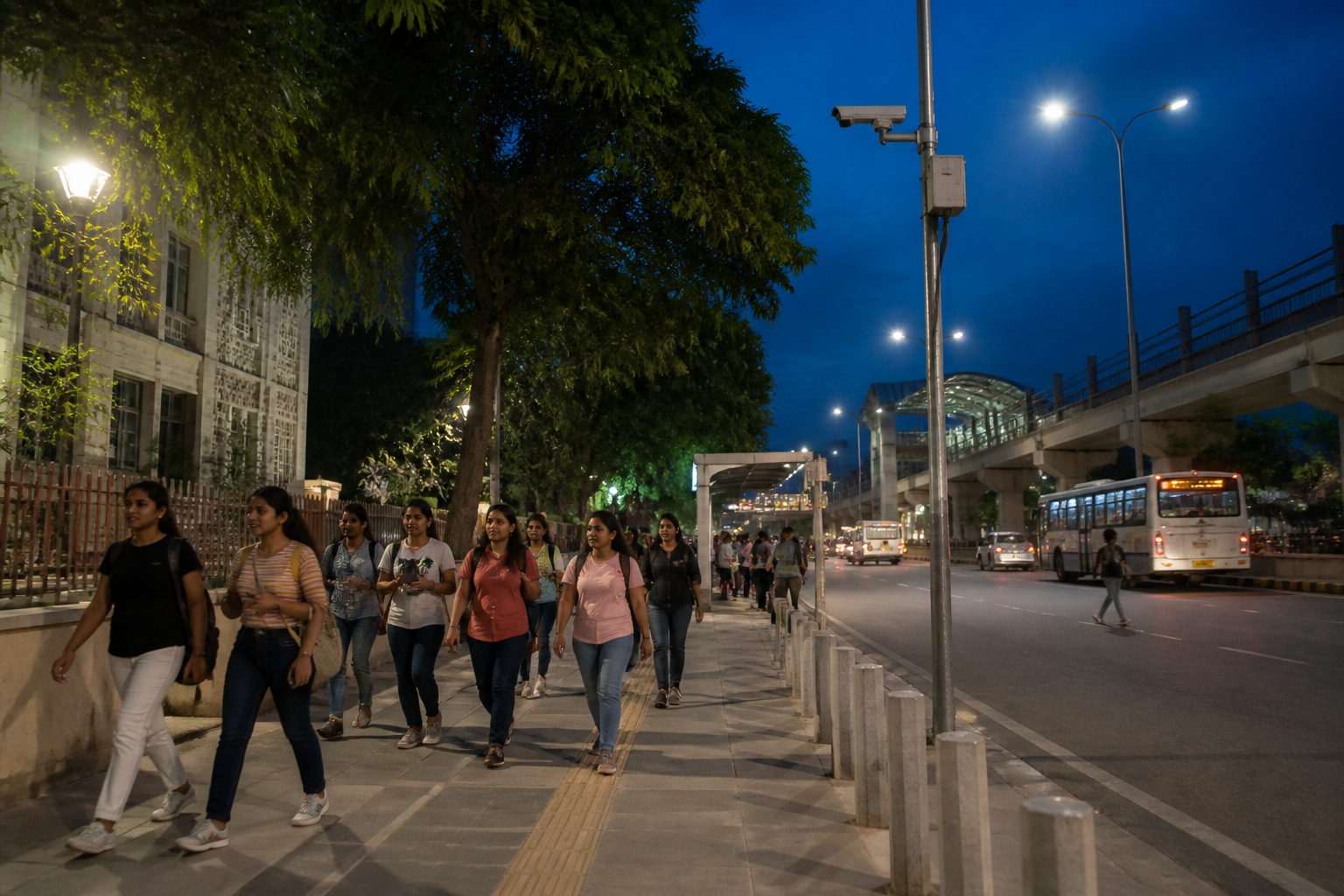
Delhi’s latest women’s safety response is moving beyond advice directed at women and towards the physical and administrative conditions that shape how students travel through the city. At a meeting with principals of women’s colleges, Lieutenant Governor T S Sandhu heard concerns about unsafe parks, dark spots, encroached footpaths, weak last-mile connectivity and inadequate public facilities. Chief Minister Rekha Gupta, speaking at Maitreyi College, said that boys should be taught the same lessons of responsibility traditionally imposed on girls, while also announcing plans for 50,000 CCTV cameras and one lakh streetlights.
The significance of the announcements lies in the gap between a safety message and the systems required to make public movement safer. The concerns raised by college principals were not limited to incidents inside campuses. They covered the routes students use to reach colleges, bus stops, Metro stations, public parks, pathways and streets. That makes women’s safety a question of urban design, transport operations, lighting, public-space management and coordination between agencies rather than only a matter of individual behaviour or policing.
The immediate political context is a series of student protests following the gangrape of a minor at a park in South Delhi. The protests brought safety concerns into public view, but the issues recorded at the meeting suggest that many of the risks are embedded in routine journeys. Students may be inside a secure campus yet remain exposed while walking from a college gate to a bus stop, travelling through an unlit stretch, crossing an encroached footpath or waiting for public transport after evening classes.
This distinction matters because urban safety is experienced across connected spaces. A college, Metro station or bus stop cannot be assessed in isolation if the links between them are poorly lit, difficult to walk through or weakly monitored. The principals of Lady Shri Ram College, Miranda House, Indraprastha College, Jesus & Mary College and Gargi College were among those who raised concerns at the meeting. Their submissions included unsafe parks near campuses, insufficient lighting, encroached footpaths, unregulated vending, dark spots, public toilets near colleges and obscene flashing incidents.
These concerns also reveal how several forms of urban disorder can combine. An encroached footpath can force pedestrians into the carriageway. Unregulated vending can reduce visibility or narrow walking space. A dark stretch can make surveillance and informal observation more difficult. An unsafe park can become a concern not only because of what happens inside it, but because of the routes students must take around it. Public toilets and bus stops require attention to location, maintenance, visibility and access. Each issue may fall under a different department, but students encounter them as one continuous journey.
The response announced by the Lieutenant Governor’s office assigns responsibilities across multiple institutions. The meeting included Delhi University Vice-Chancellor Yogesh Singh, police personnel and officials from the Municipal Corporation of Delhi, the Transport department and the Public Works Department. Sandhu directed agencies to repair streetlights, install high-mast lights in dark spots on roads used by students, place CCTV cameras at bus stops and other public spaces, increase patrolling around colleges and conduct safety audits around educational institutions.
He also directed officials to strengthen connectivity between colleges and Metro stations. The proposed measures include shuttle services during evening hours and the provision of U-Special and Metro feeder buses. This is an important shift in the way the problem is framed. A safety plan that focuses only on cameras and patrols can leave the transport network’s weakest links untouched. Evening connectivity, waiting time, walking distance and the availability of a predictable service determine whether students can leave a campus without being pushed towards isolated or poorly observed routes.
The proposed CCTV expansion and streetlight installation will therefore have to operate as part of a wider network. Cameras may assist investigations or provide monitoring in selected locations, but they do not by themselves repair a footpath, improve the frequency of a bus service or make a public space usable. Similarly, streetlights have value when they are functional, appropriately placed and maintained. The directions to repair existing lights and add high-mast lighting acknowledge that infrastructure provision is not the same as infrastructure performance.
The numbers cited by the Chief Minister—50,000 CCTV cameras and one lakh streetlights—signal the scale of the planned intervention. However, the supplied account does not specify the installation schedule, locations, maintenance arrangements, operating authority, budget or monitoring framework for these assets. Those details will determine whether the programme becomes a durable safety system or remains a collection of installations. The same question applies to the proposed shuttles and feeder buses: their usefulness will depend on routes, operating hours, frequency, stop locations and coordination with college timetables.
The meeting also highlights a governance problem common to large cities: the space where a problem is experienced is often different from the institution that can fix it. A student may identify an unsafe path, but repairs may involve the municipal corporation or the Public Works Department. A bus stop may require transport and policing measures. A route to a Metro station may involve a combination of road design, bus operations, lighting and enforcement. Without a shared audit and follow-up mechanism, individual directions can remain fragmented across departments.
The proposed safety audits around educational institutions could provide that common framework if they map complete journeys rather than only campus boundaries. The concerns listed by principals point towards a need to examine entrances, pathways, parks, vending areas, toilets, bus stops and Metro connections together. They also indicate that students and college administrations hold practical knowledge about when and where safety deteriorates. Their participation can help identify recurring gaps that may not be visible during a short official inspection.
Gupta’s remarks add a social dimension to the infrastructure response. She argued that restrictions are often imposed on girls and said boys should be taught the same lessons of responsibility. Her statement places the burden of safety within families and society as well as government. Yet the meeting’s institutional agenda shows that social messaging cannot substitute for functioning public systems. Students need streets that can be walked, transport that can be accessed and public spaces that are managed, lit and monitored.
The timing of the measures also exposes the difference between reactive and preventive urban governance. The current response follows protests and a serious crime, but the concerns raised by principals describe conditions that may have existed before the incident. A safety audit conducted after public pressure can identify problems, but the larger administrative test is whether such assessments become routine and whether agencies report what was repaired, installed or changed.
Delhi’s women’s safety challenge, as reflected in the meeting, is therefore not reducible to a single technology, department or awareness campaign. It is a connected urban-service problem involving public lighting, pedestrian infrastructure, transport access, policing, public-space management and institutional accountability. The city has announced substantial numbers and several immediate directions. What remains to be established is how these commitments will be mapped to specific locations, funded, implemented and reviewed.
The next developments to monitor are the safety audits around colleges, the repair and installation of lighting, the placement of CCTV cameras at public transport points and the design of evening shuttle and feeder services. These steps will show whether Delhi’s response can convert a set of urgent directions into a coordinated system that supports safer movement for students beyond the boundaries of their campuses.
