


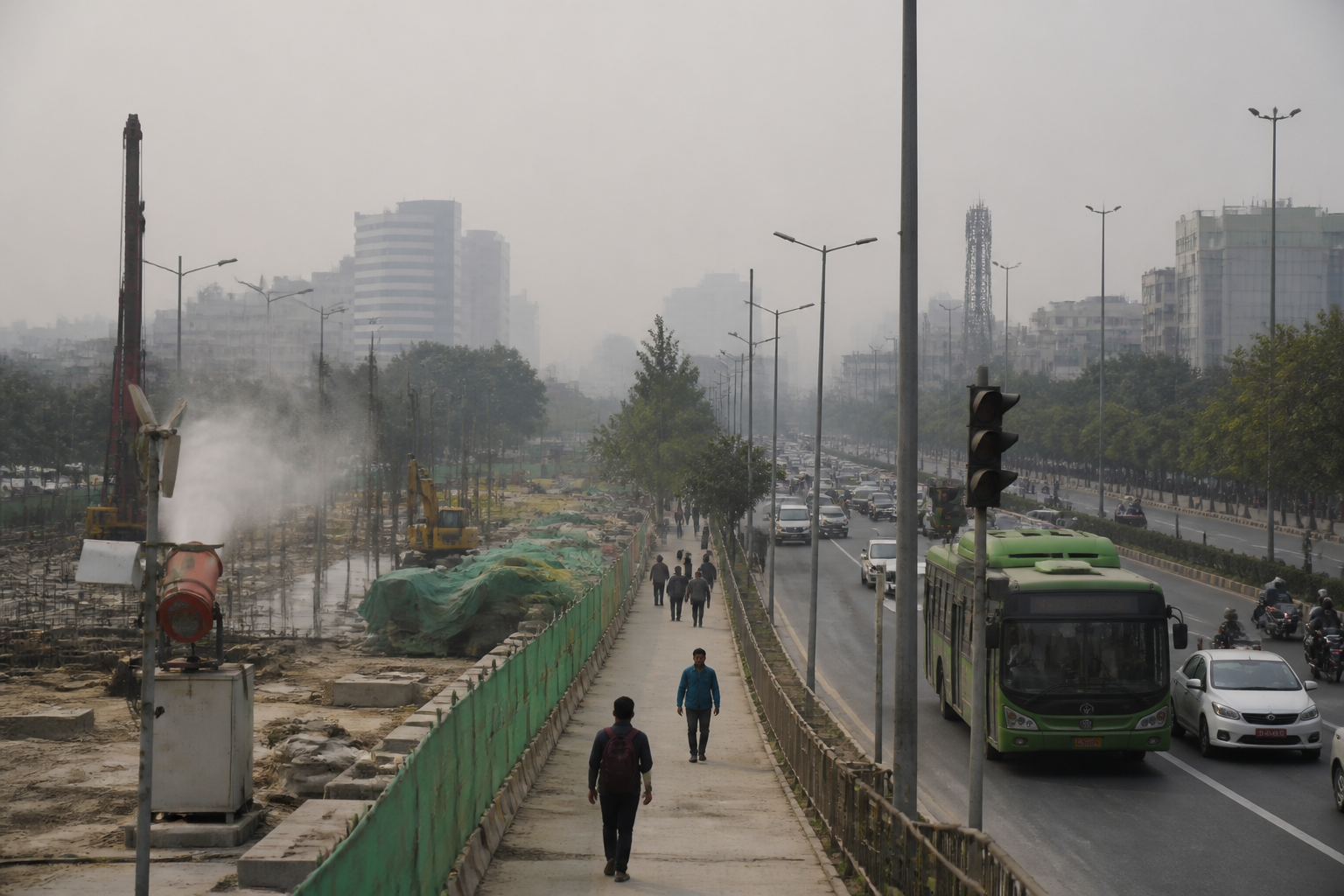
Delhi’s new winter pollution plan is designed to replace last-minute restrictions with a fixed calendar of measures covering construction, vehicles, offices, parking, public transport and industrial enforcement. Beginning November 1, 2026, and continuing until January 31, 2027, the plan will affect how the capital builds, moves, works and monitors pollution during the season when cold conditions and emissions combine to worsen air quality across the National Capital Region.
The shift is significant because Delhi’s winter response has often been organised around escalating emergency restrictions under the Graded Response Action Plan. Those restrictions are triggered as pollution levels deteriorate, but the government says the new Winter Pollution Master Plan will provide residents, businesses and public agencies with advance notice. The new framework brings several measures into a predetermined schedule, including a 50% work-from-home arrangement, restrictions on older and more polluting vehicles, doubled parking charges and curbs on dust-generating construction.
According to a government statement cited by The Hindu, Union Environment Minister Bhupender Yadav and Delhi Chief Minister Rekha Gupta reviewed the preparations on September 28 and finalised the measures. Neighbouring States have been asked to complete their own plans by October 10, underlining the administration’s position that Delhi’s air cannot be managed within the city’s boundaries alone.
The plan therefore treats winter pollution as an airshed problem rather than only a Delhi municipal problem. Vehicle emissions, industrial activity, road dust and crop-residue burning operate across administrative borders. The government has called for coordinated action with neighbouring States to address crop-residue burning, which it identifies as a major contributor to winter smog. The effectiveness of the plan will consequently depend not only on Delhi’s enforcement capacity but also on whether NCR authorities adopt compatible measures.
Construction is one of the clearest areas where the plan converts a seasonal risk into a project-management deadline. Dust-generating demolition and outdoor civil construction will be prohibited from November 1 to January 31. A complete ban on construction and demolition activity is planned from December 10 to January 20. Cement-concrete works are expected to be completed by October 31, while bitumen works are to be completed by November 15.
This schedule creates a defined operating window for the construction sector, but it also places pressure on agencies and contractors to complete planned works before restrictions intensify. The government has set a target of redeveloping 3,065 km of roads in 2026, of which 1,193 km had been completed when the plan was announced. Construction sites will be monitored through the Delhi government’s Dust Portal, cameras and sensors. Major sites will also be required to use anti-smog guns and mist-suppression systems.
The plan links dust control with the condition of public streets. The government intends to accelerate road redevelopment and end-to-end paving of footpaths, with a stated focus on walkability. That connection is important: road construction, unpaved edges and poorly managed footpaths can increase dust exposure, while incomplete pedestrian infrastructure can push more short trips towards motorised transport. The supplied plan, however, does not establish how the paving programme will be sequenced or how its effect on local dust levels will be measured.
Mobility measures are similarly designed to influence both emissions and traffic demand. Delhi will restrict the entry of vehicles registered outside the capital that do not meet BS-VI emission standards from November 1. CNG and electric vehicles will be exempted. Vehicles that have crossed their prescribed lifespan—15 years for petrol vehicles and 10 years for diesel vehicles—will not be provided fuel at filling stations, according to the Chief Minister’s Office.
A ‘No PUCC, No Fuel’ campaign will begin on October 1 at all 500 petrol pumps in Delhi equipped with Automatic Number Plate Recognition systems. Vehicles without a valid Pollution Under Control Certificate and end-of-life vehicles will be denied fuel under the announced enforcement process. The government also plans to inspect the functioning of ANPR cameras and carry out fitness checks on around 2.5 lakh vehicles at three automated testing stations. Those stations currently have a combined annual capacity to test 2.44 lakh commercial vehicles.
The figures reveal a potential enforcement challenge. The planned fitness checks are close to the stated annual capacity of the three automated testing stations, even before considering other testing requirements or operational constraints. The source does not specify the period over which the 2.5 lakh vehicles will be tested, nor does it explain how authorities will manage congestion, appeals or vehicles that fail inspection. What is clear is that the plan relies on a large expansion of automated identification and compliance checks rather than only roadside enforcement.
The workplace measures seek to reduce peak-hour movement. Government and private offices may allow up to 50% of employees to work from home during the winter season, while office timings will be staggered. Municipal Corporation of Delhi offices will operate from 8.30 a.m. to 5 p.m.; Delhi government offices will operate from 10 a.m. to 6.30 p.m. Healthcare, emergency services, public transport, power, water and sanitation will remain exempt.
Parking charges at authorised sites will be doubled, except at facilities owned and managed by the Delhi Metro Rail Corporation. The measure is intended to support the wider effort to reduce car use and peak-hour congestion, but its practical effect will depend on the availability, location and cost of alternatives. The government is also targeting higher public transport use. It says Delhi currently has 5,088 electric buses and a total bus fleet of 6,840, with another 150 electric buses planned. Last-mile connectivity is available at all 228 Metro stations, according to the announcement.
The stated ridership targets are ambitious in operational terms: average daily Metro ridership is to rise from 65 lakh to 72 lakh, while Delhi Transport Corporation ridership is to increase from 37 lakh to 42 lakh. The plan does not provide a detailed timetable for achieving these targets or explain how the additional demand will be distributed across routes, stations and bus services. It does, however, place public transport at the centre of the pollution response rather than treating it as a separate mobility policy.
The enforcement architecture extends beyond transport and construction. The government plans to increase continuous air quality monitoring stations from 47 to 60 and deploy 334 enforcement teams, including 256 ward-level teams and 78 Delhi Pollution Control Committee teams. These teams will be supported by pan-tilt-zoom cameras and geo-tagged, time-stamped monitoring. An AI-enabled command-and-control centre is also planned for integrated monitoring and industrial enforcement.
The government said that between December 1, 2025, and September 26, 2026, 11,271 industrial units were surveyed and 2,283 polluting units were closed or sealed. Separately, action was taken against around 1.15 lakh units during the same broader period, with 2,283 sealed, according to Environment Minister Manjinder Singh Sirsa. The announcement specifically identifies tyre and e-waste burning as enforcement priorities and says buildings involved in polluting activities could be sealed.
Delhi’s hotspot strategy adds a local layer to the citywide plan. Authorities will conduct weekly inspections, issue daily evening AQI bulletins and invite citizen reports through the 311 helpline and the Green Delhi app. Forty-two hotspots have been rectified, with eight more targeted for October. One-way traffic and decongestion trials are also planned at identified locations in consultation with the Delhi Traffic Police. Public representatives are expected to visit traffic hotspots with officials, Residents’ Welfare Associations, traders and traffic police personnel.
The plan’s central institutional question is whether these measures can operate as one system. Construction restrictions are administered through project sites and dust monitoring; vehicle rules depend on petrol pumps, ANPR cameras, testing stations and transport enforcement; office measures depend on employers; public transport targets depend on fleet and last-mile capacity; and regional pollution sources require cooperation from neighbouring States. The government’s proposed command-and-control centre and airshed approach are intended to link these separate responsibilities.
What remains unresolved in the supplied material is how success will be assessed. The plan sets dates, fleet numbers, monitoring targets, road-redevelopment figures and ridership goals, but it does not specify a single outcome benchmark for winter air quality or a public reporting framework connecting each intervention to changes in pollution. Its significance will therefore be tested not only by the number of restrictions announced, but by whether agencies can coordinate implementation, maintain essential services and demonstrate results across the NCR. The next formal milestone is October 10, when neighbouring States are expected to finalise their plans, ahead of the November 1 start of the winter measures.
