


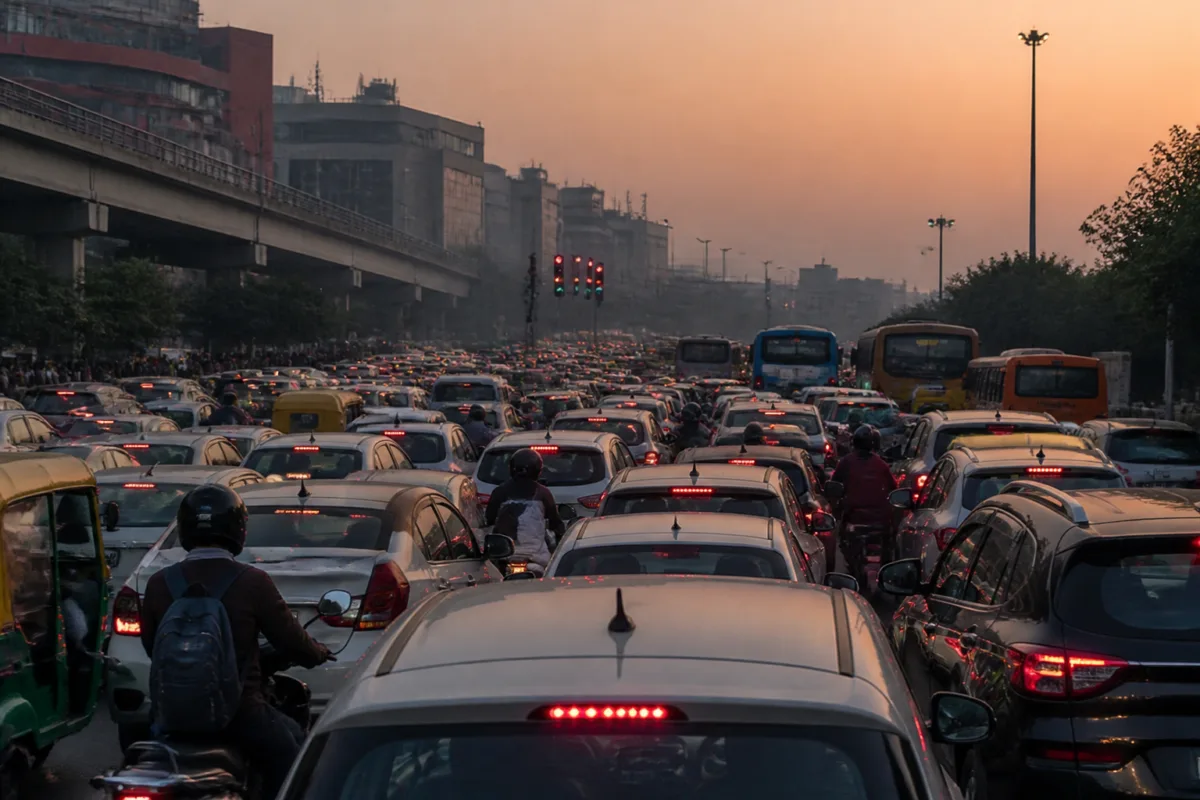
Delhi traffic jams intensified across several major corridors on Monday evening as festive-season shopping and office-hour travel coincided with rising vehicle pressure and the implementation of Stage II of the Graded Response Action Plan, according to a report by Jagran. Vehicles moved slowly or remained queued across parts of central, south, east and outer Delhi, leaving commuters facing longer journeys during the evening peak.
Traffic pressure had been visible in several areas from the morning, but conditions deteriorated after office hours as people travelled home and shoppers headed towards markets. The report said the combined movement of returning employees and festive shoppers placed additional pressure on roads and junctions across the capital.
The most affected locations included ITO, India Gate Circle, Mathura Road, Lajpat Nagar, Nehru Place, Okhla and the Ashram area. Roads leading towards Humayun’s Tomb also saw long queues. In south Delhi, traffic movement was affected on routes towards Mehrauli and Qutub Minar, while vehicles leaving Okhla Phase-I and nearby industrial areas faced delays.
Other stretches reporting congestion included Dhaula Kuan, Delhi Cantonment, Vikas Marg, National Highway 9 and Shahdara’s GT Road. The pressure was also felt by people travelling between east Delhi, central Delhi and New Delhi, with commuters looking for alternative routes around the Ashram and other affected corridors.
The disruption came as Delhi’s pollution levels were rising and Stage II of the Graded Response Action Plan had been put into effect, the report said. The traffic congestion added a mobility challenge to a period when authorities were already responding to worsening air quality. The supplied report did not provide corridor-wise traffic speeds, delay durations or details of any specific traffic diversion order.
Commuters posted photographs, map screenshots and route updates on social media to describe the delays. Some users tagged traffic officials and requested the deployment of personnel on affected roads and at congested junctions. These posts reflected the ground-level experience of a city where festive demand can quickly intensify pressure on already busy road networks.
The traffic buildup was linked in the report to three overlapping movements: festive shopping, increasing footfall around markets and the evening return of office commuters. Their concentration in the same time window affected roads around commercial areas, arterial junctions and routes connecting residential and employment districts.
With festive shopping expected to continue, the report said traffic police face the task of maintaining movement around major junctions and markets. No specific traffic management schedule, additional deployment plan or official timeline for easing the congestion was included in the supplied material.

