


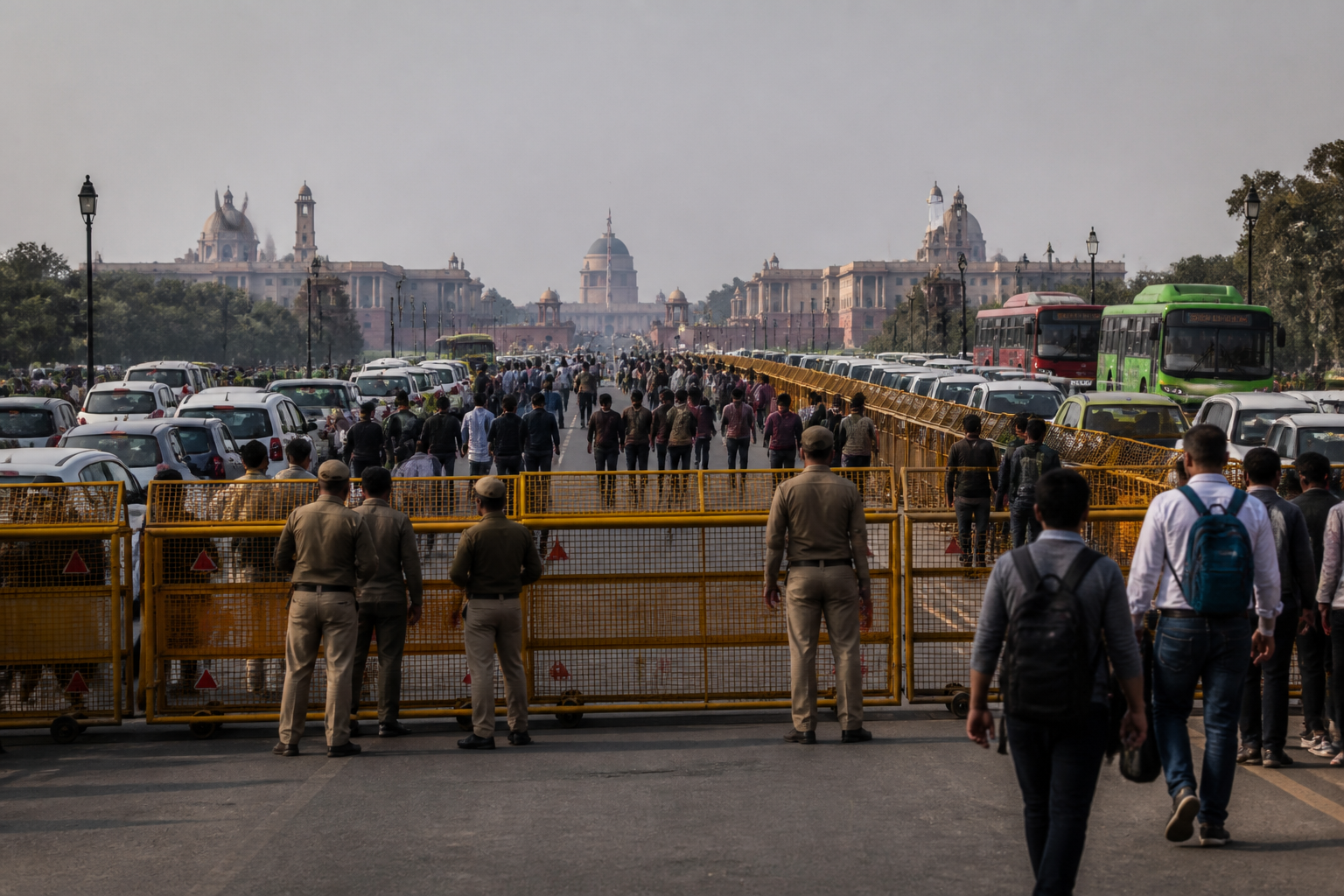
Delhi traffic was severely disrupted on Tuesday after Rahul Gandhi and opposition leaders marched from Parliament towards the Election Commission headquarters, prompting the closure of several roads in central Delhi and leaving commuters, patients, office workers and travellers stranded.
The march was held amid opposition demands for the resignation of Chief Election Commissioner Gyanesh Kumar. According to Jagran – New Delhi, the demonstration began in the afternoon and later stopped near the Reserve Bank of India headquarters on Parliament Street. Rahul Gandhi, Priyanka Gandhi and other leaders reached the area around Akashvani Bhawan, where they remained during the protest.
Ashoka Road, Raisina Road, Parliament Street, Rafi Marg and Pant Marg were among the roads closed during the march. The report said around a dozen roads were affected, bringing traffic movement in the area to a standstill. Large numbers of Delhi Police and paramilitary personnel were deployed as authorities prevented opposition MPs from proceeding towards the Election Commission office.
The closures created difficulties for people travelling through the central Delhi district. The report said mothers returning from schools with their children had to walk several kilometres after being unable to proceed through the restricted routes. Some patients travelling for treatment were also reported to be stuck, while passengers and employees remained inside hotels and offices. Several travellers faced the possibility of missing flights because of the disruption.
The incident illustrates the operational difficulty of managing large political demonstrations in a district that contains Parliament, government offices, diplomatic and institutional buildings, major roads and transport links. When access is restricted around Parliament Street and adjoining roads, the effects can extend beyond the protest site because commuters are diverted through a limited network of alternative routes.
Rahul Gandhi said more than 300 opposition MPs wanted to meet Gyanesh Kumar and the Election Commissioners but had been stopped from reaching the Election Commission office. He said elected representatives represented the voice of the public and questioned the meaning of democracy if the Election Commission did not meet them. His remarks were reported in the context of the protest and were not independently verified in the supplied material.
The report said police began detaining opposition MPs when they reached the area near Akashvani Bhawan. Rahul Gandhi then travelled to the location by bus and entered the building, while police prevented him from leaving. Rahul Gandhi, Priyanka Gandhi and other Congress leaders subsequently sat in protest on a platform around a tree. Mats and later mattresses were brought for the leaders after the sit-in continued for more than three hours.
The immediate disruption was linked to the road closures and security arrangements around the march. The supplied report did not provide a reopening time for the affected roads or details of alternative traffic routes issued by Delhi authorities. Further movement will depend on the conclusion of the protest and the lifting of the restrictions around Parliament Street and adjoining roads.

