


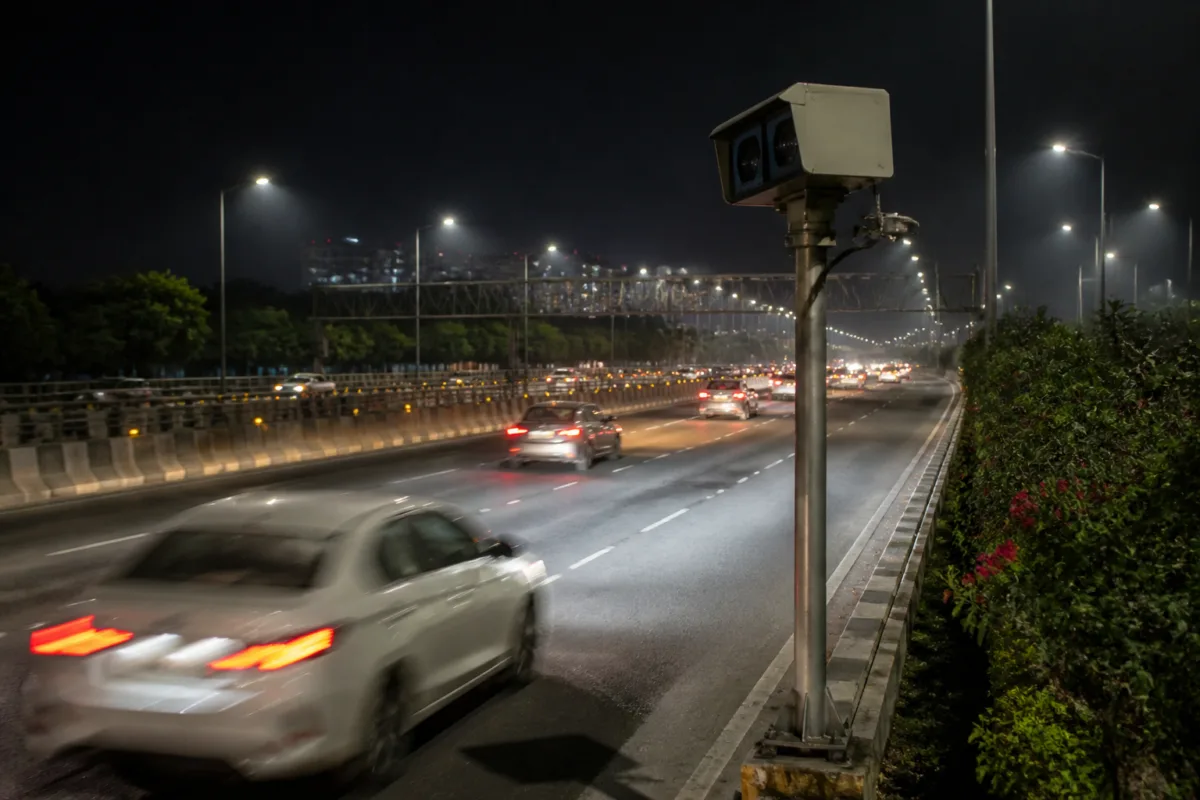
Delhi’s speeding crisis is no longer only an enforcement problem. The death of a 22-year-old man in a crash involving an alleged speed of 202 kmph in Vasant Kunj has again exposed the limits of relying on penalties after a vehicle has already exceeded a safe speed. Traffic police data cited in the report shows that the city issued nearly 23 lakh speeding notices in the first 10 months of the year, yet speeding remains a persistent feature of Delhi’s roads, particularly at night and on expressways.
The figures describe a system that is active but largely reactive. Police can detect violations, issue notices and impose fines, but these actions generally occur after a driver has crossed the speed threshold. The policy question now emerging from Delhi’s experience is whether road safety can improve meaningfully without changing the physical and technological conditions that allow dangerous speeds in the first place.
## Delhi’s enforcement numbers reveal a recurring problem
An average of 7,535 speeding notices were issued every day in Delhi during the period covered by the report, taking the total to almost 23 lakh until October. The figure is close to the more than 27.6 lakh speeding notices issued during the whole of the previous year. The comparison indicates that speeding detection has become a substantial policing function rather than an occasional intervention.
However, the number of notices is not the same as the number of crashes prevented. The supplied data does not establish how many notices led to payment, prosecution, repeat-offender identification or a measurable reduction in dangerous driving. Nor does it show whether enforcement is concentrated on particular corridors, vehicle categories or times of day. Those gaps matter because a large enforcement count can coexist with unsafe road conditions if the behaviour continues after detection.
The report also records 49 cases in which traffic personnel caught motorists speeding and issued challans on the spot during the period. A senior police officer said some motorists described being in a hurry, while others admitted speeding for the thrill of it. The officer added that the problem tends to worsen at night, especially on expressways. This points to a behavioural dimension, but it also identifies locations and periods in which road design, surveillance and speed management become particularly important.
## Fines intervene after the risk has already formed
Under the Motor Vehicles Act, motorists caught speeding face a fine of Rs 2,000 for light motor vehicles, while drivers of medium and heavy motor vehicles can be fined Rs 4,000. These penalties establish a legal consequence, but they do not physically prevent a vehicle from accelerating beyond the posted limit.
That distinction is central to the road-safety debate. A fine is an administrative response after a violation. A speed limiter, calibrated road design or an active traffic-calming device intervenes while the vehicle is being driven. The two approaches are not mutually exclusive, but their safety effects are different. Enforcement seeks compliance through the possibility of punishment; built-in controls seek to reduce the opportunity for a driver to exceed a limit.
Delhi currently has around 250 speed-detection cameras, according to the report. Cameras can expand the reach of traffic police, especially on corridors where round-the-clock physical enforcement is difficult. Yet camera-based enforcement still depends on detection, identification, notice issuance and subsequent compliance. It may improve the certainty of being caught without addressing the underlying capacity of vehicles to reach extreme speeds.
The report does not provide a corridor-wise assessment of the cameras or evidence of their impact on crashes. Without that information, it is not possible to conclude whether the current camera network is sufficiently distributed, whether it covers the highest-risk stretches or whether notices are changing driver behaviour. The data nevertheless shows that detection is already extensive, while the speeding problem remains visible.
## Road engineering is a governance responsibility
Joint Commissioner of Police (Traffic) Sanjay Tyagi said the police are installing speed-limit signboards, taking enforcement action and coordinating with civic agencies to build speed breakers at vulnerable stretches. He also said traffic-calming devices, public awareness and road engineering are part of the response.
This is significant because speed management on an urban road is not controlled by the traffic police alone. Police can enforce the law and identify violations, but civic agencies typically influence the physical design and maintenance of roads. Signboards, speed breakers, lane geometry, junction design, lighting and the treatment of pedestrian crossings all affect how a road is used. The report does not identify the agencies responsible for specific stretches or provide a timeline for the proposed interventions, but the coordination described by Tyagi indicates that road safety requires multiple institutions to act together.
The phrase “vulnerable stretches” also raises an important administrative question: how are those stretches identified? The supplied report does not state whether the assessment is based on fatal crashes, speeding data, citizen complaints, road geometry or police observation. A transparent risk-identification process would help distinguish between roads that require physical traffic calming and those where better enforcement, signage or redesign may be more suitable. Without such detail, the response risks remaining a collection of measures rather than a clearly targeted safety programme.
## Vehicle power has outpaced the safety environment
Former Delhi deputy transport commissioner Anil Chhikara argued that governments, vehicle manufacturers and society have failed to discourage high-speed driving. He pointed to the marketing of vehicles through high power and torque, as well as the social appeal of speed. He further said that many modern SUVs and high-end motorcycles have power outputs that rival or exceed those of commercial buses and trucks.
These claims, as presented in the report, shift the focus from individual drivers to the wider vehicle environment. A city may post speed limits and issue penalties, but it is also regulating a fleet whose performance can greatly exceed legal urban speeds. The supplied material does not provide comparative vehicle specifications or establish how vehicle power relates to Delhi’s crash patterns. It does, however, present a clear policy tension: vehicles are increasingly capable of rapid acceleration, while enforcement and road design remain dependent on drivers voluntarily observing limits or being detected after a violation.
Chhikara proposed intelligent speed limiters for all vehicle categories, using GPS and geofencing to regulate vehicles according to the official speed limit of a road. Such a system would represent a move from manual or camera-based enforcement towards technical control embedded in the vehicle. The proposal is not described in the report as an existing government policy, and no implementation framework, cost, legal mandate or technical standard is provided. It should therefore be understood as a policy suggestion rather than an announced programme.
## The evidence supports a layered safety approach
The report cites official records as showing that speeding is the primary cause of road accident fatalities in India, accounting for more than 70% of road deaths. It does not identify the specific dataset, reporting period or methodology behind that figure. The statistic should therefore be read as a broad indicator cited in the source, not as a detailed assessment of Delhi’s roads.
Even without a complete breakdown of crash circumstances, the available information supports a layered approach to speed management. Delhi already uses cameras and fines, while the traffic police says it is adding signage, traffic-calming devices and road-engineering measures. The proposed speed limiter would add a vehicle-level intervention. Each layer addresses a different point in the chain: awareness seeks to influence behaviour, engineering changes the road environment, cameras increase detection, penalties create legal consequences and technical limiters restrict vehicle performance within defined zones.
The effectiveness of that system will depend on how the layers are designed and coordinated. A speed breaker that is poorly placed can create new risks; a sign that is obscured or inconsistent with the road layout may be ignored; and a camera network without reliable follow-through may produce large notice numbers without sustained deterrence. Similarly, a geofenced limiter would require accurate speed-limit maps, dependable location data, rules for exceptions and a system for handling roads where limits change.
## The larger urban question is who controls speed
Delhi’s latest crash and enforcement figures show that the city has treated speeding primarily as a violation to be recorded and penalised. The continuing scale of notices suggests that this model has not eliminated the behaviour. The response now being discussed is broader: roads must be designed to communicate and enforce safe speeds, vehicles must be assessed not only for performance but also for their use in dense urban environments, and agencies must share responsibility for identifying and treating dangerous corridors.
The evidence supplied does not show whether Delhi will adopt intelligent speed limiters or how current road-engineering measures will perform. It does show that the city is already operating at a scale where fines alone are not an adequate description of the road-safety challenge. The next important developments will be the implementation of traffic-calming measures on identified stretches, the expansion and evaluation of speed detection, and any formal government decision on vehicle-based speed controls.

