


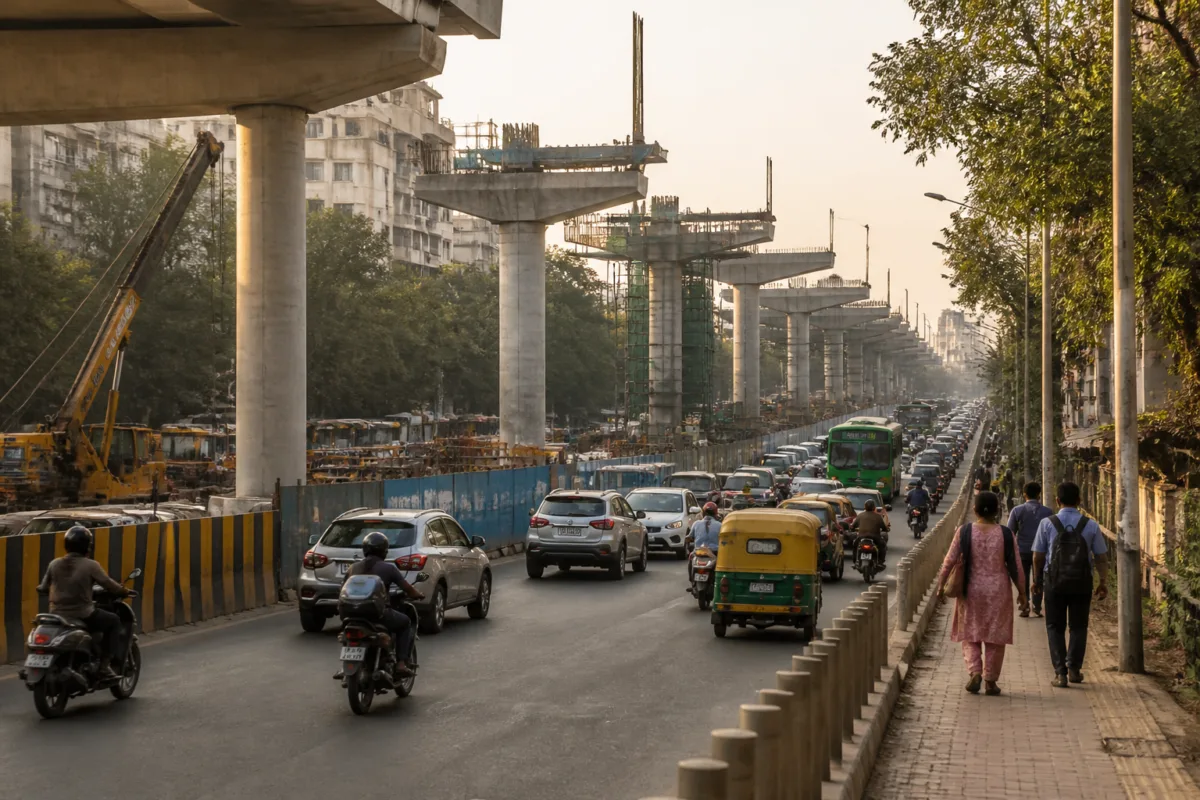
Delhi’s plan to improve traffic movement across 10 signal-free corridors includes flyover extensions, junction upgrades, a new interchange and a proposed tunnel between Inderlok and ISBT Kashmere Gate, according to a MagicBricks report citing details shared by the Public Works Department (PWD) during a review meeting with Chief Minister Rekha Gupta.
The reported programme covers busy routes in North, South and Central Delhi. Some stretches have already seen improvements, while other projects are under construction or remain at the planning stage. The full list of all 10 corridors, along with individual completion dates, has not been released.
The Modi Mill–Kalkaji–IIT Gate stretch is among the main areas identified for work. The Modi Mill flyover is being extended towards Kalkaji, while a parallel flyover is being built at the Savitri Cinema junction. The plan also includes additional half-flyover work near Kalkaji Mandir.
The combined project is estimated to cost Rs 371.75 crore. According to the project document cited in the report, work began on May 3, 2026, and is targeted for completion by March 31, 2028. A new flyover at Savitri Cinema is expected to be 435 metres long.
The projects are intended to reduce stops at junctions along the Outer Ring Road and improve movement between Modi Mill, Kalkaji and IIT Gate. However, the available information does not establish how traffic will be managed during construction or how the separate structures will be integrated with nearby junctions.
In North Delhi, the reported proposal involves an extension of the Munak Canal elevated road towards Kashmere Gate. It includes an approximately 4-km tunnel between Inderlok and ISBT Kashmere Gate. The proposed connection is intended to link routes near ISBT, the Outer Ring Road and the Wazirabad corridor, providing a more direct road connection from the Delhi-Haryana border towards Central Delhi.
The tunnel remains at the proposal stage. No construction start date or completion timeline has been announced. The report also identifies an extension of Munak Canal Road towards Kashmere Gate as planned, without providing a schedule.
Other road projects listed in the report include a separate interchange at Kalindi Kunj, which is to receive funding from the Central government. The report does not provide the project’s cost or construction timeline.
Improvements have already been reported on parts of Vikas Marg, Mathura Road near Supreme Court Metro station and the Barapullah flyover. The PWD is also considering changes at locations where traffic continues to build up around junctions.
The Delhi Traffic Police has shared a list of 538 locations with the PWD for possible interventions. These include Metcalfe House, Kingsway Camp, Azadpur and Madhuban Chowk. Suggested measures include additional U-turn lanes, foot overbridges, revised signal timings and road widening where feasible.
The range of proposed measures indicates that the programme is not limited to grade-separated infrastructure. Signal changes, pedestrian crossings and junction redesigns could affect how people walk and transfer between roads and public transport, although the report does not provide detailed designs or pedestrian-safety assessments for the individual locations.
For commuters, the projects have different levels of certainty. Work is under way on the Modi Mill and Savitri Cinema flyovers, with a March 2028 target for the combined project. Improvements on Vikas Marg, Mathura Road and Barapullah are described as completed. The Inderlok–Kashmere Gate tunnel and the Munak Canal extension are still proposals or planned works.
The central implementation question will be whether the improved stretches operate as a connected network rather than shifting congestion to the next untreated junction. The report provides no traffic forecasts, travel-time estimates or complete corridor-level implementation plan. Until those details are published, existing road and Metro access remains a more reliable basis for assessing daily connectivity than proposed projects alone.

