


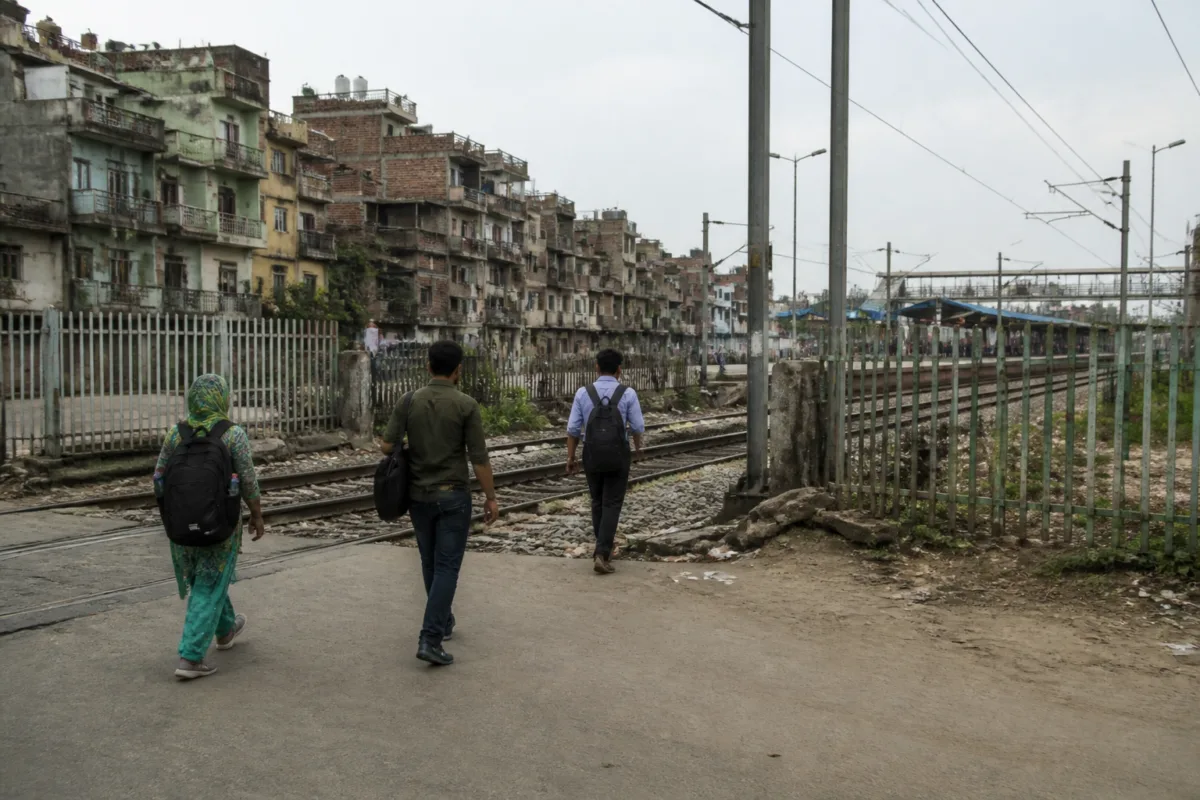
Delhi-NCR recorded 6,379 cases of railway-track trespassing up to September 10 this year, more than double the 3,147 cases reported during the corresponding period in 2025. The rise, reported from Railway Protection Force data, is also a measure of how railway safety is being shaped by the way neighbourhoods, workplaces and crossing points have developed around active tracks.
The enforcement response has become faster since the Delhi division began implementing provisions of the Jan Vishwas Act on June 19. Fines collected from trespassing cases rose from about Rs 14 lakh in the comparable period last year to Rs 31 lakh this year. Of the 6,379 people caught, 4,084 were proceeded against under the new provisions, generating Rs 20.4 lakh in fines, according to the report.
The figures establish an enforcement change, but they do not by themselves establish that trespassing has doubled in every location or that the increase represents only a change in behaviour. More people may be getting caught because penalties can now be imposed through a fixed process rather than requiring every violator to be produced in court. The data therefore reflects both the scale of unsafe track crossing and the greater administrative capacity to record and penalise it.
Before the new provisions, RPF officials said, the process could require a violator to appear in court. If the person pleaded financial inability to pay, the fine could be reduced or not fully recovered, depending on the judicial magistrate’s discretion. Under the revised process described by officials, a fixed penalty is prescribed under the relevant sections without the earlier court appearance, allowing enforcement to move more quickly.
That administrative shift matters because railway trespassing is not simply a policing problem. The RPF has identified 10 trespassing-prone stretches across Delhi-NCR, including Mangolpuri-Mundka-Shakur Basti, Bijwasan-Gurgaon, Adarsh Nagar and the section between Badli and Delhi Azadpur railway stations. These are not isolated points on a map. They are sections where railway infrastructure intersects with residential settlements, workplaces, markets and everyday pedestrian routes.
RPF officials cited several conditions associated with trespassing: dense jhuggi settlements and residential colonies near tracks, missing fencing and boundary walls, inadequate road overbridges and designated passageways, suicides, and limited public awareness of the danger of crossing active railway lines. Another official said many residents use the tracks as shortcuts to reach workplaces, markets and other destinations, particularly when a designated route takes more time.
This makes the recorded increase a window into the access problem around railway corridors. When settlements grow close to tracks and formal pedestrian connections do not keep pace, the railway boundary becomes part of the neighbourhood’s informal street network. Residents may understand that crossing is illegal and dangerous, yet still use it when the alternative involves a long detour or when the nearest safe crossing does not align with their daily destinations.
The report does not provide the number, condition or location of all available foot overbridges, road overbridges, underpasses or boundary walls along the 10 identified stretches. It also does not establish how many trespassing cases occurred at each location. Those gaps prevent a detailed comparison of which infrastructure deficiencies contribute most to the problem. They do, however, show why enforcement numbers alone cannot explain the safety challenge.
The mortality figures add another layer to the issue. The data cited in the report recorded 2,160 bodies found on railway tracks in 2025 and 1,406 bodies this year. The supplied material does not specify whether these figures cover the same period, whether all deaths were caused by trespassing, or how many involved accidental crossings, suicides or other circumstances. RPF officials nevertheless identified trespassing as one of the major reasons behind such incidents.
That distinction is important for interpreting the numbers. A body found on a track is an outcome requiring investigation, not an automatic measure of unlawful crossing. At the same time, the reported association between trespassing and deaths demonstrates the consequences of treating track access as a routine shortcut. The railway corridor can be both a transport asset and a lethal barrier when communities living nearby lack safe, convenient and visible ways to cross it.
The Jan Vishwas Act provisions address one part of the system: the speed and certainty of penalties. Section 147 of the Railways Act is being used against people who cross railway tracks without authorisation, according to Senior Divisional Security Commissioner (RPF) Ashutosh Pandey. The change can reduce procedural delays and improve recovery of fines, but the information supplied does not show whether faster penalties have reduced repeat offences or changed behaviour on the identified stretches.
RPF’s stated response combines enforcement with prevention. Pandey said personnel were being deployed at platforms, trespassing-prone stretches and level-crossing gates. The force is also organising awareness workshops and coordinating with the Government Railway Police to take action against trespassers. These measures place immediate responsibility on railway security agencies, while the physical design of surrounding neighbourhoods remains a wider administrative concern.
The division of responsibility is significant. RPF can detect and penalise unauthorised crossings and deploy staff at vulnerable points. The Government Railway Police has a separate policing role. Railway authorities are responsible for operational safety and railway assets, while the provision of roads, bridges, underpasses, boundary infrastructure and access routes may involve other public agencies depending on the location. The supplied report does not identify a single agency responsible for correcting each infrastructure gap.
That institutional fragmentation can make the problem difficult to resolve. A railway line may be managed as a protected operational corridor, while the settlement on either side is governed through a different administrative system. A new crossing, boundary wall or overbridge therefore requires more than enforcement at the track edge. It requires identifying the pedestrian movement that the infrastructure is currently failing to accommodate and assigning responsibility for a safe alternative.
The data also shows why fine collection should not be treated as the sole indicator of success. Fines increased from about Rs 14 lakh to Rs 31 lakh, while the number of people caught rose from 3,147 to 6,379. Since 4,084 people were caught under the new provisions after June 19, the recorded enforcement surge is closely linked to the legal and procedural change introduced during the year. Without location-wise data, repeat-offender data or a longer trend, it is not possible to conclude from the supplied figures that the underlying risk has improved or worsened solely because of the fines.
A more complete safety assessment would need to connect enforcement records with the physical conditions at each trespassing-prone stretch. The relevant questions include where boundary walls are absent, where the nearest formal crossing is located, how far residents must travel to reach it, and whether the crossing serves the settlements and destinations on both sides. The source material does not provide those measurements, but the reasons cited by officials point directly to their importance.
The Delhi-NCR case illustrates a broader urban challenge: transport infrastructure often divides communities that developed around it. Railways need controlled corridors for safety and operations, but cities also need connected neighbourhoods. When planning and investment do not reconcile those two requirements, informal crossings emerge. Penalising them may be necessary, particularly where active tracks are involved, but enforcement cannot substitute for safe connectivity.
What the available evidence confirms is that Delhi-NCR’s recorded trespassing cases have risen sharply, the fixed-penalty system has increased the speed and volume of enforcement, and the RPF has identified specific stretches where the problem is concentrated. What remains unclear is how much of the increase reflects more trespassing, more detection or both, and whether the proposed combination of penalties, awareness campaigns and deployments is changing behaviour. The next meaningful measure will be whether the identified stretches receive safer access infrastructure and whether future data shows a sustained reduction in unsafe crossings and track-related deaths.

