


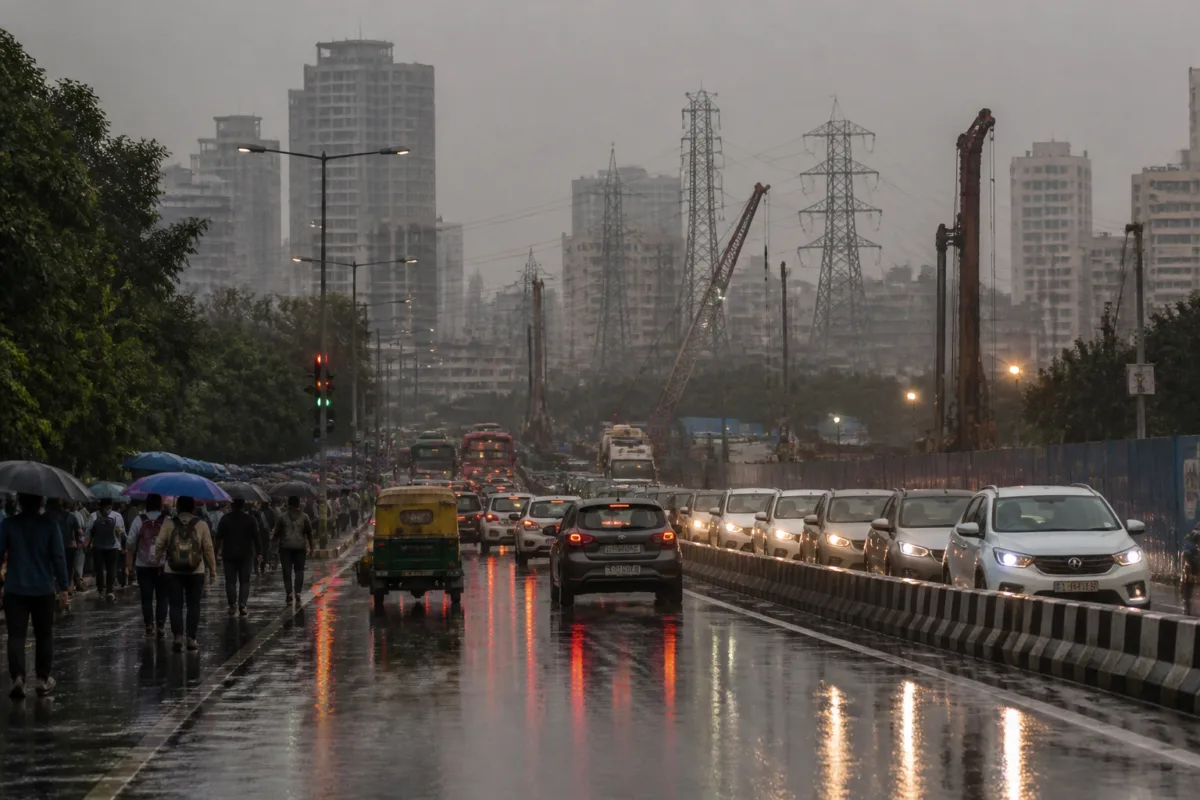
Delhi pollution may fall after rain, but the relief is usually temporary. A study covering 612 rainfall events between 2003 and 2024 found that pollution particles returned to their pre-rain levels within five days in 310 cases, showing why weather-driven improvement cannot replace sustained control of emissions across the city and its surrounding urban region.
The finding matters because rainfall is often treated as a natural reset for Delhi’s air. When rain washes particles from the atmosphere, visibility can improve and pollution readings may decline. But the study reported that this effect does not necessarily last. Once rainfall stops, emissions from vehicles, industries, construction activity and other sources continue, while chemical reactions in the atmosphere can generate new pollutant particles.
The research, titled “Why Rainfall Alone Cannot Mitigate Urban Pollution”, was conducted by Gayatri Balachandran and Dr Sumit Satindran of the Amrita-Natural Resource Monitoring Lab at Amrita Vishwa Vidyapeetham, Kerala. It was published in the Journal of Atmospheric and Solar-Terrestrial Physics, according to the report.
Its central contribution is to move the discussion away from individual weather events and towards the persistence of urban emissions. A clean-air spell immediately after rain can conceal the continuing production of pollution at street level, across industrial areas and through wider regional atmospheric processes. In that sense, rainfall can change the condition of the air temporarily without changing the system that produces the pollution.
The study analysed satellite observations along with rainfall and meteorological data over 22 years. It included rainfall events with more than 5 mm of daily precipitation. To measure atmospheric particles, the researchers used aerosol optical depth, or AOD, which indicates the extent to which airborne particles block or scatter light.
AOD is not the same as the Air Quality Index recorded by ground-based monitoring stations. The distinction is important. AOD provides an atmospheric view of the concentration and behaviour of suspended particles, while AQI measurements are based on pollutants recorded at monitoring locations near the ground. The study therefore does not provide a direct replacement for Delhi’s ground-level AQI readings. Instead, it examines how atmospheric aerosol conditions change after rainfall over a long period.
The results show that rain intensity alone did not determine how long cleaner conditions lasted. The researchers found no significant relationship between the amount of rainfall and the speed at which pollution returned. More rain, therefore, did not automatically mean a longer period of cleaner air.
This finding complicates the idea that heavy showers can deliver a durable natural solution. Rain can remove particles already present in the atmosphere, but it does not stop new emissions. The study identified vehicles, industry, construction and other sources as continuing contributors. It also pointed to chemical reactions between gases in the atmosphere that can produce additional pollutant particles after the rain has passed.
The time taken for pollution to return also varied by season. The median period was six days during the monsoon, five days during summer, five days during winter and only three days during the post-monsoon season. These differences indicate that the same rainfall event does not operate in the same atmospheric environment throughout the year.
The post-monsoon period is particularly significant in the study’s findings because the median return period was the shortest. The report does not establish a single cause for this seasonal variation, but it shows that rainfall cannot be assessed separately from wider weather conditions and the pattern of emissions active during a particular season.
At the same time, the results were not uniformly negative. Around 45 per cent of the rainfall events examined had still not returned to their pre-rain pollution levels after 30 days. This means rainfall can sometimes be associated with a longer period of lower atmospheric particle levels. But the result is uneven: it does not establish that rain will reliably produce a month-long improvement, nor that the effect will be similar across all seasons or rainfall events.
That uncertainty is central to interpreting the study. It does not say that rain has no role in reducing pollution. It shows instead that the role is temporary or variable in many cases, and that the persistence of cleaner air depends on more than the quantity of rainfall. The return of pollution within five days in more than half of the analysed events provides the strongest warning against treating rainfall as a durable pollution-control measure.
The evidence also highlights a governance problem. Air pollution is not controlled by one agency or one intervention. Vehicles, construction sites, industrial operations and atmospheric emissions fall within different administrative and regulatory systems. The study’s conclusion that emissions must be reduced continuously therefore points towards a coordinated approach rather than a response that begins only when pollution levels rise or when weather conditions worsen.
For city administration, the practical distinction is between removing existing particles and preventing new emissions. Rain can assist with the first process by washing particles from the atmosphere. It cannot perform the second. Preventing pollution from returning requires controls that operate on ordinary dry days as well as during severe pollution episodes.
The study also places short-term weather relief in a longer urban timeline. Delhi’s pollution problem is often experienced through daily readings and temporary changes after rain. The research instead uses 22 years of observations to examine repeated patterns. Its dataset covers 612 rainfall events, making the question broader than a single monsoon or one unusually clean day.
The numbers do not establish how much each emission source contributes to the return of pollution in every event. They do, however, provide evidence that the atmospheric improvement following rain is not reliably permanent. They also show why a city cannot evaluate its air-quality performance only by observing whether pollution falls immediately after a shower.
The larger urban question is whether Delhi’s air-quality strategy is built around weather-sensitive relief or source-sensitive reduction. The study supports the latter approach. If pollution returns because emissions continue and new particles form through atmospheric reactions, then a temporary decline in pollution levels is not equivalent to a structural improvement in air quality.
The evidence confirms three limits to the natural-washout assumption: pollution returned within five days in 310 of 612 events; rainfall quantity had no significant relationship with the speed of return; and the duration of relief varied across seasons. What remains unresolved in the supplied study report is how the relative contribution of individual sources changes across these periods. The next policy question is therefore not whether rain can clean Delhi’s air, but whether emissions remain low enough for that temporary cleaning effect to last.

