


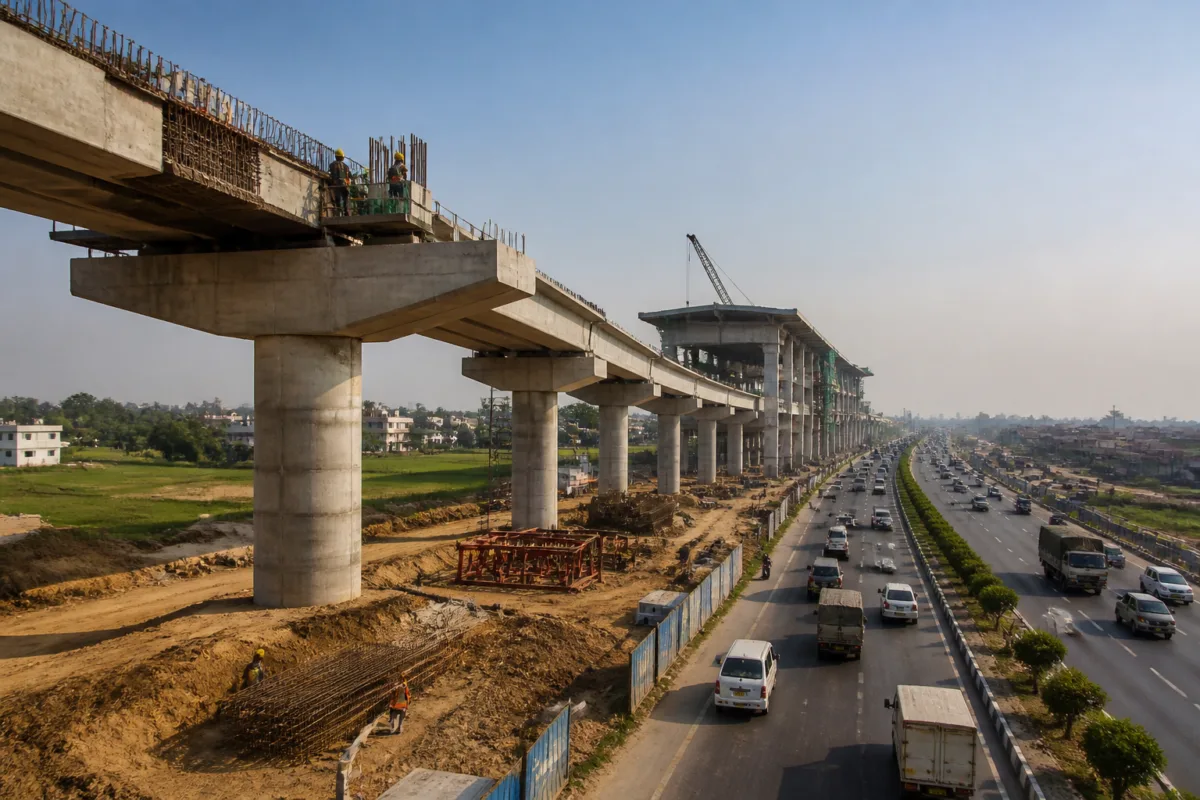
The Delhi–Panipat–Karnal Namo Bharat corridor is set to improve regional connectivity between Delhi and cities in Haryana, while potentially changing development patterns in Sonipat, Panipat and Karnal. The 136.3-km project has received land-use permission from the National Highways Authority of India (NHAI) for pier construction, station development and the shifting of high-tension power lines, according to an Economic Times report.
The corridor is being developed by the National Capital Region Transport Corporation (NCRTC) at an estimated cost of about Rs 33,051 crore. It is targeted for completion by 2030 and will run broadly parallel to the Delhi–Ambala highway, or NH-44. Preliminary work has begun on an approximately 22-km stretch between Narela and Murthal.
The project proposes 22 stations. Most are planned as elevated stations, while Kashmere Gate in Delhi and the stations in Panipat are expected to be at ground level, the report said. Trains will have a maximum design speed of 180 kmph and an operating speed of 160 kmph, with services planned at intervals of five to 10 minutes.
The corridor is expected to reduce the journey from Delhi to Panipat to about one hour, compared with the current two to two-and-a-half hours by road or regular train. The journey to Karnal, currently reported to take three-and-a-half to four hours, is expected to fall to about one-and-a-half hours.
These travel-time reductions could make locations outside Delhi more attractive to households seeking lower-cost housing with access to the National Capital Region. Abhay Kumar Mishra, president and chief executive of Jindal Realty, said faster public transport could support residential, commercial and mixed-use development in areas that have not reached their potential because of weak connectivity.
Yashank Vasan, managing director of Royal Green Realty, said demand could increase not only for housing but also for retail, schools, healthcare and other everyday services near stations. Vinod Kumar, director and founder of Sky Byte Developers, similarly linked improved connectivity with potential demand for residential and commercial property in emerging locations such as Sonipat and Panipat.
The Haryana government has included the corridor in its Transit-Oriented Development policy, according to the report. This creates a policy basis for denser station-area development, including high-rise housing, offices, retail and other commercial uses. The extent of that transformation will depend on how station-area planning, land assembly, utility relocation and local infrastructure are implemented.
The project also provides a direct link between Haryana and the Namo Bharat network. Through the Delhi–Meerut corridor, it will connect the region to Uttar Pradesh. For residents, the main benefit will be faster access to employment, education, healthcare and services across the wider National Capital Region. For municipalities, the arrival of high-capacity regional rail will increase the need to coordinate land use, roads, public spaces and local transport around stations.
The approvals and preliminary work mark progress, but the corridor remains a project with a stated completion target rather than an operational service. Its eventual effect on real-estate values and urban form will depend on construction progress and the quality of development around the proposed stations.

